
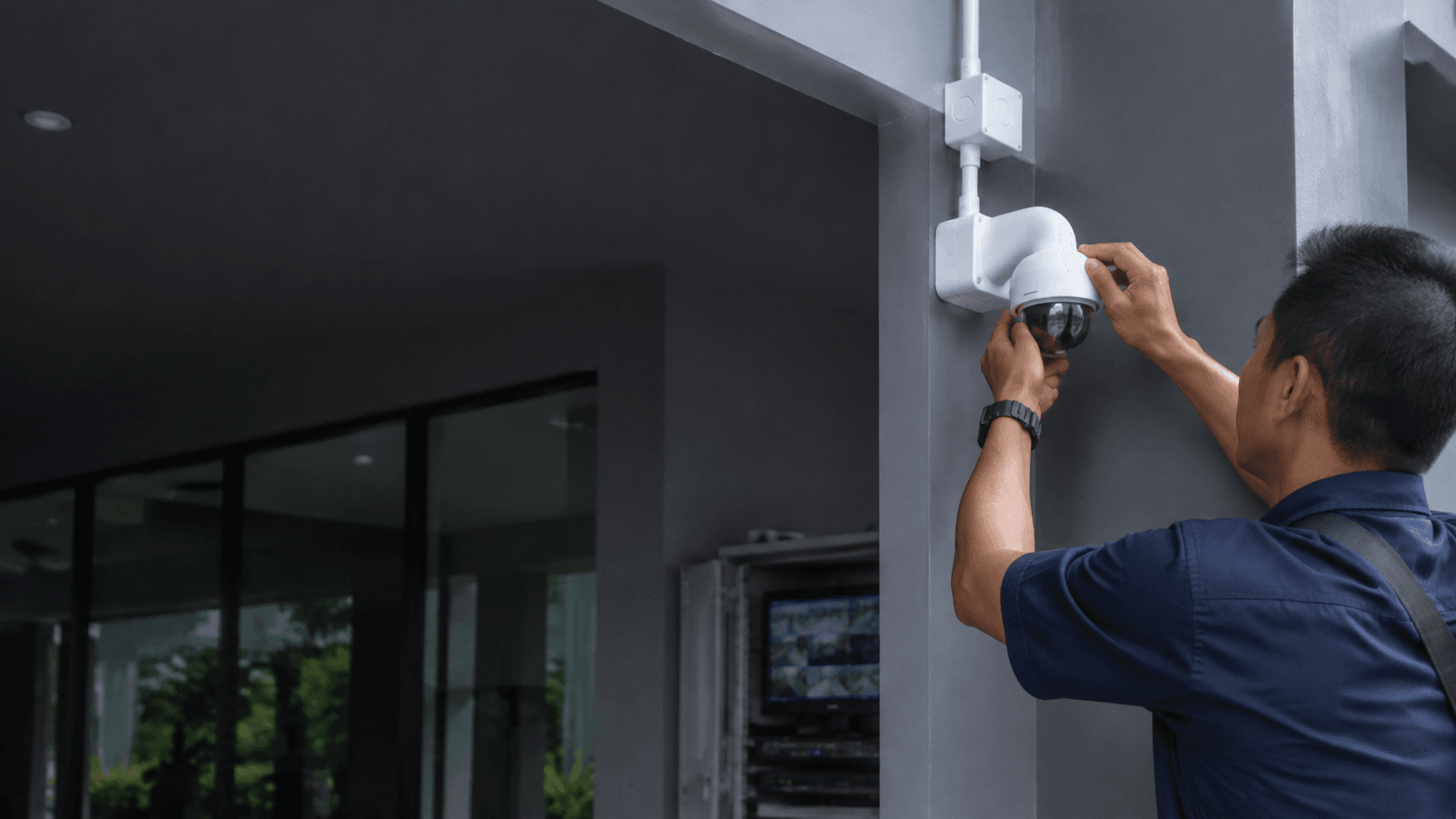
The appeal is obvious. fewer cable runs, less drilling through finished walls, and cameras that can be repositioned later without re-pulling cable. The catch is that Wi-Fi is a shared, invisible medium, and an outdoor camera sits at the far end of it, often behind a wall, a gate or a car porch roof. Most disappointing installations fail on signal, power or lighting long before the camera itself is the problem.
Eyonic Sdn Bhd plans, supplies and installs monitoring systems with camera placement, recording and remote viewing for homes, offices, shops and industrial sites in Sarawak. The company's founder, Eric Yong, has worked in technical installation of digital security solutions for commercial businesses in Sarawak for more than 10 years.
Cctv wifi outdoor. what the term covers in practice
The phrase covers a few different arrangements, and they behave differently on site.
A Wi-Fi camera with no recorder streams to an app and usually stores footage on a memory card or a paid cloud plan. A Wi-Fi camera paired with a wireless NVR records to a local hard drive while the camera-to-recorder link is wireless. A camera described as wireless may still need a power cable, or it may run on a battery or a small solar panel.
That distinction matters because "wireless" in product listings often means only the video link. Power still has to reach the camera somehow, and the options are a nearby power point, a new circuit, a battery that needs periodic charging, or a solar panel that depends on how much direct sun the mounting position receives.
Eyonic's CCTV service covers camera placement, NVR setup and remote viewing, so the recorder question gets settled alongside the camera question rather than after purchase.
Why signal, power and lighting decide the outcome
Three physical conditions determine whether an outdoor Wi-Fi camera performs as expected.
Signal. Wi-Fi weakens with distance, and it weakens further through reinforced concrete, metal roofing, foil-backed insulation and tiled walls. A camera mounted on a front gate pillar may sit 20 metres from the router with two walls between them. The phone in the same spot may show a usable bar count because phones and cameras do not have identical radios or antennas. The only reliable test is at the camera position, at the camera height, with the camera hardware or an equivalent device.
Power. A camera position without a nearby power source forces a choice between a new circuit, a battery model with a charging routine, or a solar-assisted model. Each has a maintenance implication that should be understood before installation, not after.
Lighting. Eyonic recommends checking actual lighting conditions before confirming placement for ColorVu-style cameras. A position that looks bright at midday can be genuinely dark at 8pm under a single sodium lamp, and a position that looks dark may have more ambient light than expected from a neighbouring shop sign. Night performance is decided by what light actually reaches the scene, not by what the camera specification claims in isolation.
Cctv wifi outdoor placement checks before any drilling
Placement is where most of the value is created or lost. The checks below are the ones that change decisions.
- Site survey, covering the property layout, existing network, power availability and the areas that need coverage.
- System proposal, setting out camera positions, recording approach and the practical trade-offs of each option.
- Installation, including mounting, cabling where required, network configuration and recorder setup.
- Handover, covering mobile viewing, playback and everyday operation.
Before that sequence begins, several placement questions are worth answering on site.
What must be identified — a face, a vehicle plate, a gate, a doorway, a stockyard perimeter? Identification needs the subject to occupy a reasonable portion of the frame, which usually means a closer camera rather than a wider one. Coverage and identification pull in opposite directions, and a single camera rarely does both well.
Where does the camera point relative to the light? A camera facing a bright street lamp, a setting sun or a reflective shopfront will flare and lose contrast. A camera facing away from the dominant light source usually reads better at night.
Is the mounting height practical? Very high mounts reduce tampering but push the face out of frame and make cleaning and adjustment harder. Very low mounts are easy to reach and easy to obstruct.
Does the position have line of sight to the recorder or access point, or does it rely on a signal passing through a wall? If it passes through a wall, that is a design decision that should be made deliberately.
Is there anything that will move in the frame constantly — a tree, a hanging sign, a busy road? Constant motion triggers constant recording and constant notifications, which shortens retention and trains people to ignore alerts.
How a site survey turns a plan into a working system
A survey is not a sales visit. It is the point where assumptions about signal, power and lighting get tested against the actual property.
For a Kuching Immigration Office project, the work focused on arrival flow, staff areas, visitor movement and dependable daily operation. That framing is useful for any site: the cameras exist to support how the place actually runs, not to cover every square metre on a diagram.
A KTA Sarawak Sdn Bhd project in Kuching needed a practical office setup supporting staff movement, visitor handling, tidy cabling and clearer daily site control. Tidy cabling is not cosmetic. Loose or improvised cable runs are where water ingress, rodent damage and intermittent faults begin.
Approximate budgets for that type of work sit in the RM 8,000 to RM 18,000 range for the office project and RM 12,000 to RM 28,000 for the public office project. Those figures describe completed project scopes, not a per-camera price, and a Wi-Fi outdoor setup for a single shop lot will sit well below them.
Eyonic's published package tiers are RM 1,599 for a Hikvision CCTV package covering camera supply and setup, basic recording configuration and mobile viewing handover, RM 1,599 for a Hikvision alarm system, and RM 1,599 for an autogate package. These are package starting points rather than a quotation for a specific wireless outdoor layout.
Recording, remote viewing and daily operation
Recording decisions follow from what the footage is for. Continuous recording captures everything and consumes storage quickly. Motion-triggered recording saves space but depends on detection settings that are tuned to the scene, not left at defaults.
Remote viewing is the feature most people actually use day to day, and it depends on the property's internet connection being stable and adequately provisioned. A camera that streams fine on a home connection can stutter when several people view simultaneously or when the upstream bandwidth is already busy.
Retention is a practical question with a practical answer: how far back does footage need to go to be useful? If incidents are typically noticed within a few days, a shorter retention window is sufficient. If footage is needed for a month, storage has to be sized for that from the start.
Daily operation also includes the unglamorous parts — checking that recording is still running, that the app still connects, and that nobody has accidentally unplugged something. A short handover covering mobile viewing and playback is what makes that possible without a call-out.
Cctv wifi outdoor questions worth settling early
Will a wireless camera hold a stable connection at the gate? That depends on distance, wall construction and what else is on the network. It cannot be answered from a product page, and it should be tested at the position before mounting.
Does every wireless camera still need power? No. Battery and solar-assisted models exist, but they introduce charging or sunlight dependency. Mains-powered models avoid that dependency but need a power source at the mounting point.
Is a wireless system always cheaper than a wired one? Not necessarily. Where cable routes are short and accessible, wired can be simpler and more predictable. Wireless tends to win where cable routes are long, finished surfaces would be damaged, or the property is rented.
What happens if the Wi-Fi drops? A camera recording to a local card or a local recorder keeps recording. A camera that depends entirely on a cloud service may not. This is worth confirming for the specific hardware before purchase.
Can cameras be added later? Usually, but the network and recorder have to be able to carry them. Adding cameras to a saturated wireless link degrades every camera on it, so headroom should be planned from the start.
Who confirms placement? A site survey is the point at which placement is confirmed against real signal, power and lighting conditions rather than assumptions. Eyonic's process places that survey before the proposal, which means the proposal reflects the property rather than a generic layout.
Share your location, property type and required system with Eyonic on WhatsApp at +60 11-5111 7959 for the next practical step.