
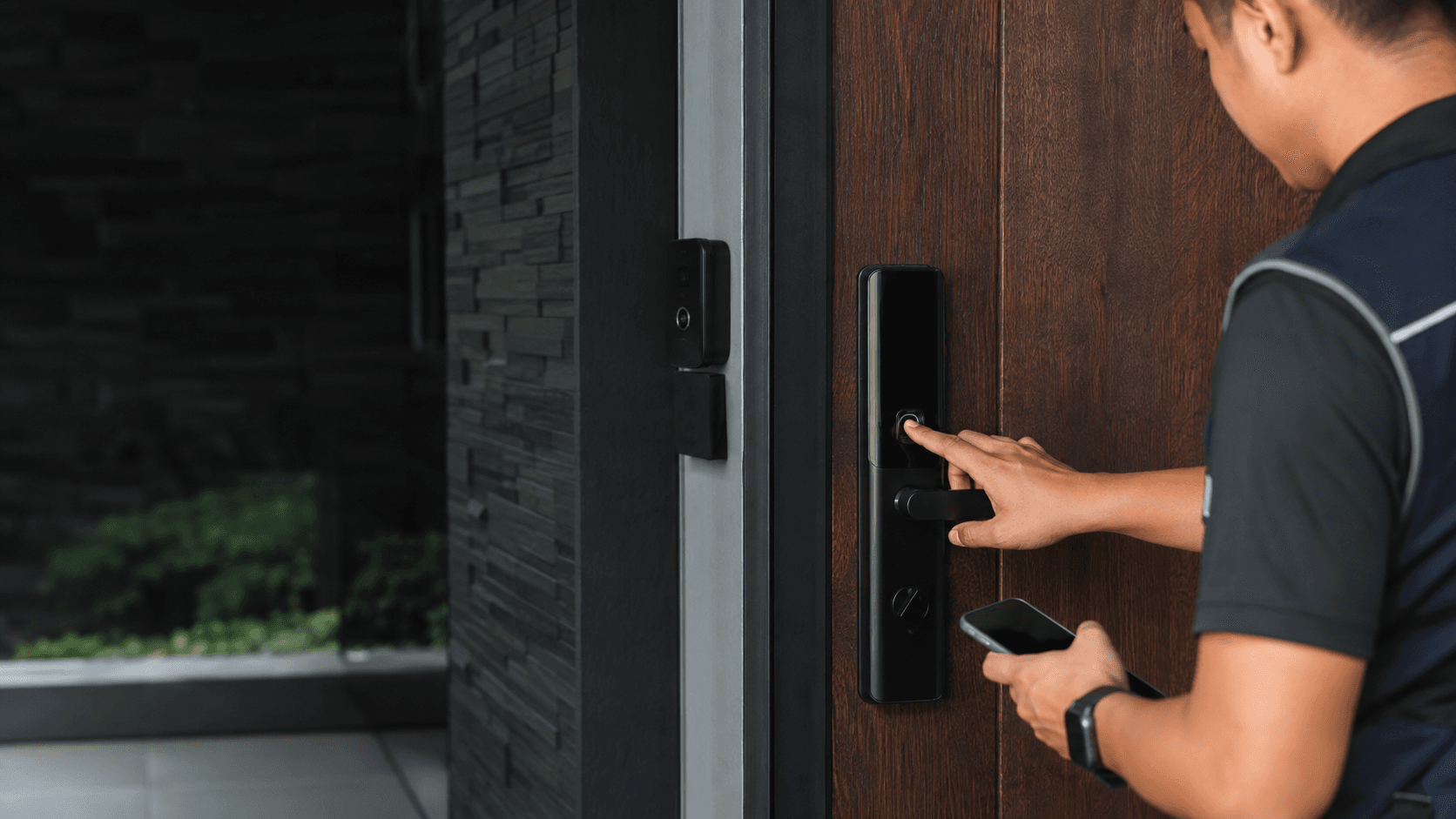
The exact-match query fingerprint digital lock describes hardware that replaces a keyed cylinder with a biometric reader, a keypad, or both. Buyers in Malaysia usually meet the term while comparing imported smart locks against locally supplied and installed units, and the two paths differ in who surveys the door, who fits the lock, and who answers when something stops working.
Eyonic Sdn Bhd plans, supplies and installs security and ELV systems in Sarawak, and its published smart lock door access guidance states that smart locks work best when the door condition, user roles and backup method are reviewed before installation. For business use, the same guidance notes that Eyonic usually checks whether a standalone smart lock or an access-control panel is more appropriate.
What a fingerprint digital lock replaces at the door
A fingerprint digital lock replaces the keyed entry method at a single door. The mechanical deadbolt or latch body may stay, but the way a person proves identity changes from a cut key to a stored fingerprint, a code, a card, or a combination of those methods.
That shift matters because it moves access decisions from physical key copies to digital records. A key can be duplicated without the owner knowing. A fingerprint template or user code is issued, changed or removed by whoever administers the lock, which is why user permissions become part of the purchase decision rather than an afterthought.
On a residential door, the practical gain is convenience: no key to carry, no hidden spare under a pot, and a record of who entered. On a commercial door, the same hardware raises a different question, because staff turnover, visitor handling and shared entrances all affect how many users the lock must manage and how often that list changes.
Door condition and user roles before installation
Door condition is the first constraint. A fingerprint digital lock is fitted to an existing door, so the door's construction, its existing lock type and the way it closes all shape what can be installed. A door that does not sit squarely in its frame, or that needs to be lifted to latch, will keep causing problems after any lock is fitted, because the lock is not the part that is out of alignment.
User roles are the second constraint. A household needs a handful of fingerprints and perhaps a temporary code for a cleaner or a relative. An office needs a way to add a new staff member and remove a departing one, and it needs someone who is responsible for doing that. If nobody owns that task, the lock quietly accumulates active credentials that nobody tracks.
Eyonic applies a short sequence of checks before quoting smart lock door access work:
- Inspect the actual door, its frame and its existing lock to confirm what the door can accept.
- List the people who need entry, and separate permanent users from temporary or one-off visitors.
- Decide who administers user permissions, and how a credential is removed when someone leaves.
- Agree the backup entry method for the day the reader does not recognise a finger or the power runs out.
- Confirm whether a standalone lock is enough or whether the door needs an access-control panel instead.
Those checks follow the same survey-first pattern Eyonic publishes for its other installation work, where a site survey and system proposal come before installation and handover. The order matters because a lock chosen before the door is inspected is a guess.
Standalone lock or access-control panel
A standalone fingerprint digital lock manages its own users and stores its own records. It suits a single door with a small, stable group of users, and it needs no separate controller or software.
An access-control panel suits a door that has to fit into a wider system: multiple doors under one administration, entry that must be logged centrally, or access that has to be granted and revoked alongside other building systems. The trade-off is scope. A panel adds a controller, more cabling and more configuration, which is unnecessary overhead for a single household door and often necessary for a staffed office entrance.
Eyonic's published guidance treats this as a genuine fork rather than a default, which is why the standalone-versus-panel question is settled during the survey rather than at the counter.
Backup entry and daily operation
Backup entry is the part buyers most often leave until after installation. Every electronic lock needs a way in when the primary method fails, whether that is a mechanical key override, a keypad code, or a second credential type. The backup method should be decided before the lock is fitted, and the person who holds it should be named.
Daily operation then depends on habits rather than hardware. A fingerprint digital lock works when the enrolled finger is presented the same way each time, when the door is allowed to close properly, and when someone notices a low-battery warning before it becomes a locked-out situation. None of those are technical problems, but all of them decide whether the lock feels reliable six months later.
Fingerprint digital lock installation in Sarawak
Installation in Sarawak is a local question, not a product question. A unit bought online arrives as hardware; the survey, the fitting, the user setup and the handover are separate work, and they are the parts that determine whether the lock suits the door it was bought for.
Eyonic's completed projects in Kuching include work for the Kuching Immigration Office, focused on arrival flow, staff areas, visitor movement and dependable daily operation, and for KTA Sarawak Sdn Bhd, an engineering consultancy office that needed support for staff movement, visitor handling, tidy cabling and clearer daily site control. Both are access and movement problems rather than lock problems, and both were solved by planning the flow before choosing the hardware.
That experience is relevant to a fingerprint digital lock decision because the same questions recur: who arrives, how often, through which door, and who is accountable for the access list. A door that carries heavy daily traffic needs a different answer from a store room that two people open each week.
Eric Yong, founder of Eyonic Security Systems, has worked in the industry for more than ten years and is experienced in technical installation of digital security solutions for commercial businesses in Sarawak. That background sits behind the survey-first approach rather than replacing it.
What the evidence does not yet cover
Several details that buyers ask about are not established by the available material. There is no supplied evidence of fingerprint capacity, recognition speed or biometric accuracy for any fingerprint digital lock, and no supplied evidence of battery life, power backup or weather resistance. Supported door thickness, mortise type and deadbolt compatibility are likewise not documented, and neither is app, Wi-Fi or smart home platform support.
There is also no supplied price for a fingerprint digital lock. The published RM 1,599 packages cover a Hikvision CCTV package, a Hikvision alarm system and an autogate package, and none of those three covers door access hardware. Warranty terms and product ratings are not documented either, and no completed Eyonic fingerprint digital lock project is published; the available case studies cover a public office and an engineering consultancy office.
Those gaps are worth naming because they are exactly the specifications that imported product pages lead with. A buyer comparing a datasheet against a local quotation should treat the missing items as questions to ask, not as details to assume.
Matching the lock to the door and the users
A fingerprint digital lock suits a door with a small, stable user group and a clear backup method. It suits a home entrance, a staff door, a store room or an office entrance where the access list changes slowly and someone owns it.
It fits less well where the door itself is the problem, where dozens of users change weekly, or where entry has to be logged alongside other building systems. In those cases the honest answer is often an access-control panel, or a repair to the door before any lock is fitted.
The practical test is simple. If the door closes cleanly, the user list is short and stable, and a named person holds the backup key, a standalone lock is usually enough. If any of those three is untrue, the survey should settle the question before money is committed.
Readers who want a specific answer for a specific door can share the location, property type and required system with Eyonic on WhatsApp at +60 11-5111 7959.