
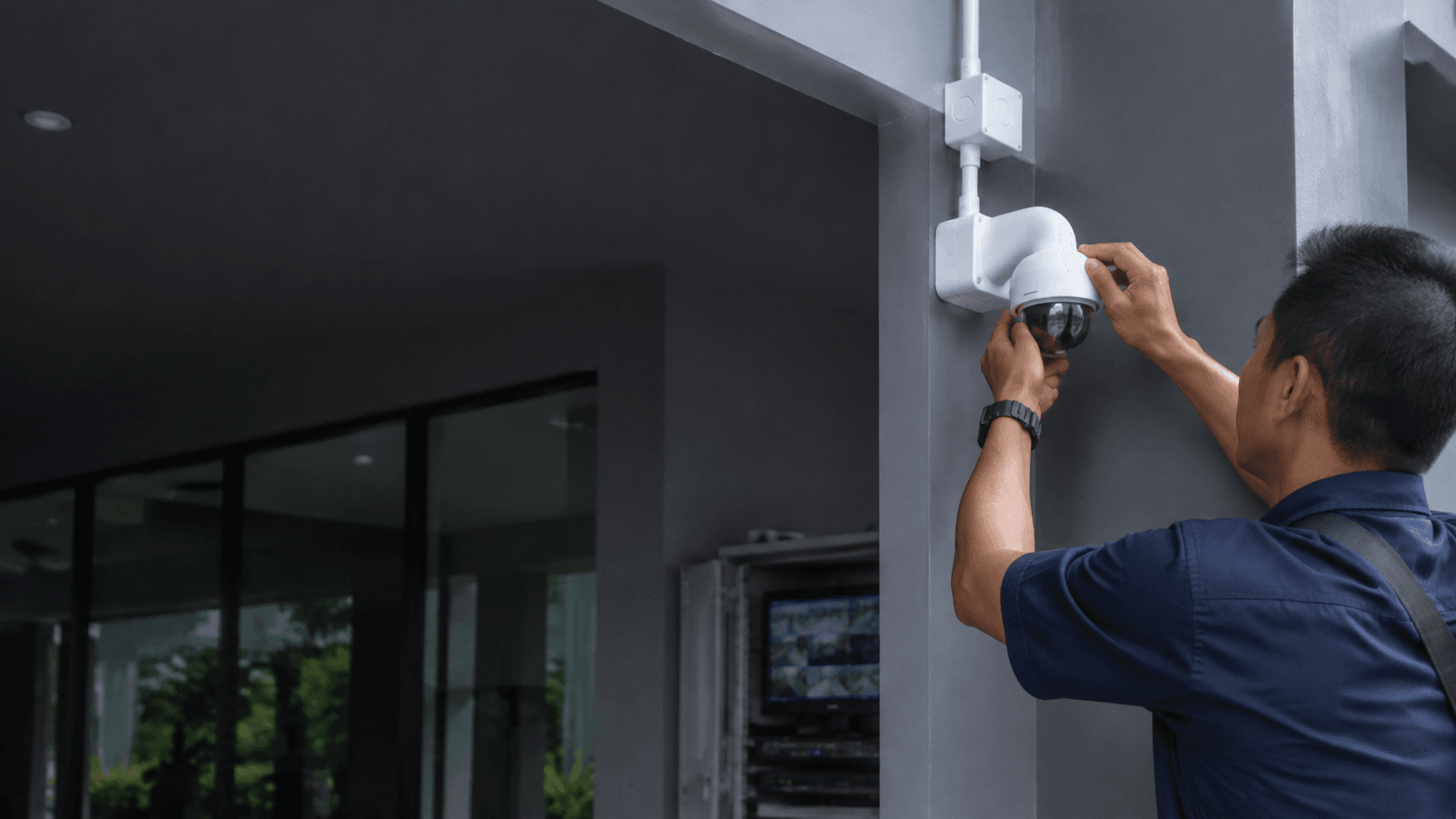
The work starts with a site survey rather than a product list. Eyonic Sdn Bhd is a security system supplier in Sarawak, Malaysia, specialising in CCTV and ELV systems, and its installation process runs through four stages: site survey, system proposal, installation and handover.
That sequence matters because a camera that faces a bright doorway or a dark corridor produces a different result from one aimed at a lit car park. Placement decisions made on site, with the actual lighting and movement patterns in view, hold up better than placement decisions made from a floor plan alone.
What a cctv security cameras system includes
A working system has four parts that have to agree with each other: cameras positioned to cover real movement, a recorder that stores what the cameras capture, a network path that carries the video, and a viewing method that staff can actually use.
Eyonic describes its CCTV work as planning, supplying and installing monitoring systems with camera placement, recording and remote viewing for homes, offices, shops and industrial sites. Those four elements — placement, recording, remote viewing and the site type — are the practical scope of a project.
The RM 1,599 Hikvision CCTV Package covers camera supply and setup, basic recording configuration, and mobile viewing handover. Two other packages sit at the same price point: the Hikvision Alarm System, which includes a control panel and sensors, siren and zone setup, and user testing and handover; and the Autogate Package, which includes motor recommendation, remote-control setup, and safety testing and handover.
What the packages do not settle is how many cameras a given property needs, what resolution suits a particular entrance, or how long footage should be retained. Those answers depend on the site, and no verified figure exists for them in advance of a survey.
How Eyonic plans a cctv security cameras installation
The process is deliberately ordered. Each stage produces something the next stage depends on, which is why skipping the survey tends to surface problems during installation instead of before it.
- Site survey. The property is reviewed on location so that entry points, movement routes, existing cabling and lighting conditions are known before any equipment is chosen.
- System proposal. A proposed system is put together from what the survey found, covering camera placement, recording and remote viewing for the site type.
- Installation. Cameras, recorder and cabling are installed and configured according to the agreed proposal.
- Handover. The system is handed over with the recording configuration and mobile viewing set up so that the people who use it day to day can operate it.
Eric Yong, founder of Eyonic Security Systems, has been in the industry for more than 10 years and is experienced in technical installation of digital security solutions for commercial businesses in Sarawak. That background sits behind the survey stage, where the difference between a workable layout and an awkward one is usually visible on site.
Why the survey comes before the proposal
A proposal written before a survey is a guess about coverage. A proposal written after one can name where each camera goes and why, which makes the quotation easier to check and the installation faster to complete.
The survey also exposes constraints that affect cost and tidiness: whether cable routes already exist, whether a recorder can sit somewhere with power and ventilation, and whether the building's layout allows a single recorder to serve all the cameras or needs a different arrangement.
Camera placement and lighting checks before confirming
Placement is the decision that most affects whether footage is useful. A camera pointed at the right area at the wrong angle can record a scene that shows movement without showing anything identifiable.
Eyonic recommends checking actual lighting conditions before confirming placement for ColorVu-style cameras. That check is specific rather than general: the lighting at a location during the hours that matter is what determines whether a camera performs as expected there.
Several conditions are worth walking through on site:
- Direct light sources. A camera facing a bright lamp, a reflective surface or a low sun angle can lose detail in the brightest part of the frame.
- Deep shadow. Areas that receive no ambient light at night behave differently from areas with street lighting or security lighting nearby.
- Movement patterns. The route people and vehicles actually take through a space is not always the route drawn on a plan.
- Obstruction over time. Trees, signage and parked vehicles can block a view that was clear on the day of the survey.
Where lighting is uneven across a property, placement may need to differ from camera to camera rather than following one rule. That is a site-level judgement, and it is one reason a survey is more useful than a standard layout applied to every building.
Recording, NVR setup and remote viewing
Recording is what turns a camera into evidence. The recorder — an NVR in a network-based setup — receives video from the cameras and stores it, and the configuration of that recorder determines what is kept and for how long.
Eyonic lists NVR setup and remote viewing as part of its CCTV service scope. In practice, NVR setup covers bringing the cameras onto the recorder, confirming that each one is recording, and setting the recording behaviour the site needs. Remote viewing covers the mobile viewing handover, so that the people responsible for the property can check the cameras from a phone.
Remote viewing depends on the network at the site. A property with stable internet and a sensible router arrangement will support mobile viewing more reliably than one where the recorder sits on a weak connection. This is worth confirming during the survey rather than after installation.
What handover should leave behind
Handover is the point where the system stops being an installation and starts being something staff use. A useful handover covers how to open the live view, how to find recorded footage from a specific time, and who to contact when something looks wrong.
Eyonic's package structure reflects this: the Hikvision CCTV Package ends with mobile viewing handover, the Hikvision Alarm System ends with user testing and handover, and the Autogate Package ends with safety testing and handover. Each package closes with the user, not the equipment.
A public office project in Kuching
Eyonic completed a project for the Kuching Immigration Office, a public office in Kuching. The work focused on arrival flow, staff areas, visitor movement and dependable daily operation.
That combination of priorities is typical of a public building. Arrival flow and visitor movement involve areas where people pass through in predictable directions, while staff areas involve spaces that need coverage without interfering with daily work. Dependable daily operation is the requirement that ties them together: a system that needs constant attention is a system that stops being used.
The approximate budget for this type of work is RM 12,000 to RM 28,000. A second Eyonic project, for KTA Sarawak Sdn Bhd, involved a practical office setup in Kuching to support staff movement, visitor handling, tidy cabling and clearer daily site control, with an approximate budget of RM 8,000 to RM 18,000.
Tidy cabling appears in that second project description for a reason. Cabling is the part of an installation that is most visible after the work is finished, and it is also the part that most affects how easily the system can be maintained later.
What these projects suggest about scope
Both projects were office environments with a mix of public-facing and internal areas. Neither is described in terms of camera counts or specifications, which is consistent with how the work is scoped: from the site and its movement patterns first, and from equipment second.
For a home, shop or industrial site, the same starting point applies, though the priorities shift. A shop tends to care about counter and entrance coverage. An industrial site tends to care about perimeter and loading areas. A home tends to care about entrances and the areas around them.
Choosing a supplier for in Malaysia
The practical question for a buyer in Malaysia is whether the supplier will look at the actual site before proposing a system. A supplier who surveys, proposes, installs and hands over is offering a different service from one who ships a box.
Three things are worth confirming before committing:
- Whether a site survey happens before the proposal, so that placement and lighting are decided on location.
- Whether recording configuration and remote viewing are included, rather than treated as separate work.
- Whether handover covers the people who will use the system daily, not just the person who placed the order.
Eyonic's stated coverage is Sarawak, and its completed projects are in Kuching. Buyers outside that area should confirm coverage directly rather than assuming it.
On cost, the published figures are the three RM 1,599 packages and the two project budget ranges. Anything beyond those — monitoring fees, subscription costs, warranty terms or response times — is not something the available evidence supports, and a buyer should ask about it specifically.
Share your location, property type and required system with Eyonic on WhatsApp at +60 11-5111 7959 for the next practical step.