
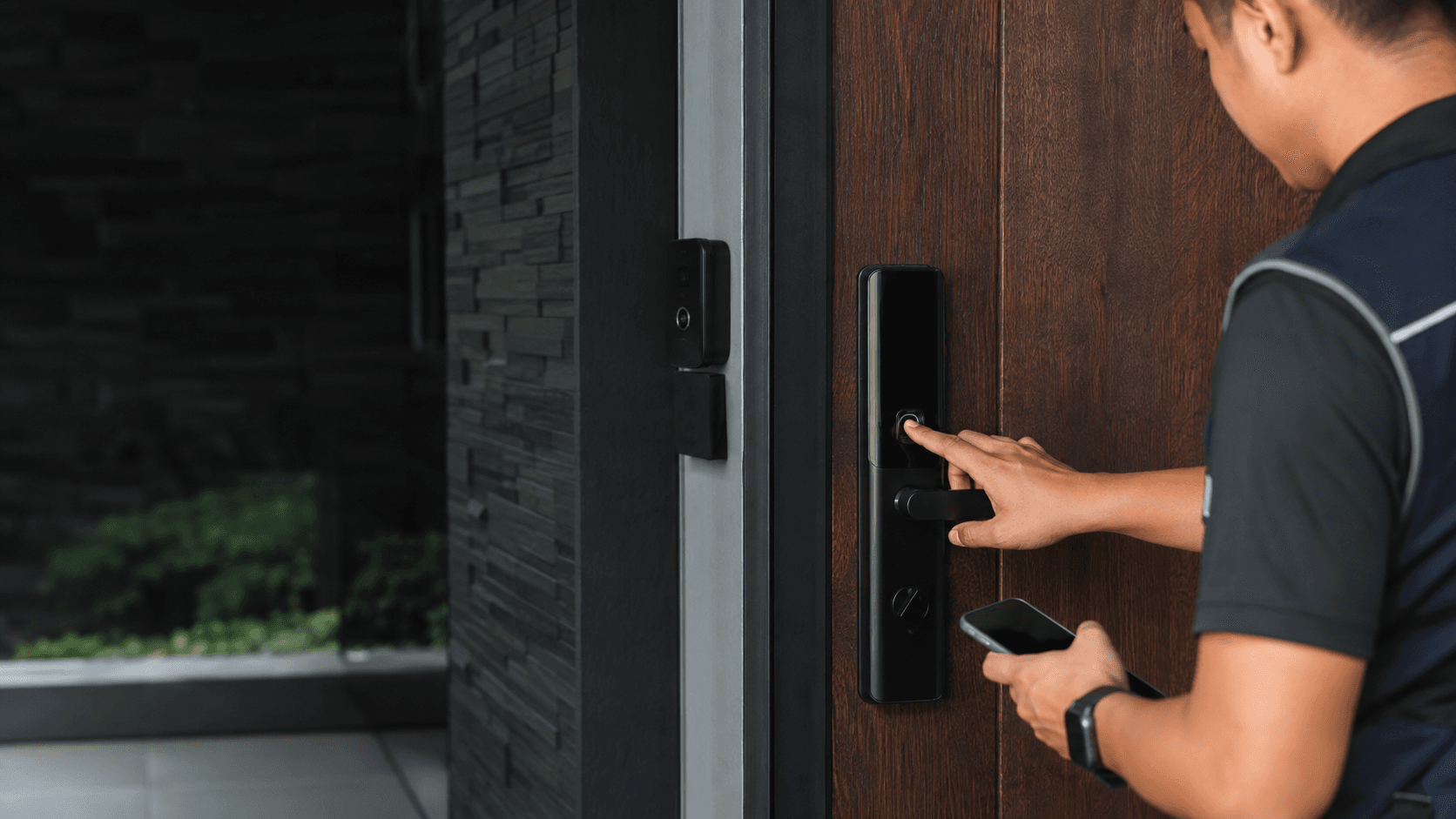
That pairing is the core of the category. The lock itself is hardware — a deadbolt, lever, or mortise unit — while the phone side is software: an app that issues commands over Bluetooth, Wi-Fi, or a hub. Eyonic Sdn Bhd, a security system supplier in Sarawak, Malaysia, treats smart lock door access as a fit for controlled convenience when user permissions and backup entry are planned properly.
Getting the pairing right matters more than the brand name on the box. A lock that works flawlessly on a timber apartment door can fail on a metal grille or a glass office entrance, and a lock that suits one household member can frustrate a business with rotating staff.
Door Lock Controlled By Phone. What Matters Before You Choose
Three things decide whether the setup works in daily use: the door itself, the connectivity method, and the fallback when the phone is unavailable.
- Check the door condition — thickness, material, existing cutout, and whether the frame can take a deadbolt or mortise body.
- Decide the connectivity route — Bluetooth for close-range unlocking, Wi-Fi for remote control, or a hub that bridges both.
- Map user roles — who needs permanent access, who needs temporary access, and who needs none.
- Plan the backup entry method — mechanical key, keypad code, or a second credential — before installation, not after.
- Confirm power and network — battery type, expected replacement cycle, and whether the Wi-Fi signal reaches the door.
- Test the full sequence at handover — app pairing, code entry, remote unlock, and lock status reporting.
Eyonic's own installation process follows a similar shape: site survey, system proposal, installation, and handover. The survey stage is where door condition and user roles get reviewed, and it is the stage that most often changes the recommended product.
Choosing the Right Door Lock Controlled By Phone
The right choice depends on how the door is used, not on how many features the lock advertises. A residential front door, an office entrance, and a rental unit each place different demands on the same category.
Match the lock to the door, not the other way around
Smart locks work best when the door condition, user roles, and backup method are reviewed before installation. A door that is too thin, warped, or fitted with an unusual lock body may need a different model or a different approach entirely. For business use, Eyonic usually checks whether a standalone smart lock or an access-control panel is more appropriate — the two solve different problems.
Connectivity decides what the phone can actually do
Bluetooth locks use the smartphone as a key at close range. That suits a home or a small office where the person unlocking is standing at the door. Wi-Fi or hub-connected locks extend control beyond the doorway, which matters when a business needs to grant or revoke access without being on site. The trade-off is real. remote capability usually adds a hub, a bridge, or a mains-powered component, and each of those introduces another point that can lose power or signal.
User roles separate home from business
A household typically needs a handful of permanent users and occasional guest access. A business needs something closer to a permission structure — staff who join and leave, visitors who need temporary entry, and a record of who entered. The lock hardware may be identical; the planning is not.
What Is Door Lock Controlled By Phone?
A door lock controlled by phone is a locking device that accepts commands from a smartphone app rather than only from a physical key. The app handles unlocking, locking, user management, and sometimes access history. The lock still contains a physical mechanism, and most models retain at least one non-phone entry method.
The category overlaps with smart locks generally, but the emphasis falls on the phone as the primary control surface. That distinction matters when comparing products: a lock with a keypad but no app is not the same thing, and a lock with an app but no keypad leaves the user dependent on a charged, working phone.
Amazon.com Smartphone Door Lock
Marketplace listings for smartphone door locks tend to emphasise feature counts — fingerprint readers, facial recognition, video doorbells, voice assistant compatibility, and ANSI security grades. Those features are genuine differentiators, but a listing cannot assess whether a specific door will accept the lock or whether the household's Wi-Fi reaches the entrance.
Buying from a marketplace also separates the product from the installation. A lock that arrives without a survey may fit the door, or it may not. Where a supplier handles planning, supply, and installation together, the door condition and user roles get checked before the product is confirmed — which is the sequence Eyonic follows on its own projects.
Practical Considerations for
Several constraints show up repeatedly once a lock is in daily use. None of them are reasons to avoid the category; they are reasons to plan before committing.
Power network and the failure case
Battery-powered locks need a replacement routine, and a lock that loses power mid-cycle can leave a door in an unexpected state. A mains-powered or hub-connected lock avoids battery swaps but depends on the electrical supply and, for remote features, on the network. The practical answer is a documented fallback: a mechanical key kept somewhere sensible, or a keypad code that does not depend on the app.
Door material and existing hardware
Timber doors, metal grilles, glass entrances, and fire-rated doors all behave differently. Retrofitting a smart lock onto an existing deadbolt is usually simpler than cutting a new opening, but the existing hardware has to be compatible. This is the single most common reason a chosen model cannot be installed as planned.
Who holds the credentials
Every phone that can unlock the door is a credential. When staff leave, when a tenant moves out, or when a phone is lost, the access list needs updating. Locks that support remote revocation handle this cleanly; locks that only support local pairing require someone to be at the door.
Integration with the wider security setup
A door lock rarely sits alone. It may need to work alongside CCTV, an alarm system, an autogate, or an intercom. Eyonic supplies and installs CCTV and ELV systems across Sarawak, and its project work has covered arrival flow, staff areas, visitor movement, and dependable daily operation at the Kuching Immigration Office, as well as office setups supporting staff movement, visitor handling, and tidy cabling for KTA Sarawak Sdn Bhd. Those projects illustrate the same principle that applies to a single door: access control works better when it is planned as part of the site rather than added to it.
Making an Informed Choice About
The decision usually comes down to a short set of questions. Is the door suitable? Is the connectivity method adequate for how the entrance is actually used? Is there a backup that works when the phone does not? Are user roles clear enough that access can be granted and revoked without friction?
Where the answers are straightforward — a single household, a standard timber door, a phone that stays charged — a standalone smart lock is often sufficient. Where the answers involve rotating staff, multiple entrances, or integration with existing security systems, an access-control approach may fit better, and the lock becomes one component rather than the whole solution.
Eyonic's founder, Eric Yong, has worked in the industry for more than ten years, with experience in technical installation of digital security solutions for commercial businesses in Sarawak. That background shapes how the company scopes a job: survey first, then a proposal, then installation and handover. For a door lock controlled by phone, the survey is where the door, the network, and the user list get settled.
For readers in Sarawak weighing a smart lock against a broader access-control setup, sharing the location, property type, and required system with Eyonic on WhatsApp at +60 11-5111 7959 is the next practical step.