
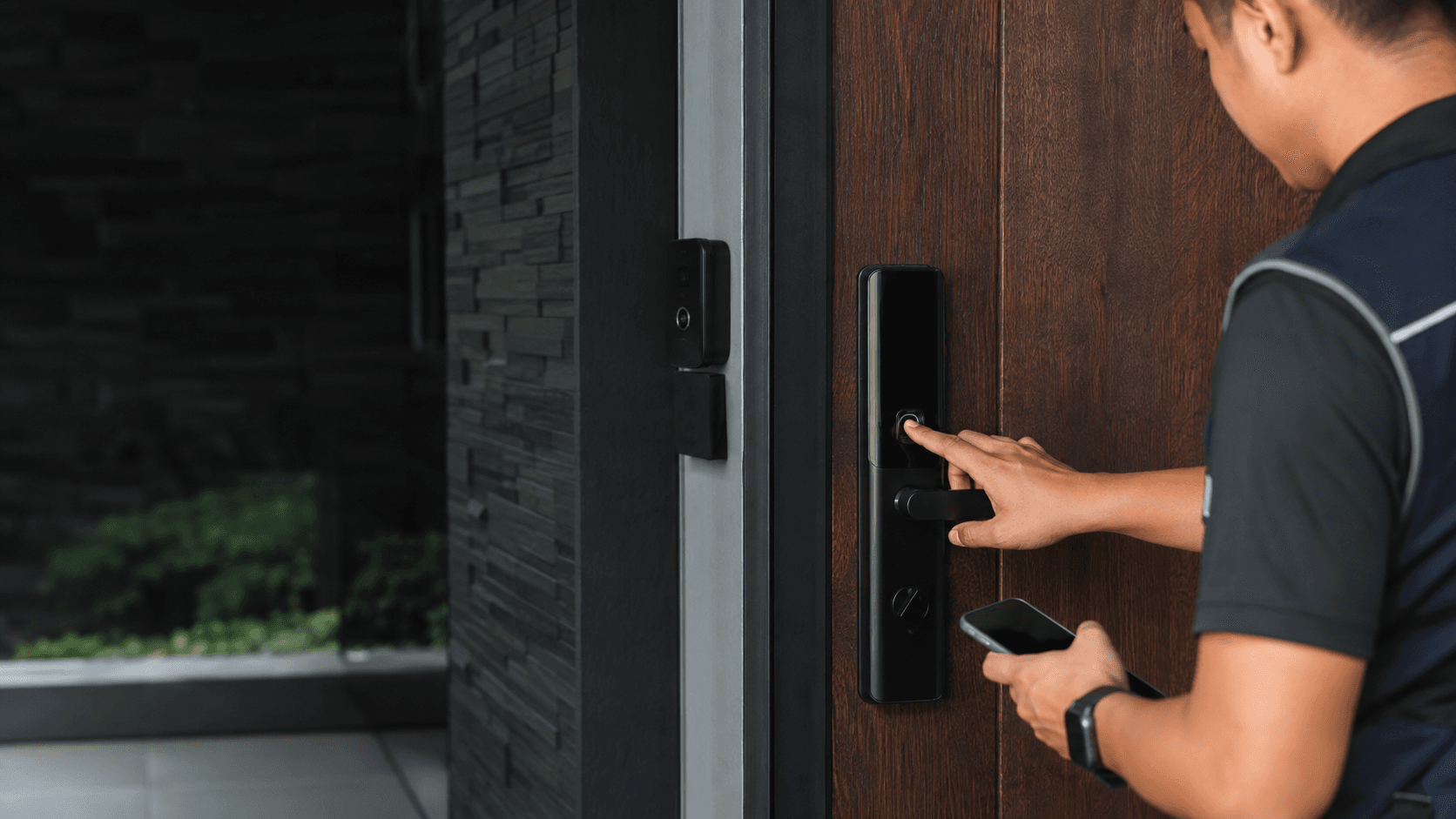
The exact-match query keyless door entry describes a door that opens without a cut metal key. The credential might be a numeric code, a card, a phone, or a fingerprint, and the lock decides whether that credential is valid. What changes is not only how the door opens but who can open it, when, and what happens when the usual method fails.
Eyonic Sdn Bhd plans, supplies, and installs security and ELV systems in Sarawak, Malaysia, for homes, offices, shops, and industrial sites. Its own product review guidance states that smart locks work best when door condition, user roles, and backup method are reviewed before installation, and that for business use the choice between a standalone smart lock and an access-control panel should be checked first.
What keyless door entry changes at the door
A mechanical lock has one secret: the key. Anyone holding a copy can enter, and the lock cannot tell who came in or when. Keyless door entry moves that decision into the lock or a connected panel, so access becomes something that can be issued, limited, and withdrawn.
That shift creates three practical differences at the door itself.
The first is that entry no longer depends on a physical object being carried. A code can be shared and later changed. A card can be cancelled. A phone can be removed from the list. The second is that access can be scoped. A cleaner, a delivery driver, and a family member do not need the same rights. The third is that the door can produce a record of use, which a mechanical key cannot.
None of this removes the need for a working door. A lock is only as good as the frame, the alignment, and the hardware it is fixed to.
Door condition and daily traffic
Before any model is discussed, the door has to be assessed. Eyonic's smart lock review guidance puts door condition first for a reason: a door that has dropped on its hinges, a frame that has swollen, or a strike plate that no longer lines up will cause problems for any lock, electronic or mechanical.
Daily traffic matters just as much. A home entry door used a few times a day behaves differently from an office door used by staff, visitors, and contractors across a working day. High traffic puts more cycles on the mechanism and more demand on whatever powers it.
For business doors, Eyonic usually checks whether a standalone smart lock or an access-control panel is more appropriate. That is a real fork in the road. A standalone lock suits a single door with a small, stable group of users. An access-control panel suits a site where multiple doors, larger user groups, or central administration are involved.
Two completed Eyonic projects show how much the surrounding flow matters. The Kuching Immigration Office project focused on arrival flow, staff areas, visitor movement, and dependable daily operation. The KTA Sarawak Sdn Bhd project supported staff movement, visitor handling, tidy cabling, and clearer daily site control. Both are office environments where a door is one part of a movement pattern, not an isolated fixture.
Credentials, permissions, and backup entry
Credentials are the things a person presents to the door. Common categories include a numeric code, a card or fob, a smartphone app, and a fingerprint. The right mix depends on who uses the door and how often.
Permissions are the rules attached to those credentials. A permission set answers questions such as which doors a credential opens, which days and hours it works, and how quickly it can be removed when someone leaves. This is where keyless door entry earns its place in a business setting, because a lost card can be cancelled without changing a cylinder.
Backup entry is the part most often left until later. Every keyless system needs a defined answer for the day the primary method does not work. That answer might be a mechanical key override, a separate administrator credential, or a documented procedure held by the site. The important point is that the answer is decided before installation, not after a lockout.
Eyonic's review guidance names backup entry alongside door condition and user roles as one of the three things to settle first. Treating it as an afterthought is what turns a convenience into a problem.
How the practical sequence runs
Eyonic's installation process follows a defined order, and the same order applies to access work.
- Site survey — the door, frame, traffic pattern, and existing infrastructure are inspected on site.
- System proposal — the recommended approach is set out, including whether a standalone lock or a panel fits better.
- Installation — hardware is fitted and configured.
- Handover — users, permissions, and backup entry are explained and tested.
The survey stage is where most of the risk is removed. A door that looks straightforward in a photograph can present alignment, cabling, or power questions that only appear in person. Eyonic applies the same principle to camera work, recommending that actual lighting conditions be checked before confirming placement, and the logic carries across to access hardware.
Power, network, and battery realities
Keyless door entry depends on something other than a hand. That dependency is the main trade-off against a mechanical lock.
Battery-powered locks avoid wiring but introduce a maintenance item. Mains-powered hardware avoids battery changes but needs a power route to the door. Network-connected locks add remote management and records but also add a dependency on that connection. Each choice moves the failure point rather than removing it.
The honest position is that no specific power-outage or network-outage behaviour can be stated for a lock model without the manufacturer's documentation for that model. That documentation should be obtained and read before purchase, not assumed from a product category.
What can be planned in advance is the response. A site should know which doors fail safe and which fail secure, who holds the override, and how a user gets in when the primary method is unavailable. For a home, that may be a single mechanical key kept off-site. For an office, it is usually a written procedure with a named responsibility.
Battery and connectivity claims should be verified against the specific model's datasheet. Generic figures circulating online do not transfer reliably between products, and a claim that holds for one lock may be wrong for another.
Planning keyless door entry with Eyonic
Eyonic Sdn Bhd is a security system supplier based in Sarawak, Malaysia, working across CCTV and ELV systems for homes, offices, shops, and industrial sites. The founder, Eric Yong, has more than ten years in the industry and works on technical installation of digital security solutions for commercial businesses in Sarawak.
Access work sits alongside the other systems Eyonic handles, which matters when a door needs to coordinate with an intercom, an alarm, or a camera. A door that opens is one event; a door that opens and is recorded is a system.
Budget expectations should be set from a survey rather than a list price. For reference, Eyonic's published package pricing places a Hikvision CCTV package, a Hikvision alarm system, and an autogate package at RM 1,599 each, and completed office projects have carried approximate budgets in the range of RM 8,000 to RM 18,000 for the KTA Sarawak Sdn Bhd work and RM 12,000 to RM 28,000 for the Kuching Immigration Office work. Those figures cover broader scopes than a single door and are useful only as a sense of scale.
Hardware and installation pricing for keyless door entry in Malaysia is not published here, because no verified figure is available for it. A site survey is what produces a real number.
What to prepare before a survey
A productive survey starts with a short list of facts about the door and its users. Knowing these in advance shortens the process.
Bring the number of people who need access, whether any of them need time-limited or one-off entry, whether the door is the main entrance or a secondary one, and whether a mechanical key must remain as a fallback. Note the door material and whether it is a swing or sliding type. If the site already has an alarm, intercom, or camera system, mention it, because integration changes the design.
For multi-door sites, list every door that should be covered, even if the first phase only includes one. Planning the full set early avoids rework later.
Where keyless entry fits and where it does not
Keyless door entry suits a door where access needs to change over time. A rental property, an office with staff turnover, a shop with shift patterns, and a home with regular visitors all fit that description.
It fits less well where the door itself is failing, where no reliable power or maintenance arrangement exists, or where the site cannot commit to managing permissions. In those cases the underlying problem should be fixed first. A lock cannot compensate for a door that does not close properly.
For larger sites, the question is not whether to go keyless but at what level. A single standalone lock on one door is a different project from a managed access-control system across a building, and the two should not be priced or planned as if they were the same.
Share the location, property type, and required system with Eyonic on WhatsApp at +60 11-5111 7959 to arrange the next practical step.