
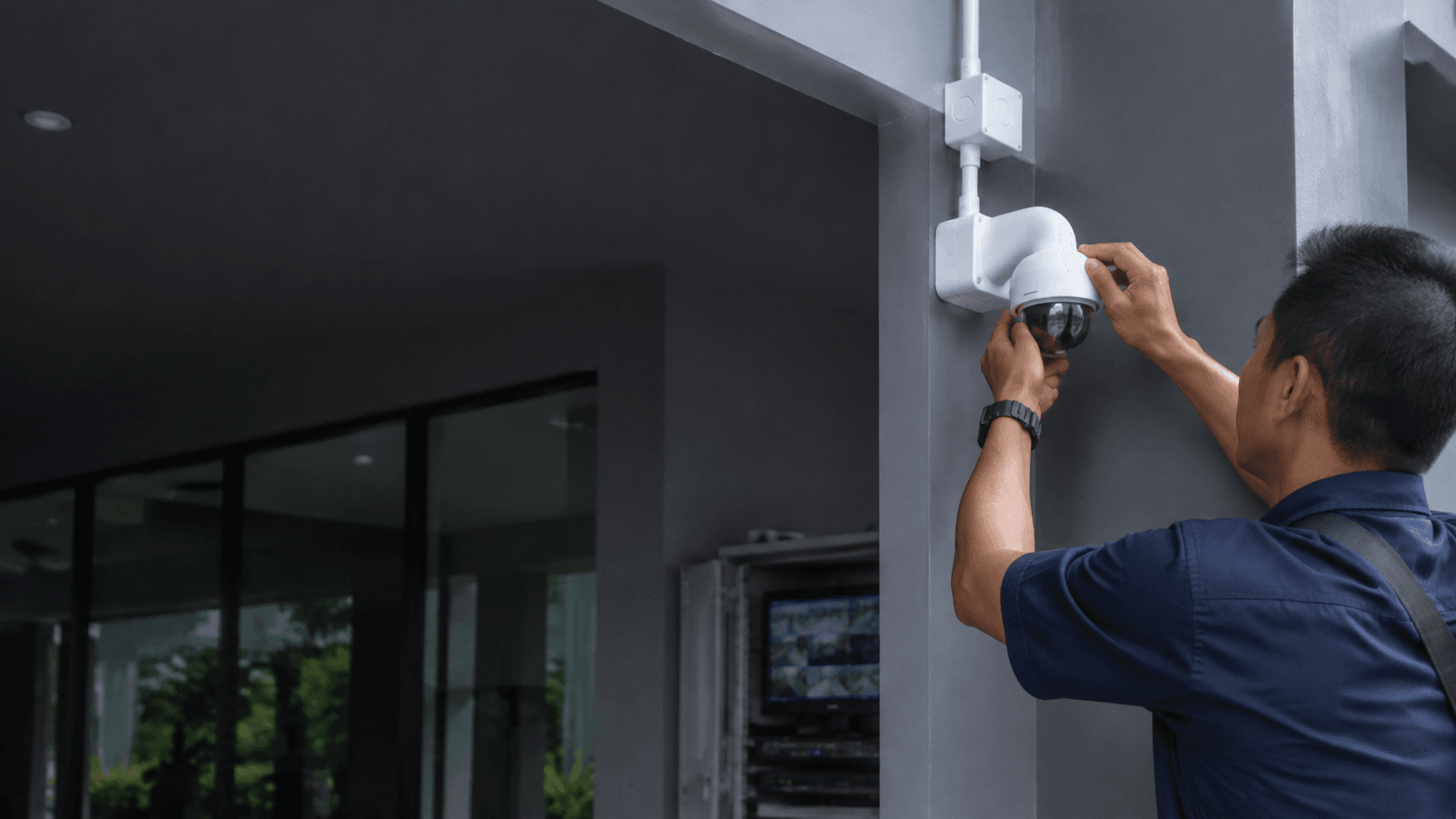
Eyonic Sdn Bhd, a security system supplier in Sarawak, plans, supplies and installs monitoring systems with camera placement, recording and remote viewing for homes, offices, shops and industrial sites. The same four-stage process applies whether the premises is a single-lot shophouse or a multi-floor retail unit.
Most shop owners arrive with the same question: what does a CCTV camera for shop installation actually involve, and what will it cover? The answer sits in three areas — where cameras point, how the recording and remote viewing are set up, and how the work is sequenced so trading hours are not disrupted.
Cctv Camera For Shop. What a Shop Setup Usually Covers
A shop surveillance system is not a single camera pointed at the door. It is a small set of cameras, each chosen for a specific zone, connected to a recorder that stores footage and pushes a live view to a phone.
Eyonic's documented service scope for CCTV security systems covers four connected elements: camera placement, recording, remote viewing, and NVR setup. Those four elements map directly onto what a shop needs.
Camera placement decides what is captured. Recording decides how long footage stays available after an incident. Remote viewing decides whether the owner can check the shop from outside. NVR setup ties the cameras and the recording together into one system that can be reviewed later.
Because the shop floor, the back office and the entrance have different purposes, the placement plan matters more than the number of cameras. A camera that covers the counter but misses the till drawer, or one that watches the door but not the stockroom corridor, leaves gaps that only become obvious after something goes wrong.
Entrances, Counters and Stock Areas Need Different Camera Angles
Each zone in a shop presents a different viewing problem, and the angle has to match the problem.
An entrance camera is usually positioned to capture faces and movement as people come in and out. The useful angle looks slightly downward toward the doorway rather than straight along the corridor, because a straight-on view at head height often catches the top of a head instead of a face.
A counter or till camera needs to see both the person serving and the transaction area. This is the zone where disputes over cash, refunds or voids tend to arise, so the camera angle should include the counter surface and the staff position together, not one without the other.
A stock area or storeroom camera is usually about movement in and out rather than detail inside. The angle covers the doorway and the shelving approach so that entries and exits are visible, which is more useful than a wide view of a room where nothing identifiable happens.
Where a shop has a back entrance used for deliveries, that door is a separate zone from the front entrance and normally needs its own camera. Delivery doors are frequently left open during receiving, which changes what the camera needs to cover.
How a CCTV Camera for Shop Installation Is Planned and Handed Over
Eyonic's CCTV installation process follows four documented stages. The sequence matters because each stage depends on the one before it.
- Site survey. The premises is reviewed on location to understand the layout, the zones that need coverage, and the conditions that affect camera performance.
- System proposal. A proposed system is put together based on what the survey found, covering camera placement, recording and remote viewing.
- Installation. Cameras, cabling and the recorder are installed and configured.
- Handover. The system is handed over with the recording and mobile viewing set up so the owner can use it.
The site survey is the stage that most affects the final result. A survey done properly identifies where cameras can physically be mounted, where power and network cabling can run, and which zones genuinely need coverage versus which can be left to a wider view.
The proposal stage is where the shop owner gets to see the plan before any drilling happens. Because the proposal is based on the survey rather than a standard package, the camera count and positions reflect the actual premises.
Installation and handover are where the system becomes usable. Handover includes setting up mobile viewing, which is the part most shop owners rely on day to day — checking the counter during a quiet period, or reviewing footage after a stock discrepancy.
Lighting Conditions Decide Where a Camera Actually Works
Lighting is the constraint that most often changes a placement plan, and it is the reason a survey is done on site rather than from a floor plan.
Eyonic's guidance on ColorVu-style cameras is to check the actual lighting conditions before confirming placement. A position that looks ideal on a plan may sit in a spot where light levels at night are too low for the camera to produce a usable image, or where a bright light source creates glare that washes out the view.
Shops have uneven lighting by nature. A counter under a bright display light, a stockroom corridor with a single bulb, and a back entrance that is dark after closing all present different conditions. A camera that performs well in one of those positions may not perform in another.
This is why placement is confirmed after the survey rather than before. The lighting at the actual position, at the actual time of day the shop operates, determines whether the camera delivers a usable image when it matters.
A Kuching Immigration Office Project Shows the Same Planning Logic
Eyonic completed a project for the Kuching Immigration Office, providing practical support for a public office in Kuching focused on arrival flow, staff areas, visitor movement and dependable daily operation.
The planning logic in that project is the same logic that applies to a shop. Arrival flow corresponds to a shop entrance. Staff areas correspond to a counter or back office. Visitor movement corresponds to customer movement across the floor. Dependable daily operation corresponds to a system that keeps recording without needing constant attention.
The approximate budget for that type of work was RM 12,000 to RM 28,000. That figure belongs to a public office project, not to a shop, and it is not a shop installation price. It is useful only as an indication of how project scope affects cost — a larger premises with more zones and more cameras sits at a different level from a single-lot shop.
Eyonic also completed a project for KTA Sarawak Sdn Bhd, an engineering consultancy, providing a practical office setup in Kuching to support staff movement, visitor handling, tidy cabling and clearer daily site control. Tidy cabling is a detail that matters in a shop too, because exposed or poorly routed cable is both a hazard and a maintenance problem.
Practical Next Step for a CCTV Camera for Shop in Malaysia
The most useful thing a shop owner can prepare before a survey is a clear description of the premises and what needs watching. That means the number of floors, the entrances in use, where the counter sits, whether there is a stockroom, and whether the shop trades after dark.
Eyonic's basic Hikvision CCTV package is priced at RM 1,599 and covers camera supply and setup, basic recording configuration, and mobile viewing handover. That package is a starting point rather than a shop-specific quotation, and the final scope depends on what the survey finds.
For a shop with more than one zone, the survey is what determines whether the basic package is sufficient or whether additional cameras and a larger recorder are needed. The number of cameras, the recorder capacity and the cabling route all follow from the layout.
Shop owners in Malaysia researching a CCTV camera for shop installation can share the location, property type and required system with Eyonic on WhatsApp at +60 11-5111 7959 to move to the next practical step.
What the Survey Cannot Confirm in Advance
Some details can only be settled on site. The exact mounting positions depend on the building structure and where cabling can run. The lighting at each position depends on the actual fixtures and the shop's operating hours. The recorder capacity depends on how many cameras the layout requires.
Because those details are confirmed during the survey, a shop owner should expect the proposal to be specific to the premises rather than drawn from a standard template. That is the point of the survey stage in the four-step process.