
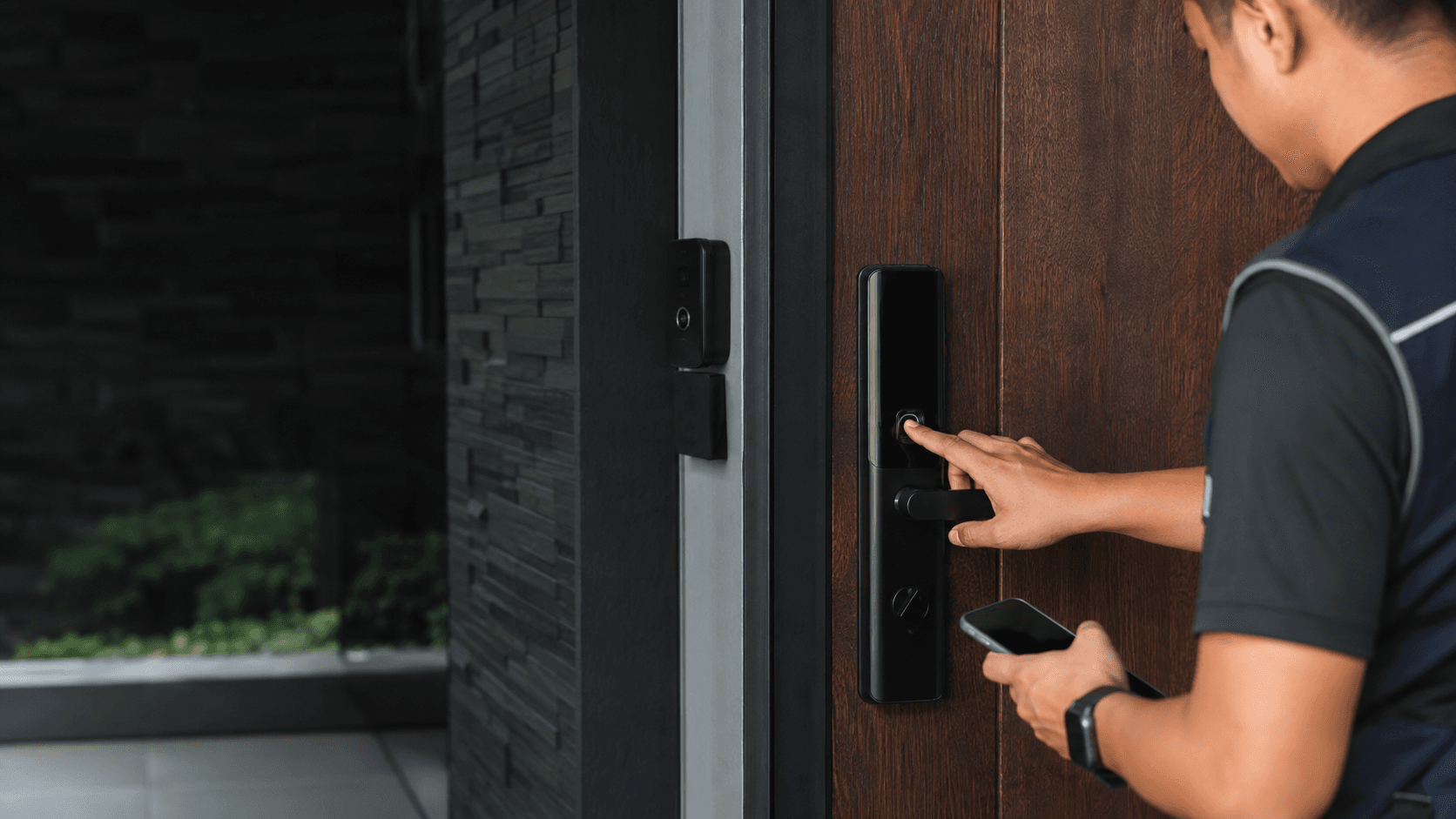
The term covers a wide range of hardware. A basic keypad deadbolt stores a few codes and opens with a turn of the thumbturn. A connected smart lock adds app control, schedules and audit trails. A commercial access-control panel moves the decision-making off the door entirely and into a controller that manages many openings at once. All three are sold as number locks, and all three behave differently on the same door.
Eyonic Sdn Bhd supplies and installs security and extra-low-voltage systems in Sarawak, including smart lock door access, and treats a front door number lock as one part of a wider entry plan rather than a standalone gadget. The company's own product guidance notes that smart locks work best when door condition, user roles and backup method are reviewed before installation, and that business sites often need a check on whether a standalone smart lock or an access-control panel is the better fit.
Front Door Number Lock. What Buyers Compare
Most buying decisions come down to five practical questions rather than brand preference. The answers depend on the door, the people who use it, and what happens when the power or the network fails.
- Door condition and thickness. The door must be solid enough to carry the lock body, and the existing bore holes must match the new hardware or be re-drilled cleanly.
- Hardware compatibility. The lock has to suit the door type, the existing deadbolt or lever, and the frame's strike position.
- Who needs entry and at what level. A household needs a handful of codes; a shop or office needs separate permissions for staff, cleaners, contractors and visitors.
- Power source and battery expectations. Battery-powered locks need a replacement routine; mains-powered or panel-driven locks need a power route to the door.
- Backup entry method. Every number lock needs a documented way in when the code fails, the battery dies or the app is unavailable.
Those five checks apply whether the door belongs to a terrace house in Kuching or a shop lot with staff arriving at different hours. Skipping any one of them usually shows up later as a lock that works but does not fit the routine.
Standalone lock or access-control panel
A standalone front door number lock is the simpler choice when one door needs controlled convenience and the people using it are known. An access-control panel makes more sense when several doors, gates or rooms need to share one set of rules, or when entry records matter for a business. Eyonic's own review guidance draws the line in roughly the same place: for business use, the check is whether a standalone smart lock or an access-control panel is more appropriate.
How a Number Lock for a Door Works
A number lock for a door works by comparing an entered code against codes stored in the lock or in a connected controller. If the code matches an active credential, the lock releases the bolt or latch for a short window and then re-secures itself.
The mechanics differ by type. A self-contained keypad lock holds its own code list and drives its own motor or clutch. A connected smart lock holds the code list but also reports events to an app and accepts schedule changes. A panel-driven lock holds almost nothing on the door; the reader sends the credential to the controller, and the controller decides whether to release the strike.
That difference matters for maintenance. Self-contained locks are simple to swap but hard to audit. Panel-driven locks are easier to manage across many doors but depend on wiring, a controller and a working network path. A front door number lock on a single home entrance rarely needs the panel approach; a front door number lock on a staff entrance with shift changes often does.
Keyless entry is not the same as keyless operation
Keyless entry describes how a person gets in, not how the lock is powered or managed. A lock can offer keyless entry through a PIN code while still relying on batteries, a mechanical key override, or a mobile app for administration. Buyers who assume keyless entry means no key at all are often surprised by the override cylinder, which is usually a deliberate design choice rather than a shortcoming.
Door Condition and Hardware Compatibility
Door condition decides whether a number lock can be fitted at all, and how much preparation the job needs. A solid timber door with an existing deadbolt bore is usually straightforward. A hollow or lightweight door, a glass door, or a metal gate needs a different approach and sometimes a different product category.
Compatibility is not only about the lock body. The strike plate, the frame's alignment, the door's swing clearance and the thickness of the leaf all affect whether the bolt seats properly. A lock that fits the cutout but leaves the bolt short of the strike will not secure the door, no matter how well the keypad works.
Eyonic's installation process for its security work begins with a site survey and a system proposal before any fitting, which is the same sequence that suits a front door number lock: confirm the door and the frame first, then choose the hardware. The company's project work for the Kuching Immigration Office focused on arrival flow, staff areas, visitor movement and dependable daily operation, which is the kind of brief where door-by-door checks matter more than a single product pick.
What to check before ordering hardware
Measure the door thickness, note the backset distance from the door edge to the centre of the bore hole, and photograph the existing hardware and frame. Confirm whether the door is left- or right-handed and whether it opens inward or outward. These details decide which locks are even candidates, and they are far cheaper to gather before purchase than after.
User Roles Codes and Backup Entry
Code management is where a front door number lock either earns its place or becomes a nuisance. A home with four regular users needs very little structure. A business with rotating staff, delivery access and occasional contractors needs a plan for who holds which code and when it stops working.
Most locks support some form of user permissions, whether that means a permanent code, a temporary code with an expiry, or a one-time code for a visitor. The practical question is not how many codes a lock can store but how easily a code can be removed when someone leaves. A code that cannot be revoked quickly is a weak point regardless of the hardware's other features.
Backup entry deserves the same attention. Common options include a mechanical key override, a temporary power source applied to external contacts, or a second credential type such as a card or fingerprint. The right choice depends on who is locked out and how quickly help can arrive. For a family home, a key kept with a trusted neighbour may be enough. For a business, a documented override procedure and a named person who can act on it is the safer arrangement.
Codes permissions and shared entrances
Shared entrances need clearer rules than private ones. If several tenants, departments or family units use the same front door, each group should have its own credential so that a single departure does not force a full reissue. This is also where a panel-based system starts to look attractive, because permissions live in one place instead of being edited door by door.
Power Source and Daily Reliability
Power source shapes the daily experience more than most buyers expect. Battery-powered locks avoid wiring but introduce a replacement routine and a low-battery warning that has to be noticed. Mains-powered locks remove the battery task but need a supply route to the door, which may mean chasing walls or running conduit. Panel-driven locks sit somewhere between: the door hardware may be low-power, but the controller and network need their own supply and protection.
Reliability also depends on the environment. Doors exposed to rain, direct sun or coastal air face different conditions from an internal office door, and the lock's housing and finish have to suit that exposure. Eyonic's own product review guidance makes a comparable point about placement decisions for cameras: actual site conditions should be checked before confirming a position rather than assumed from a specification sheet. The same discipline applies to a front door number lock, where the door's exposure and traffic decide how much maintenance the hardware will need.
Network dependence is the other reliability question. A lock that relies on Wi-Fi or a mobile app for everyday entry will behave differently during an outage than a lock that verifies codes locally. Neither approach is wrong, but the choice should match how much disruption the entrance can tolerate.
Battery wiring and outage behaviour
Ask what happens at the moment power or connectivity fails. A lock with local code verification and a mechanical override keeps working. A lock that depends on a live connection may not. For a main entrance used every day, that single question often settles the shortlist faster than any feature comparison.
Installation and Handover Checks
Installation quality decides whether a good lock performs well. The lock body must sit flush, the bolt must engage the strike fully, and the door must close without being forced. A misaligned strike or a binding bolt will wear the mechanism and frustrate users long before the electronics fail.
Handover matters just as much. Someone on site should know how to add a code, remove a code, replace the battery or power source, and use the backup entry method. Eyonic's installation work follows a survey, proposal, installation and handover sequence, and the handover step is where those operating basics are transferred rather than left in a manual.
For larger sites, the handover should also cover who owns the code list and how changes are requested. Eyonic's project work for KTA Sarawak Sdn Bhd centred on staff movement, visitor handling, tidy cabling and clearer daily site control, which reflects the same principle: the system is only as useful as the routine built around it.
Testing before the installer leaves
Test every credential, not just the primary code. Confirm the bolt engages with the door closed and locked, check the low-battery or power warning, and run the backup entry method once so that it is known to work. A front door number lock that has never had its override tested is an untested lock.
Readers weighing a number lock against a wider entry setup can share the location, property type and required system with Eyonic on WhatsApp at +60 11-5111 7959 for the next practical step.