
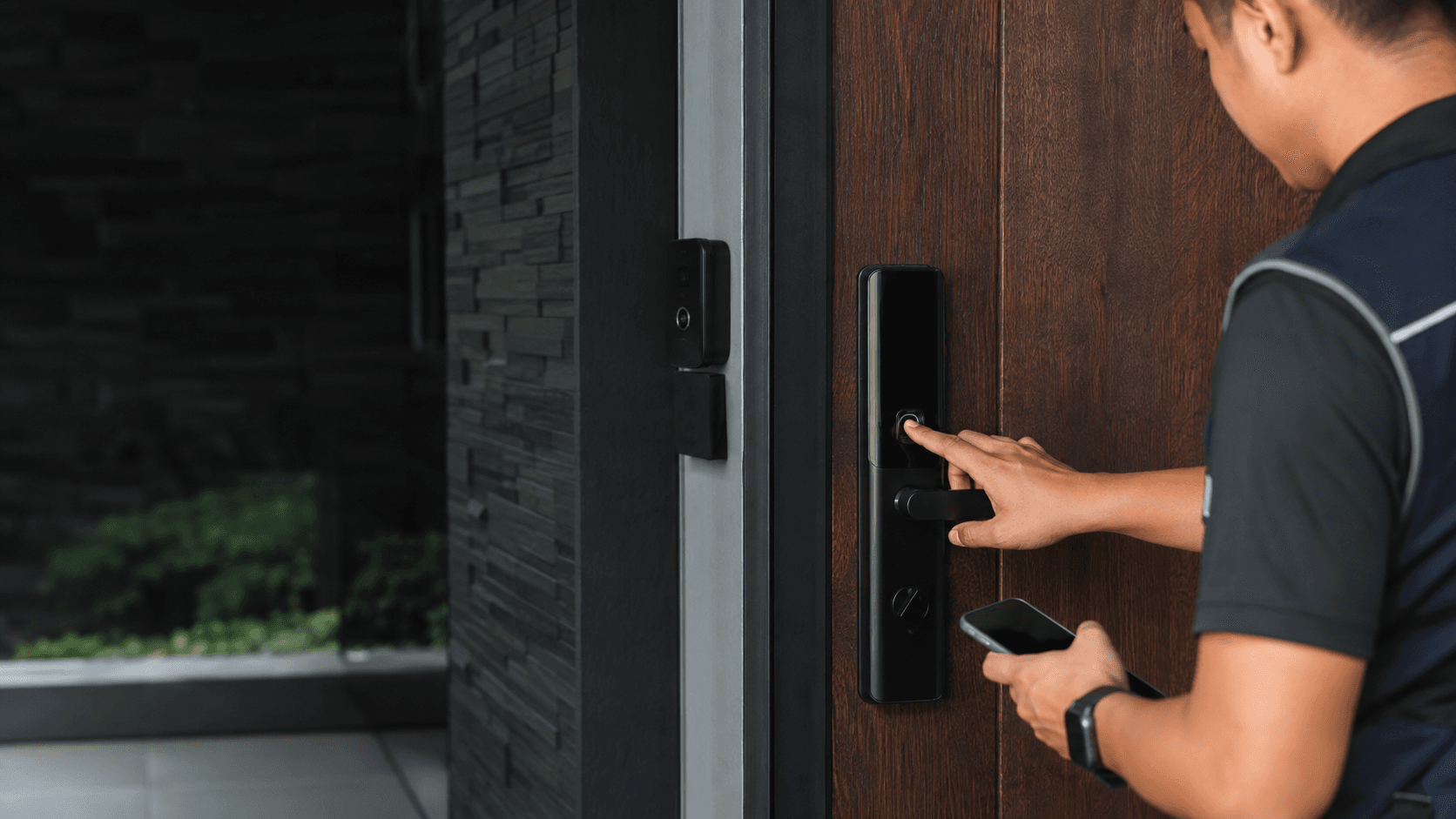
Yamiry sells several distinct lock families rather than one product, and the model names matter because the hardware shape, the access methods and the app pairing differ between them. The YR01 is a handle-style lock with a keypad and fingerprint reader. The T1B and T15B are deadbolt-style locks. The H1B is a handle lock, and Yamiry also lists a separate WiFi gateway that works across its smart locks for remote control.
Malaysian buyers searching for a yamiry smart lock are usually weighing three things at once: whether the lock fits the existing door, who needs daily access, and what happens when the battery or the phone fails. Those three questions decide more of the outcome than the brand name does.
What a Yamiry Smart Lock covers across models
Yamiry's own collection page groups its products into deadbolt locks, handle locks, and gateways. The deadbolt models listed are the T1B and T15B. The handle models include the H1B in black and the YR01 handle lock with keypad. A separate Yamiry Gateway, model G2, is listed as working with all Yamiry smart locks for remote control.
The support page adds more model names: H1B, YR01, YR02, YR04, YR05, YR06, T18, and H1B-PRO, plus two gateway variants — one for the TTLock app and one for the Nice Digi app. That split matters. A Yamiry Smart Lock paired through one app ecosystem is not automatically managed through the other, so the app in use should be confirmed against the specific model before purchase.
Because Yamiry lists models across two app ecosystems and multiple hardware shapes, the practical first step is identifying the exact model rather than treating "Yamiry smart lock" as a single specification.
Yamiry Smart Lock access methods and app control
Yamiry's product listings describe a 4-in-1 access set on at least one model: smartphone, codes, IC cards, and backup keys. The YR01 listing names fingerprint, Bluetooth, keypad and app access. Across the range, the recurring access methods are fingerprint recognition, keypad codes, app control, and a physical backup key.
App control splits into two modes. Bluetooth access works locally, with the phone near the lock. Remote control — unlocking or checking status while away from the property — depends on the WiFi gateway, which Yamiry sells separately and lists as compatible with Alexa and Google Home on the G2 model.
The gateway is the part most often overlooked. A lock without a gateway still supports keypad, fingerprint and local app use, but remote access and remote user management are not available without it. For a Malaysian landlord managing a unit from another state, that distinction changes the whole setup.
Fingerprint, keypad and backup key in daily use
Fingerprint access suits regular users — family members, long-term staff, the person who opens the door every morning. Keypad codes suit people who should not hold a permanent credential: a cleaner, a contractor, a short-stay guest. A backup key covers the case where the battery is flat or the phone is lost, and it should be stored somewhere outside the property, not inside it.
Yamiry's own product copy describes the locks as suited to hosts, rental property management, and self-housing residents. That framing is consistent with how the access methods divide: permanent credentials for residents, temporary codes for everyone else.
Door, user role and backup checks before a Yamiry Smart Lock is installed
Smart locks work best when the door condition, user roles and backup method are reviewed before installation. That is the sequence Eyonic applies to smart lock door access work, and it applies equally to a Yamiry Smart Lock. For business premises, the same review determines whether a standalone smart lock or a full access-control panel is the better fit.
- Check the door itself. Confirm the door thickness, the existing bore hole, the handle position, and whether the door is left- or right-handed. Yamiry's handle-lock listings describe a reversible handle, but the door still has to accept the lock body.
- Map the user roles. Decide who gets a fingerprint, who gets a permanent code, who gets a temporary code, and who gets nothing. Write this down before installation rather than adding users ad hoc afterwards.
- Choose the backup entry method. A physical backup key is the baseline. Confirm where it will be kept and who can reach it. If the property is a rental, the backup key should not sit inside the unit.
- Test at handover. Walk through every access method with the people who will use them, confirm the app is paired to the correct lock, and verify that temporary codes expire as intended.
The door check is the one that most often stops an installation. A deadbolt model and a handle model need different preparation, and a door that has been modified before may not accept either without additional work.
Yamiry Smart Lock in homes, offices and rental properties
In a home, the value is convenience and the removal of key duplication. A household with several family members can issue fingerprints instead of cutting keys, and revoke access by deleting a credential rather than changing a lock.
In an office, the calculation shifts. A single door with a handful of staff can run on a standalone smart lock. Once there are multiple doors, shift patterns, or a need to see who entered and when, a standalone lock becomes a weak substitute for an access-control system. Eyonic's own review of smart lock door access notes that for business use it usually checks whether a standalone smart lock or an access-control panel is more appropriate — the answer depends on how many doors and how many roles are involved.
In a rental property, the lock earns its place through turnover. Temporary codes can be issued for a stay and expire afterwards, which removes the handover of physical keys. The constraint is the gateway. without it, codes have to be set at the door, which defeats the purpose for a landlord managing remotely.
Eyonic's project work in Sarawak has followed the same pattern of matching hardware to how a building is actually used. At the Kuching Immigration Office, the focus was arrival flow, staff areas, visitor movement and dependable daily operation. At KTA Sarawak Sdn Bhd, the requirement was a practical office setup supporting staff movement, visitor handling and tidy cabling. Neither project was solved by hardware choice alone.
Costs, handover and the next practical step
Yamiry's own collection page lists lock prices in US dollars, and no verified Malaysian retail pricing for Yamiry Smart Lock models is available in the evidence reviewed here. Any local price should be confirmed with the seller at the point of purchase, along with whether the WiFi gateway is included or sold separately — the gateway is listed as a separate product.
Installation cost depends on the door. A door that already has a suitable bore hole is a straightforward swap. A door that needs modification, or a metal or glass door, is a different job. Eyonic's installation process for its security systems runs through site survey, system proposal, installation, and handover, and the survey stage is where door condition and user roles get settled.
For a property in Sarawak, Eyonic supplies and installs security systems including smart locks, and can advise on whether a standalone lock or a wider access-control setup fits the site. Share the location, property type and required system on WhatsApp at +60 11-5111 7959.
Two limits are worth stating plainly. No verified battery life, door thickness range, IP rating or wireless protocol figures for Yamiry Smart Lock models were available for this article, so those specifications should be confirmed against the manufacturer's documentation for the exact model. And no verified warranty or support terms were available either, which makes the seller's terms part of the decision rather than an afterthought.