
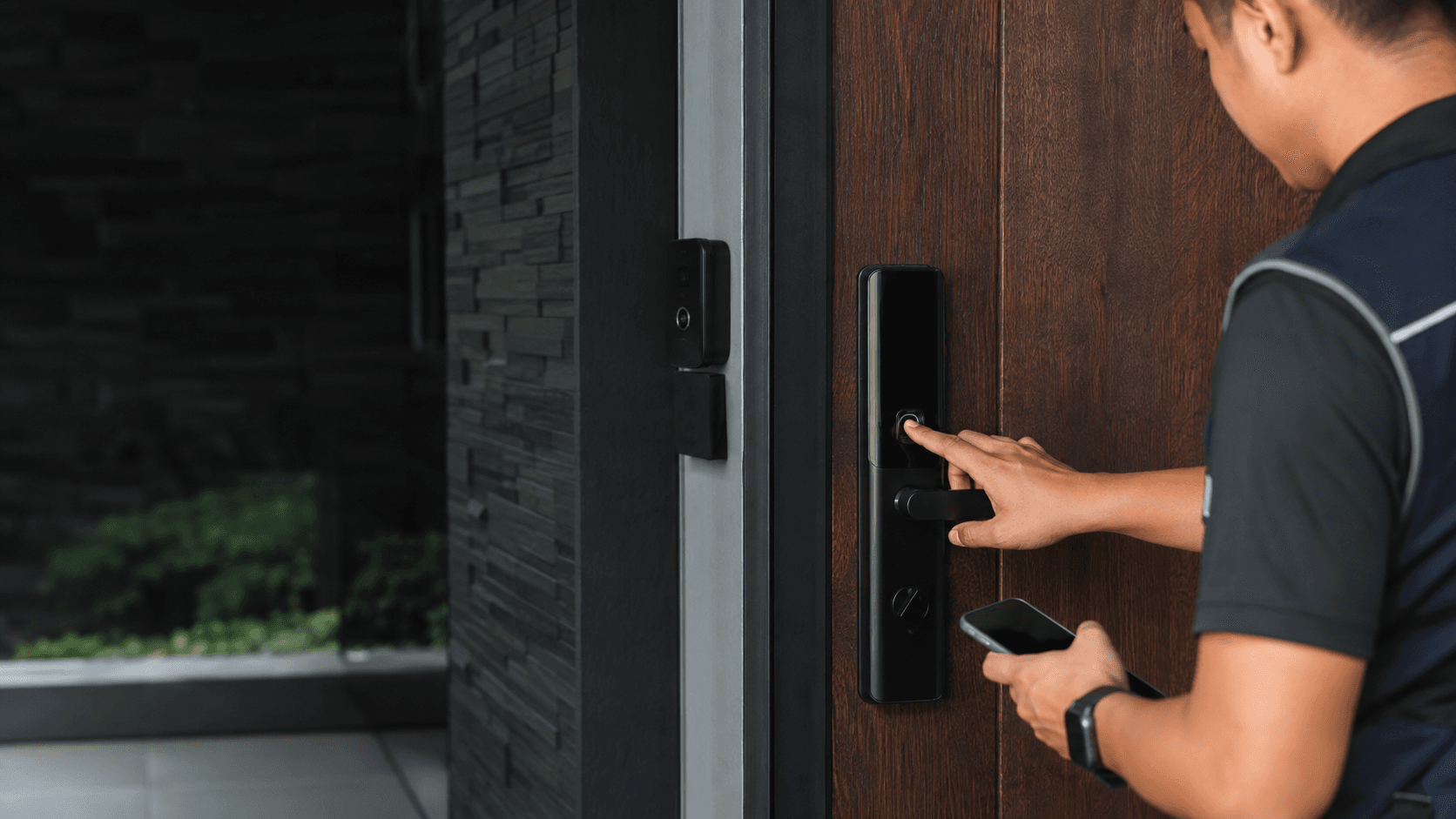
The exact-match query kwikset keyless lock describes a category rather than a single product. Kwikset publishes keyless entry locks, electronic deadbolts, and smart deadbolts as separate lines, and the differences between them matter more than the brand name on the box.
This article covers what a keyless deadbolt replaces, how keypad and touchscreen entry differ, what door and user conditions decide whether the lock suits a property, and how backup entry and battery planning keep a door usable when electronics fail. It also covers the checks that belong at handover.
What a Kwikset Keyless Lock Replaces
A conventional deadbolt is operated by a cut key that physically moves the bolt. A Kwikset Keyless Lock keeps the bolt but changes the credential: a code entered on a keypad or touchscreen authorises the same bolt movement, so the key is no longer the everyday entry method.
Kwikset's own keyless entry page describes electronic locks opened with a few button presses and locked with one touch. That is the core mechanical trade: the bolt hardware stays familiar, while the credential becomes something that can be shared, changed, or revoked without cutting metal.
Kwikset also publishes SmartKey re-keying guidance in its support material, which covers rotating a key and using a SmartKey tool to re-key a lock. Re-keying is a separate function from keyless entry. A lock can carry both, but the presence of one does not confirm the other on a specific model.
The practical consequence for a Malaysian property is that a lost key stops being the main risk. A shared code becomes the main risk instead, which is why code management and revocation matter as much as the lock hardware.
Keypad, Touchscreen and Smart Deadbolt Options
Kwikset's product structure separates three related ideas. Keyless entry covers code-based access. Electronic deadbolts cover the deadbolt form factor with digital entry. Smart deadbolts add connected features on top of electronic entry.
A keypad lock uses physical buttons. A touchscreen lock uses a lit surface instead. Kwikset's keyless entry pages reference SecureScreen technology and touchscreen security, and describe fingerprint code detection prevention as part of that touchscreen approach. The mechanism is straightforward: a touchscreen can obscure which digits were pressed, while worn physical buttons can reveal a frequently used code over time.
Smart deadbolts sit in a different bracket again. Kwikset's smart lock pages reference Home Connect Technology and describe wireless communication with other devices, plus control from a tablet, smartphone, or another internet-connected device. Those pages also reference Z-Wave and Zigbee as connection options.
The choice between the three is not about which is newer. A standalone keypad or touchscreen deadbolt needs no network, no hub, and no app account. A connected smart deadbolt adds remote locking, remote status, and integration with other systems, and in exchange it depends on a wireless protocol, a compatible controller, and stable power.
For a business door, the deciding question is usually whether access needs to be managed centrally or only at the door. Eyonic's smart lock door access review notes that for business use, the company usually checks whether a standalone smart lock or an access-control panel is more appropriate. That check applies to any keyless deadbolt, including a Kwikset Keyless Lock, because a single door lock and a managed access system solve different problems.
Door Condition and User Roles Before Installation
Door condition decides whether a keyless deadbolt fits at all. Bore diameter, backset, door thickness, and the alignment of the door within its frame all affect whether a deadbolt body seats correctly and whether the bolt extends and retracts without binding. A door that already carries a deadbolt is usually the simpler case, because the cutout exists.
Frame condition matters just as much. A deadbolt that throws into a misaligned strike plate will jam regardless of how the code is entered, and the electronics will be blamed for a mechanical problem. Warped doors, swollen timber, and loose hinges all show up as intermittent lock failures.
User roles decide the code plan. A household needs a small number of codes and a simple way to remove one when it is no longer needed. A shop, office, or rental needs a clearer split between permanent users, temporary users, and one-off visitors, plus a record of who held which code and when it was removed.
Eyonic's smart lock door access guidance states that smart locks work best when door condition, user roles, and backup method are reviewed before installation. Those three checks apply before any keyless deadbolt is fitted, and they are cheaper to resolve on paper than after drilling.
Access control also has a scope question. A single keyless deadbolt controls one door. A property with a main entrance, a staff entrance, and a store room needs either several independent locks or a coordinated system, and the two approaches differ in cost, administration, and how quickly a lost credential can be neutralised.
Backup Entry and Battery Planning
Every electronic lock has a failure mode. The two common ones are a depleted battery and a keypad or touchscreen that stops responding. Backup entry is the plan for both, and it should be decided before installation rather than after the first lockout.
Kwikset's support material covers key rotation and re-keying procedures, which implies a mechanical key path exists on the models that documentation covers. Whether a specific keyless model includes a backup key cylinder is a model-level detail, and it should be confirmed against that model's own documentation before purchase.
Battery planning is about who notices the warning and what happens next. A low-battery indication that nobody acts on becomes a lockout. For a rental or a shop, the person who changes the battery should be named, and a spare should be kept somewhere that does not require opening the door to reach.
There is also a power question for connected models. A smart deadbolt that depends on a wireless protocol and a controller adds two more failure points beyond the lock itself. A standalone keypad deadbolt removes those dependencies, which is why it remains a reasonable choice for a door that only needs code entry.
Eyonic's own installation process for its security work runs through site survey, system proposal, installation, and handover. The same sequence applies to a door lock: confirm the door and the user plan, agree what is being fitted, install, then test and hand over. Handover is where backup entry and battery responsibility should be demonstrated rather than described.
Kwikset Keyless Lock Installation and Handover Checks
Installation quality decides whether a keyless deadbolt performs. The checks below are the ones that catch most problems before they become callbacks, and they apply to a Kwikset Keyless Lock as much as to any other electronic deadbolt.
- Confirm door and frame condition, including bore size, backset, door thickness, hinge tightness, and strike plate alignment, before any hardware is fitted.
- Agree the user roles and code plan, covering permanent users, temporary users, and how a code is removed when someone leaves.
- Confirm the backup entry method for the specific model, and verify that the mechanical key path works before the lock is relied on.
- Set battery expectations, including who monitors the low-battery warning, where spares are kept, and how the door is opened if the keypad fails.
- Test the installed lock through a full cycle of locking, unlocking, code entry, and backup entry, then hand over the code plan and battery responsibility to a named person.
Two of those checks are frequently skipped. The first is the mechanical test of the backup key path, which is often assumed rather than performed. The second is naming the person responsible for the battery, which is the single most common reason a working lock becomes an unusable door.
For a property with several doors, the handover should also record which lock carries which code, so that removing one person's access does not require re-checking every door individually.
What to Confirm Before Buying
Model-level detail is where a keyless lock decision is actually made. Kwikset publishes keyless entry, electronic deadbolt, and smart deadbolt lines, and the features differ between them. Before purchase, the specific model's documentation should confirm whether it uses a keypad or touchscreen, whether it includes a backup key cylinder, what battery type it takes, and whether it connects to anything.
Local availability and pricing for a Kwikset Keyless Lock in Malaysia are not established by the sources behind this article, so those figures should come from a distributor or retailer at the point of purchase rather than from a general guide.
For a property that needs door access as part of a wider security setup, the lock is one component among several. Eyonic plans, supplies, and installs security systems for homes, offices, shops, and industrial sites in Sarawak, and its smart lock door access guidance covers the door condition, user role, and backup entry checks that precede a lock decision. Share the location, property type, and required system with Eyonic on WhatsApp at +60 11-5111 7959 for the next practical step.