
The choice is rarely about which camera looks best in a catalogue. It is about whether the provider can read a property, decide where cameras belong, run the cabling, configure recording and remote viewing, and hand the system over in a state the owner can actually operate.
That distinction matters in Malaysia because most pages ranking for home security camera companies are overseas product catalogues and review roundups. They list hardware and subscription tiers. They do not survey a house in Kuching, check where the afternoon sun lands, or explain what happens on handover day.
Home Security Camera Companies in Malaysia: What the Choice Involves
A supplier that only sells boxes leaves the hard decisions to the buyer. A provider that installs takes responsibility for the parts that determine whether footage is useful: where each camera points, how it is powered, where recordings are stored, and how the owner views them later.
Four capabilities separate the two.
- Site survey. The provider visits the property and assesses entry points, lighting, existing cabling, and where a recorder can live.
- System proposal. The provider sets out the camera positions, recording arrangement, and remote viewing setup before any work starts.
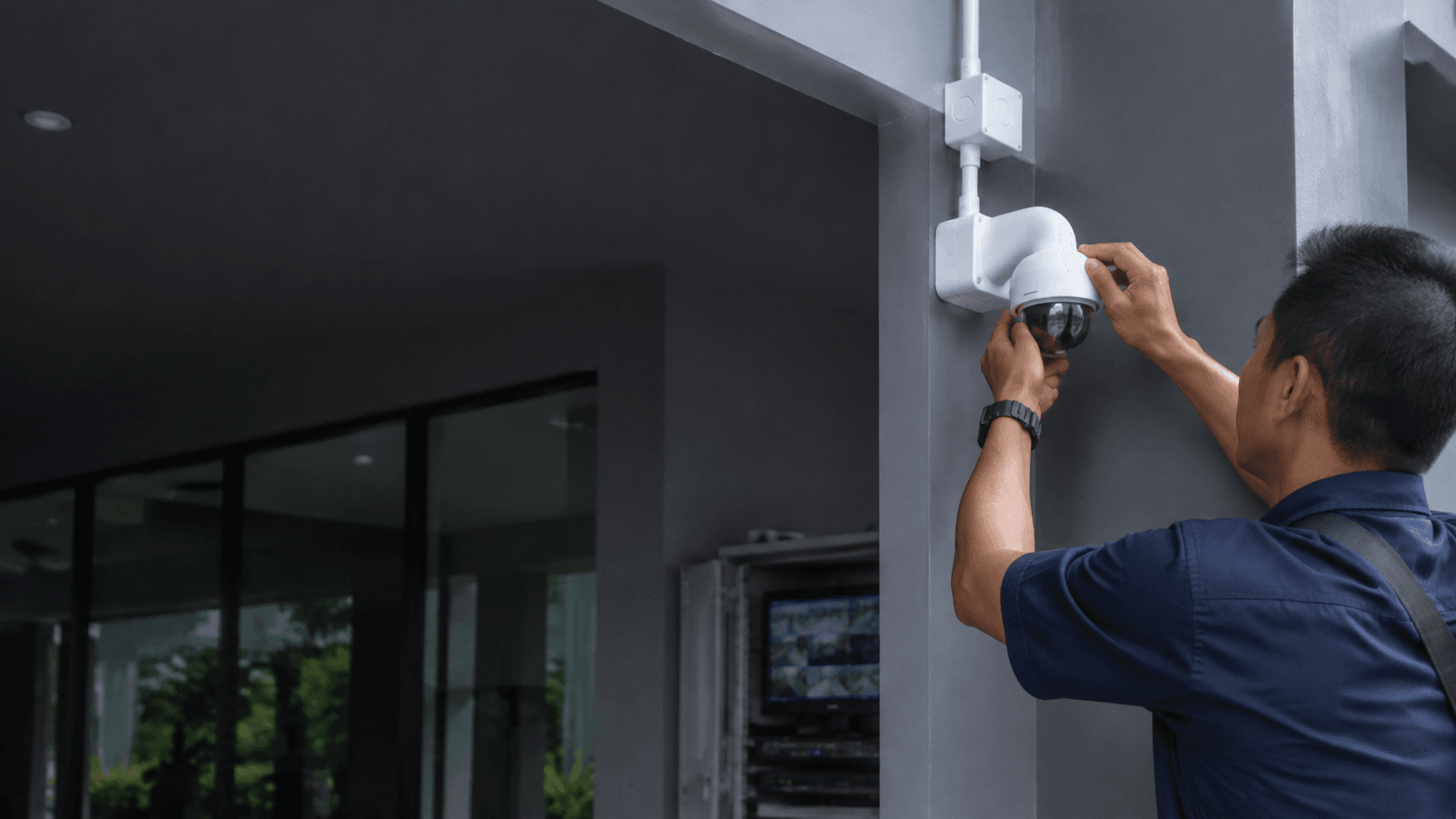
- Installation. Cameras are mounted, cabling is run, and the recorder and network settings are configured.
- Handover. The owner is shown how to view footage and operate the system, and the installation is closed out.
Eyonic documents this four-stage sequence for its CCTV installation work in Sarawak. The order matters because each stage constrains the next. A proposal written without a survey tends to over-supply cameras in easy positions and under-supply them at the awkward entry points that actually matter.
Why local capability changes the answer
Installation is physical work. It involves drilling, routing cable, mounting hardware at height, and testing a recorder on site. A provider based in the same region can return to adjust a camera angle or trace a fault. A provider shipping hardware from overseas cannot.
Eyonic is based in Sarawak and works on CCTV and extra-low-voltage systems for homes, offices, shops, and industrial sites. That scope is narrower than a national claim, and it is the honest boundary: the company's documented project work sits in Sarawak, including Kuching.
What a Local Provider Actually Delivers
The deliverable is a working system, not a carton of cameras. In practice that means planning, supply, and installation handled as one job, with camera placement, recording, and remote viewing configured together rather than assembled by the buyer afterwards.
Eyonic's stated service scope covers exactly that combination: plan, supply, and install monitoring systems with camera placement, recording, and remote viewing for homes, offices, shops, and industrial sites.
The difference shows up in the details that a hardware listing cannot address.
Camera placement decides what the footage is worth. A camera aimed at a blank wall records nothing useful. A camera aimed at a gate records every arrival.
NVR setup decides whether footage survives. The recorder, its storage, and its retention settings determine how far back the owner can look.
Remote viewing decides whether the system gets used. If the mobile view is not configured and demonstrated, the owner ends up checking the property in person anyway.
Public-sector work shows the same discipline at larger scale. Eyonic's Kuching Immigration Office project focused on arrival flow, staff areas, visitor movement, and dependable daily operation. Those are placement and coverage decisions, not product decisions.
Where a hardware-only purchase breaks down
Buying cameras directly is a reasonable path for a technically confident owner with a simple property. It becomes fragile when the property has multiple entry points, mixed indoor and outdoor coverage needs, or a requirement that recordings be retained and reviewable.
The failure is rarely the camera. It is the placement, the power and cabling route, the recorder configuration, or the fact that nobody tested remote access before the installer left.
How Camera Placement and Lighting Shape Results
Placement is the single decision that most affects whether a system performs. It is also the decision most often made from a catalogue photo rather than from the property itself.
Eyonic's guidance on ColorVu-style cameras is to check actual lighting conditions before confirming placement. That is a practical instruction, not a product claim. A position that looks correct on a floor plan can face a light source that washes out the image, or sit in shadow that the camera cannot resolve.
Three conditions drive the decision.
Light direction. A camera facing a strong light source at the time of day that matters most will produce poor footage at exactly that time. The survey should happen at a representative hour, not whenever is convenient.
Coverage overlap. Cameras that overlap slightly cover each other's blind spots. Cameras spaced evenly along a wall often leave gaps at the corners where entry is easiest.
Height and angle. Mounting height trades identification against coverage. Higher positions see more ground but capture faces at a less useful angle.
These are trade-offs, not rules. A small terrace house with one gate needs a different arrangement from a shop with a front counter, a rear loading area, and a staff entrance. The survey exists to resolve those differences before hardware is ordered.
Recording and remote viewing as placement constraints
Placement also depends on where the recorder can sit and how the network reaches it. A camera position that is ideal for coverage may be impractical for cabling. That tension is normal, and it is resolved during the survey and proposal stages rather than after installation begins.
What Installation and Handover Include
Installation ends when the owner can operate the system, not when the last camera is screwed to a wall. Handover is the stage that converts installed hardware into something the household or business actually uses.
For the Hikvision CCTV Package at RM 1,599, Eyonic lists camera supply and setup, basic recording configuration, and mobile viewing handover. Those three items map directly onto the questions that matter after installation: are the cameras in place, is anything being recorded, and can the owner see it from a phone.
The same structure appears in the other packages at the same price. The Hikvision Alarm System at RM 1,599 covers control panel and sensors, siren and zone setup, and user testing and handover. The Autogate Package at RM 1,599 covers motor recommendation, remote-control setup, and safety testing and handover.
Each package ends with handover because an untested system is an unknown system. Zone setup without user testing leaves the owner guessing which sensor triggered. Remote-control setup without safety testing leaves the gate operating on assumption.
What handover should cover
A useful handover answers operational questions rather than listing features. Which cameras exist and what each one covers. How to open the live view and find past footage. What to do when the recorder reports a problem. Who to contact and how.
Eyonic's documented contact channel is WhatsApp at +60 11-5111 7959. Sharing the property location, property type, and the system required gives the provider enough to respond usefully rather than asking for the same details twice.
Package Pricing and Project Budgets in Malaysia
Pricing in this category splits into two shapes: fixed packages for standard residential work, and project budgets for larger or more complex sites.
Eyonic publishes three packages at RM 1,599 each. The Hikvision CCTV Package covers camera supply and setup, basic recording configuration, and mobile viewing handover. The Hikvision Alarm System covers control panel and sensors, siren and zone setup, and user testing and handover. The Autogate Package covers motor recommendation, remote-control setup, and safety testing and handover.
Larger work is quoted as a project range rather than a package. Eyonic's Kuching Immigration Office project carries an approximate budget of RM 12,000 to RM 28,000. The KTA Sarawak Sdn Bhd project, a practical office setup in Kuching supporting staff movement, visitor handling, tidy cabling, and clearer daily site control, carries an approximate budget of RM 8,000 to RM 18,000.
Those two ranges are the documented figures. They are not a general price list, and they should not be read as a per-camera rate. Scope, camera count, cabling distance, and site conditions all move the number.
What drives a project above package pricing
Package pricing suits a defined, standard installation. Project pricing appears when the site has multiple zones, long cable runs, mixed indoor and outdoor coverage, or a requirement that the system support daily operations rather than just record.
The Kuching Immigration Office example illustrates the pattern. Arrival flow, staff areas, and visitor movement are three distinct coverage requirements in one building. That is a design problem before it is a hardware problem, and it is why the budget range is wider than a package price.
Comparing providers on more than price
A lower quote that omits the survey, the recording configuration, or the handover is not cheaper. It moves work back to the buyer. The comparison that matters is what the provider commits to completing, and whether that includes the stages that make the system usable.
Questions to Settle Before Contacting a Provider
Arriving with clear answers shortens the survey and produces a more accurate proposal. The provider can then spend the visit confirming conditions rather than gathering basics.
What needs covering? Gates, doors, driveways, counters, loading areas, and any point where entry is possible. A list of entry points is more useful than a camera count.
Where can a recorder live? It needs power, ventilation, and a position that is not trivially accessible to anyone on site.
How will footage be viewed? Phone, office desktop, or both. Remote viewing configuration depends on the answer.
How far back should footage go? Retention requirements shape storage, and storage shapes the recorder specification.
Is the property residential or commercial? Homes, offices, shops, and industrial sites have different coverage priorities and different tolerance for visible cabling.
What is the realistic budget shape? A standard installation fits a package price. A multi-zone site fits a project range.
Eyonic's founder Eric Yong has worked in the industry for more than ten years, with experience in technical installation of digital security solutions for commercial businesses in Sarawak. That background is relevant to the survey stage, where placement decisions are made.
For readers comparing home security camera companies in Malaysia, the practical filter is straightforward. Ask what the provider does at survey, what the proposal contains, what installation covers, and what handover includes. A provider that answers all four is installing a system. A provider that answers only the third is selling hardware.
The same filter applies when the search starts from a product name rather than a service. Someone looking for home security camera companies near Kuching is usually trying to find out who will do the work, not who stocks the box.