
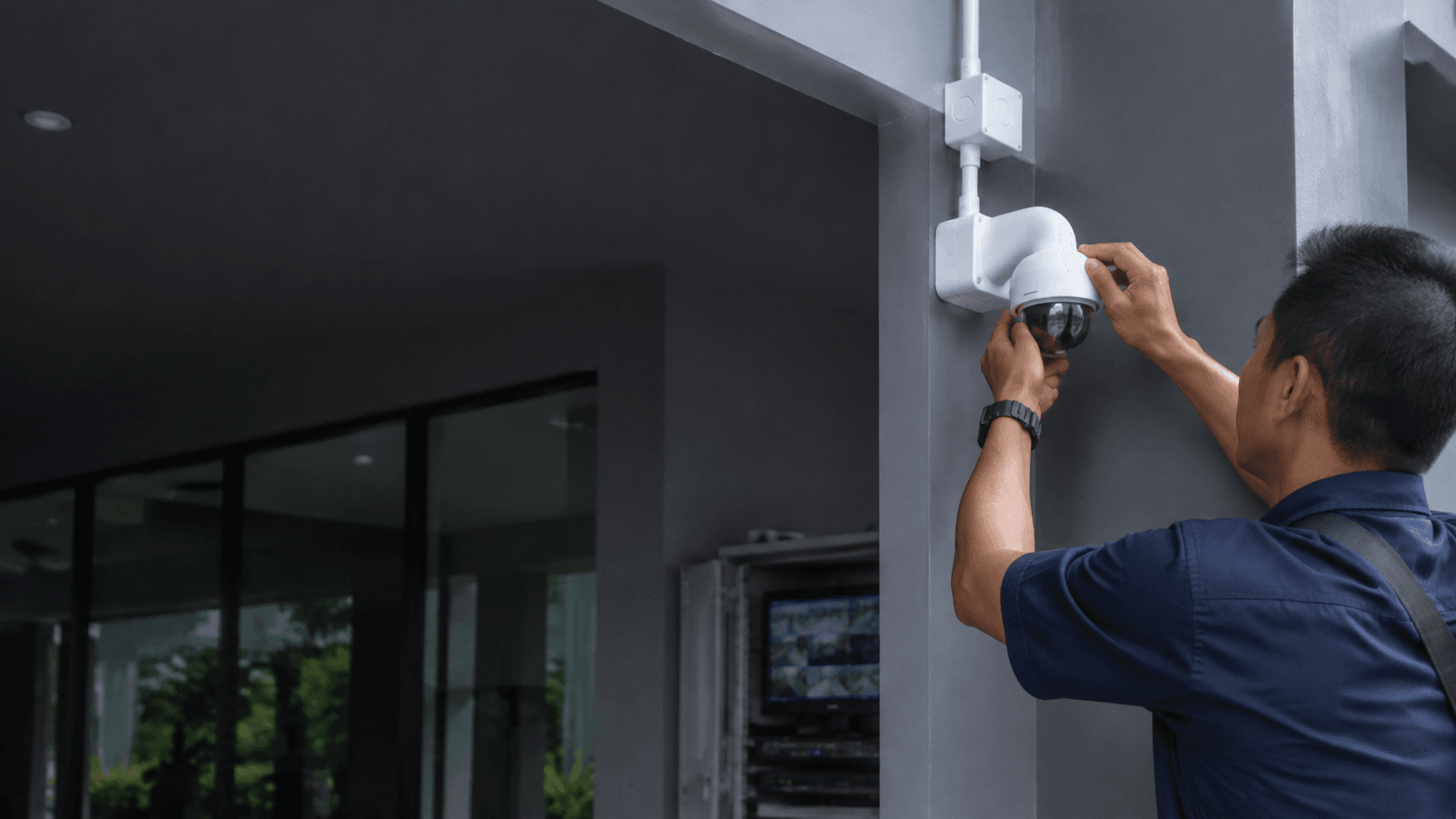
Most buyers in Malaysia search for eufy security solocam s40 expecting a simple answer about whether a solar camera works here. The honest answer is that it depends less on the camera and more on where it goes. A shaded wall, a roof overhang, or a mounting point far from the router will all change how the unit behaves day to day.
This page covers what to check before mounting, how solar charging interacts with Malaysian weather, how the camera compares with wired options, and how a survey and installation can be handled locally in Sarawak.
Eufy Security Solocam S40 placement and sunlight
Solar charging is the single biggest variable. A panel that faces open sky for most of the day will keep the battery topped up far more reliably than one that catches only a few hours of angled light. Shading from trees, neighbouring buildings, or a deep roof eave reduces charging time, and that shortfall shows up as more frequent manual charging.
Eyonic recommends checking actual lighting conditions before confirming placement for cameras that depend on available light. The same principle applies here. observe the intended mounting spot at several points during the day rather than judging it from a single glance.
Rain, haze, and heavy cloud cover all reduce solar yield. In Sarawak, the wet season brings longer stretches of diffuse light, so a panel that performs well in a dry month may struggle in a wet one. Positioning the panel to face the strongest consistent sun, and avoiding surfaces that stay wet or collect debris, reduces that risk.
Height and angle
Mounting height affects both security and charging. A camera placed high enough to be out of easy reach is harder to tamper with, but a steep downward angle can shade the panel or point it away from the sun. The practical compromise is a position that keeps the lens covering the target area while leaving the panel exposed.
Angle also affects what the camera records. A camera aimed too low captures mostly ground; aimed too high it misses the approach path. The useful reference is the actual movement being monitored, such as a gate, a driveway, or a side entrance.
What the Eufy Security Solocam S40 needs before installation
Before any mounting work, four things need confirming. Skipping them is the most common reason a solar camera underperforms after installation.
- Confirm Wi-Fi signal strength at the exact mounting point, not just inside the house.
- Observe sunlight on that spot across a full day, including morning and late afternoon.
- Choose a height that keeps the camera out of easy reach while leaving the panel exposed.
- Decide where recordings will be stored and confirm that storage is set up before handover.
Wi-Fi reach is often underestimated. A camera mounted on an outer wall, a gate pillar, or a detached structure may sit at the edge of coverage even when the signal looks strong indoors. Testing at the mounting point avoids a situation where the camera records locally but cannot be viewed remotely.
Storage decisions matter too. Whether footage is kept on the device or on separate storage changes how long recordings are retained and how they are reviewed after an incident. That choice is best made before installation rather than after.
Power and charging expectations
A solar camera is not maintenance-free. Even with good sun exposure, the battery will need occasional attention, and a run of cloudy days can draw it down. Buyers who expect to never touch the unit are often the ones most disappointed.
The realistic expectation is that a well-placed unit stays charged through normal conditions and needs manual charging only during extended poor weather or if the panel is partly shaded. That is a placement outcome, not a product flaw.
Comparing the Eufy Security Solocam S40 with wired camera options
The choice between a solar camera and a wired one usually comes down to whether power and cabling can reach the mounting point.
| Consideration | Eufy Security Solocam S40 | Wired camera |
|---|---|---|
| Power source | Built-in solar panel and battery | Mains power |
| Cabling needed | None for power | Power and video cabling to the mounting point |
| Best suited to | Spots where running power is difficult or disruptive | Spots where power and cabling can be routed cleanly |
Wired cameras avoid charging concerns entirely because they draw continuous power. The trade-off is installation work: cabling has to be routed, which may mean drilling, conduit, or lifting floor and wall finishes. On a finished building, that disruption is often the deciding factor.
Solar cameras suit locations where cabling is impractical, such as a distant gate, a temporary structure, or a wall where routing power would be costly. The cost is that charging becomes a variable the owner has to manage.
For sites where both are viable, the deciding questions are usually how stable the power supply is, how much installation disruption is acceptable, and how much ongoing attention the owner is willing to give the camera.
Where the Eufy Security Solocam S40 fits in a Sarawak property
Sarawak properties vary widely in how much open sky a mounting point receives. A detached house with an exposed perimeter wall offers very different conditions from a shophouse with a deep five-foot way or a covered car porch.
Exposed positions, such as a gate pillar or a free-standing wall, tend to charge well because nothing blocks the sun. Covered positions, such as under a wide eave or inside a porch, charge poorly and are better served by a wired camera or a different mounting point.
Eyonic's completed work in Sarawak includes the Kuching Immigration Office project, which focused on arrival flow, staff areas, visitor movement, and dependable daily operation. That kind of site shows how placement decisions follow the movement being monitored rather than a fixed rule about camera height or angle.
For residential and commercial sites in Kuching and across Sarawak, the practical question is whether the location that needs coverage also receives enough sun. When those two requirements conflict, the coverage requirement usually wins and a wired camera becomes the better fit.
Getting the surveyed and installed
A site survey resolves the questions that cannot be answered from a product page. It confirms Wi-Fi reach at the mounting point, checks sunlight across the day, identifies the height and angle that cover the target area, and settles where recordings will be stored.
Eyonic's CCTV installation process includes site survey, system proposal, installation, and handover. That sequence matters for solar cameras because the survey determines whether the chosen position will actually keep the unit charged, and the handover confirms that remote viewing and storage are working before the installer leaves.
For buyers who would rather not self-install, having the survey and mounting handled locally removes the guesswork around placement. It also means the charging behaviour can be checked against real conditions rather than assumptions.
Where a solar camera is not the right fit, a wired option can be proposed instead. Eyonic's Hikvision CCTV package covers camera supply and setup, basic recording configuration, and mobile viewing handover at RM 1,599, which gives a comparison point for sites where cabling is practical.
Share your location, property type and required system with Eyonic on WhatsApp at +60 11-5111 7959 for the next practical step.