
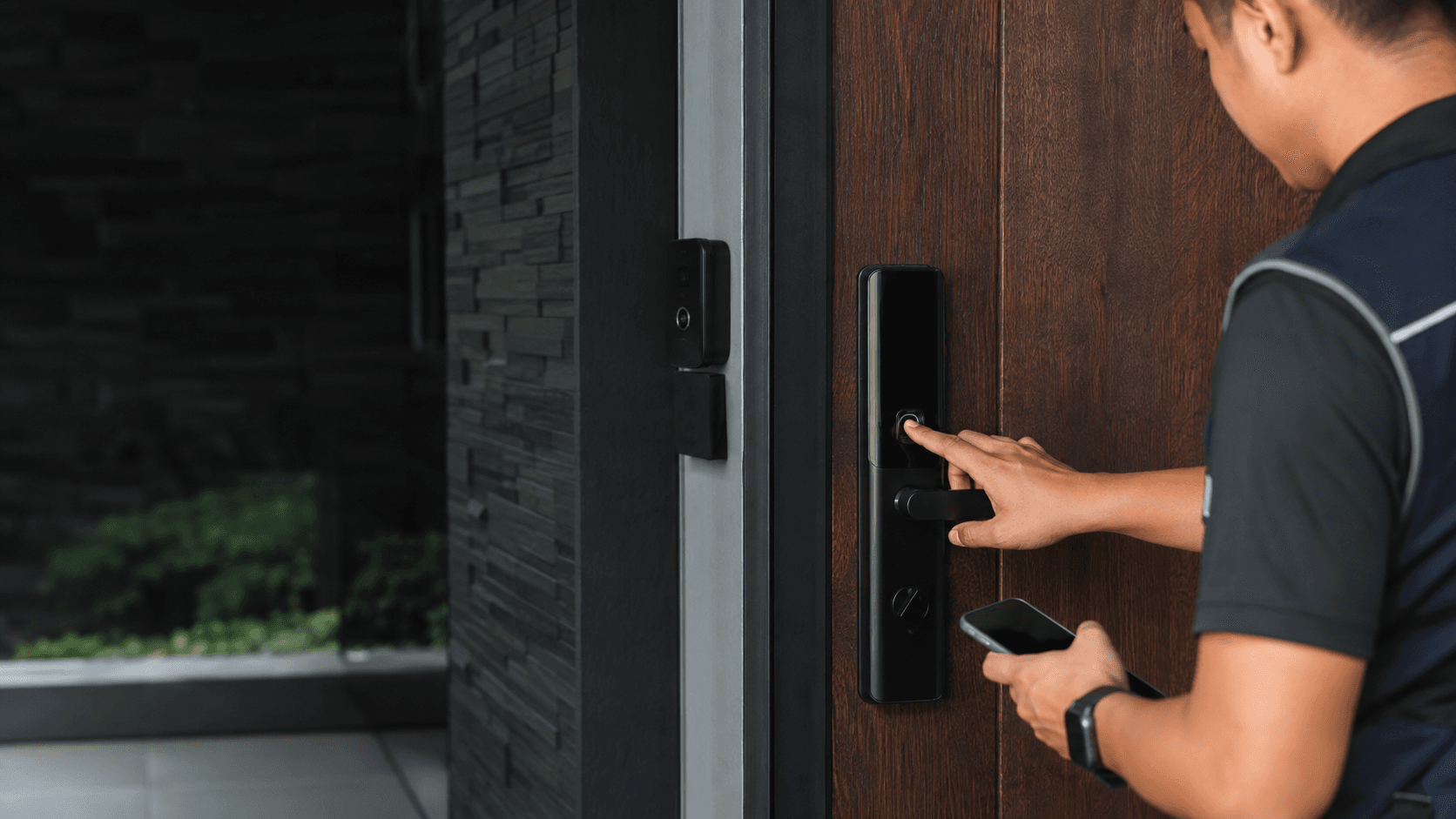
The exact-match query godrej digital door lock price returns retail listings from India and marketplace catalogue pages, and none of the nine pages analysed for this topic used the query once. That matters because a Malaysian buyer searching for a figure usually meets a rupee price, a product title, and an add-to-cart button rather than an explanation of what the number includes.
What follows is a structural answer. It explains which variables move a quoted figure, which checks belong before a purchase decision, and where a unit-only price stops being useful. No RM figure is attached to any Godrej model here, because no approved source supplies one.
What the Godrej Digital Door Lock Price Usually Covers
A quoted figure can mean three different things, and the difference is often larger than the difference between two lock models.
A unit-only price covers the lock hardware and its packaging. A supply-and-install price adds labour, door preparation, and the handover that leaves the lock working with the intended credentials. A project price adds whatever the surrounding system needs, such as a separate access control panel, power provision, or integration with existing monitoring.
Eyonic's published installation process runs through site survey, system proposal, installation, and handover, and that sequence is the clearest available guide to what a complete figure contains. A number quoted before a survey is a hardware estimate, not an installed cost.
Two practical consequences follow. First, comparing a unit price against an installed price is not a comparison at all. Second, a figure that excludes door preparation will usually grow once the door is inspected, because mortise locks, rim locks, and glass or metal doors each demand different work.
Why no RM figure appears on this page
Godrej pricing published online sits on Indian retail and marketplace pages, and those listings carry no Malaysian validity. Imported hardware also attracts duties, freight, and distributor margins that a foreign list price cannot represent. Rather than convert a rupee figure into ringgit and present it as a local price, the honest position is that the Malaysian figure is confirmed per property.
Door Condition and Access Method
The door decides more of the cost than the lock model does. A solid timber door with an existing mortise cut accepts a replacement lock with modest preparation. A metal gate, a glass panel, or a door with an unusual thickness may need additional fabrication, spacers, or a different lock format entirely.
Access method is the second variable. A PIN-only lock carries fewer components than a unit combining fingerprint, card, PIN, and mechanical key override. Each added credential type adds hardware and adds configuration time at handover.
Eyonic's own product guidance notes that smart locks work best when door condition, user roles, and backup method are reviewed before installation, and that for business use the choice between a standalone smart lock and an access control panel is usually checked first. That check is the point at which a residential figure and a commercial figure diverge.
Where a standalone lock stops being the right answer
A single door with a handful of regular users suits a standalone lock. A site with shift changes, visitor access, or a need to review who entered and when usually needs an access control panel instead, because a standalone lock stores its own records and does not report to a central system. Choosing the lock first and discovering this later is an expensive sequence.
User Roles, Backup Entry and Daily Use
User count shapes configuration time rather than hardware cost. A household with four regular users needs a short setup. An office with rotating staff, temporary codes, and revoked access needs an administrative routine that someone owns after handover.
Backup entry is the constraint that decides whether a lock is acceptable at all. Every digital lock needs a route in when the battery is flat or a credential fails. That route may be a mechanical key, an external power point, or a second entrance. If the property has only one door and no keyed override, the backup method must be settled before purchase, not after.
Daily use then tests the choice. A lock that requires a phone app for every entry behaves differently from one that opens with a fingerprint in under a second, and the difference shows up in how often the mechanical override gets used.
Business use and the access control question
For commercial premises, the relevant comparison is not between two lock models but between a lock and a panel. Eyonic's review material frames that decision around user permissions and backup entry, which are the two areas where a standalone lock most often falls short on a working site.
How to Compare a Before Buying
Comparison only works when both figures describe the same scope. The checks below are the ones that change a quoted number, and each should be answered before a figure is treated as final.
- Confirm the door type, thickness, and existing cut-out, since preparation work varies by door and is often excluded from a unit price.
- Decide the access method, because each added credential type increases both hardware and configuration time.
- Count the users and the roles, including how access is revoked when someone leaves.
- Agree the backup entry method for a flat battery or failed credential, and confirm it works on the actual door.
- Establish whether the scope is supply only, supply and install, or supply, install and integrate with existing systems.
- Confirm what handover includes, such as credential setup, a test of every entry method, and a walkthrough of the administrative routine.
Two further checks belong alongside that list. Ask whether the quoted model is actually available in Malaysia through the supplier being used, because a model listed on a foreign retail site may not be stocked locally. Ask also whether the lock is expected to work with existing monitoring or access equipment, since that requirement changes the specification rather than the price alone.
Reading a quotation
A useful quotation separates hardware, labour, and any integration work. A single lump figure hides which part is negotiable and which part is fixed. Where a supplier cannot separate them, the scope is usually not yet defined well enough to price.
Confirming a for a Property
Confirmation happens at the door. A survey establishes the door condition, the access method, the user roles, and the backup route, and those four answers produce a figure that holds. Eyonic's published process places the site survey before the system proposal for exactly this reason, and the same order applies to lock work.
Eyonic has completed security work for the Kuching Immigration Office, covering arrival flow, staff areas, visitor movement, and dependable daily operation, and for KTA Sarawak Sdn Bhd, covering staff movement, visitor handling, and tidy cabling. Both projects illustrate the same principle: the specification follows the movement pattern of the site, not the product catalogue.
For a residential door, the survey is short. For a commercial entrance, it should also cover how the lock relates to any existing access control or camera system, because a lock that cannot be tied into the wider setup may need replacing sooner than expected.
Share the location, property type, and required system with Eyonic on WhatsApp at +60 11-5111 7959 to arrange the next practical step.