
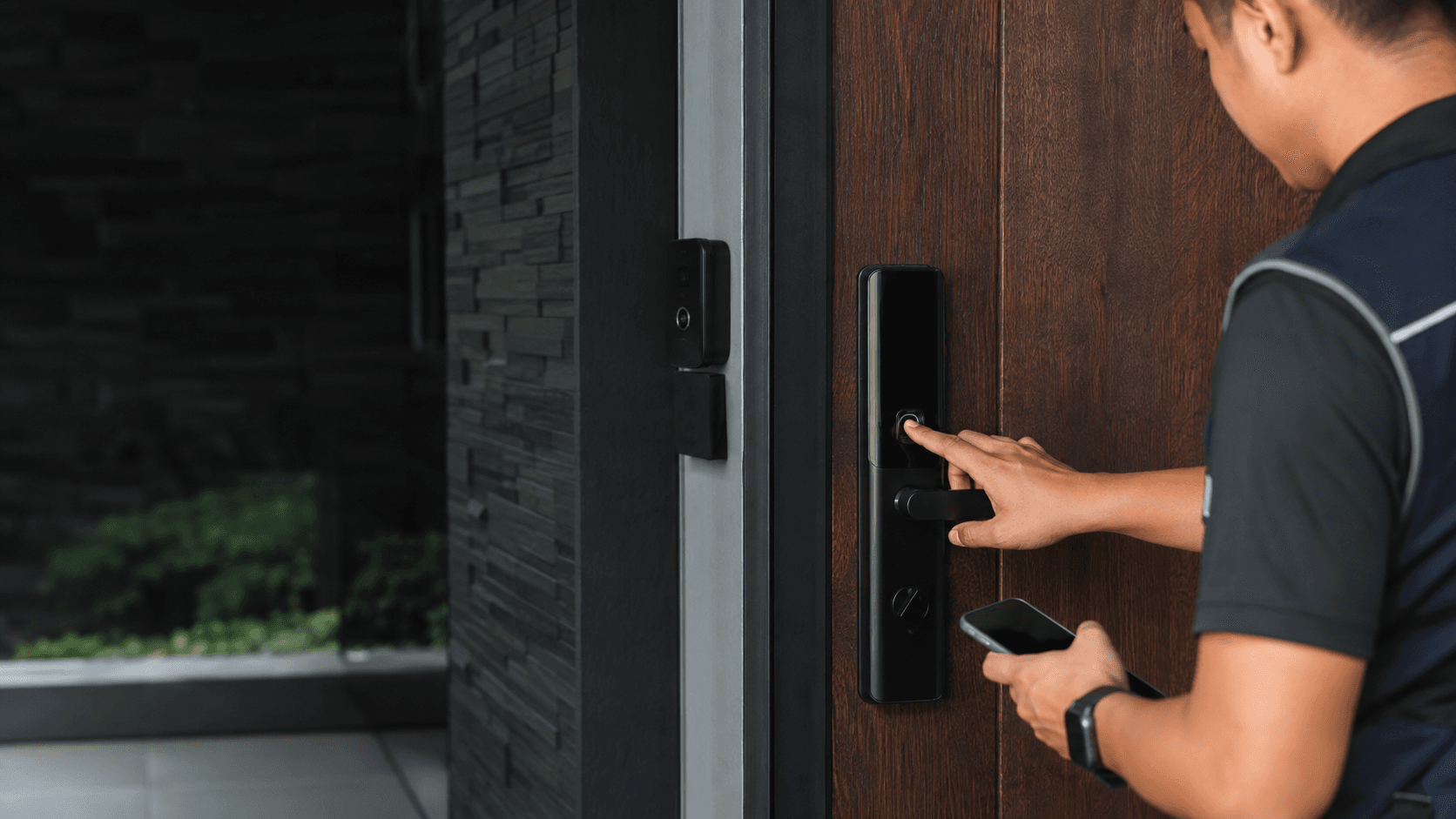
The exact-match query "app controlled door lock" describes a lock whose main controls live in a phone app rather than a key. That shift changes how entry is granted, how guests are managed, and what happens when a battery dies or the internet drops. The sections below cover how these locks work, which door types suit them, where they fail, and how a Sarawak property can plan one without guesswork.
App Controlled Door Lock. What Matters Before You Choose
Most buying mistakes with an app controlled door lock happen before any product is compared. They happen when the door, the users, and the backup entry method are decided in the wrong order.
- Confirm the door type and condition, because a deadbolt replacement, a retrofit adapter, and a lever-handle lock each fit different doors.
- List every person who needs entry, including staff, family, tenants, cleaners, and contractors.
- Decide how entry is granted, whether by app, keypad code, fingerprint, card, or a physical key.
- Check the connectivity path, since Bluetooth works locally while remote control needs Wi-Fi or a bridge.
- Agree on a backup entry method before installation, so a flat battery or outage does not lock anyone out.
- Match the lock to the wider security setup, including CCTV coverage and alarm zoning at the same door.
Eyonic's own product guidance makes the same point in fewer words: smart locks work best when the door condition, user roles, and backup method are reviewed before installation. For business use, the same guidance notes that a standalone smart lock and an access-control panel are not interchangeable, and the choice depends on how many people and doors are involved.
Choosing the Right App Controlled Door Lock
The right choice depends less on brand than on three physical and operational facts: what the door already has, who needs in, and how remote the control must be.
Match the lock type to the door
A deadbolt-replacement lock swaps the existing deadbolt and usually needs a standard bore and backset. A retrofit adapter fits over the inside of an existing deadbolt and leaves the outside key cylinder untouched, which suits renters and heritage doors. A lever or knob replacement suits doors that use a handle rather than a deadbolt. Measuring before ordering avoids the most common return reason.
Match connectivity to the actual need
Bluetooth-only locks work when the phone is within range, which is fine for a home's front door. Remote unlocking, guest codes issued from another city, and entry logs viewed away from the property need Wi-Fi or a bridge device. A lock marketed as app controlled may still be local-only unless the listing states otherwise.
Match user roles to the access method
A household needs a handful of permanent users and occasional guest codes. An office, shop, or industrial site needs role separation, time-limited codes, and a record of who entered. Eyonic's review notes that for business use the decision between a standalone smart lock and an access-control panel should be made deliberately, because a single smart lock does not scale to many doors and many staff.
What Is an App Controlled Door Lock?
An app controlled door lock is a door lock whose locking, unlocking, and access management are handled through a phone application, usually alongside a keypad, key, or card as a secondary method. The app typically shows lock status, entry history, and user permissions, and it may allow codes to be issued or revoked without visiting the door.
The mechanism is straightforward. A motor or actuator moves the bolt. A radio module, either Bluetooth, Wi-Fi, Z-Wave, Zigbee, Thread, or Matter, carries commands between the lock and the app. A microcontroller checks whether the command is authorised before the bolt moves. Battery power runs the motor and the radio, which is why battery life varies so widely between models and between heavy-use and light-use doors.
Two practical consequences follow. First, the lock is only as reliable as its power source and its network path. Second, the app becomes part of the security perimeter, so account security and permission hygiene matter as much as the bolt itself.
Amazon.com Smartphone Door Lock
Shoppers often begin on Amazon.com, where smartphone door lock listings mix deadbolt replacements, retrofit adapters, and lever locks in one search result page. The listing title usually names the lock type, the connectivity, and the finish, but it rarely states whether the lock suits a particular door in Malaysia.
Three checks reduce the risk of a wrong purchase. Confirm the lock type against the existing door hardware. Confirm the connectivity against the intended use, since a Bluetooth lock will not unlock a door from another state. Confirm the backup method, because a lock with no key override and no keypad depends entirely on the phone and the battery.
Buying online also separates supply from installation. A lock that arrives without a compatible backset, an unsuitable door thickness, or a missing bridge device can sit unused. Eyonic's installation process begins with a site survey and a system proposal before any hardware is fitted, which is the step that catches these mismatches early.
Practical Considerations for
Several constraints decide whether an app controlled door lock works well in daily use, and most of them are physical rather than digital.
Power network and failure behaviour
Battery life depends on motor effort, radio type, and how often the door is used. A Wi-Fi lock on a busy office door drains faster than a Bluetooth lock on a home door used twice a day. When the battery fails, the lock should still open by key, keypad, or an external power contact. When the network fails, local Bluetooth or keypad entry should still work. A lock that offers neither is a single point of failure.
Door condition and installation reality
Older doors may have misaligned strikes, swollen frames, or non-standard bores. A smart lock's motor is less forgiving of a binding bolt than a hand is, so a door that needs a shoulder to close will strain the mechanism. This is a survey issue, not a product issue, and it is why a physical check before purchase saves money.
Security setup around the door
A lock records and controls entry at one point. It does not show what happened in the corridor, the lobby, or the yard. Pairing the lock with camera coverage and alarm zoning at the same entrance gives a fuller picture, and Eyonic's project work follows that pattern. At the Kuching Immigration Office, the focus was arrival flow, staff areas, visitor movement, and dependable daily operation. At KTA Sarawak Sdn Bhd, the work covered staff movement, visitor handling, tidy cabling, and clearer daily site control.
Cost expectations in Sarawak
Eyonic publishes package pricing from RM 1,599 for a Hikvision CCTV package, RM 1,599 for a Hikvision alarm system, and RM 1,599 for an autogate package, each covering supply, setup, and handover. Larger integrated work scales well beyond that: the Kuching Immigration Office project carried an approximate budget of RM 12,000 to RM 28,000, and the KTA Sarawak Sdn Bhd project an approximate budget of RM 8,000 to RM 18,000. A single app controlled door lock sits at the smaller end of that range, but the figure depends on the door, the lock type, and whether access control is involved.
Making an Informed Choice About
The decision narrows quickly once the door, the users, and the backup method are settled. A home front door with a standard deadbolt and a handful of users suits a deadbolt-replacement lock with Bluetooth and a keypad. A rented unit suits a retrofit adapter that leaves the existing cylinder in place. An office, shop, or industrial entrance with staff turnover and visitor traffic usually needs role-based access and a record of entry, which points toward an access-control approach rather than a single lock.
Two edge cases deserve attention. Doors exposed to direct rain need a lock rated for the conditions, since interior electronics and exterior keypads fail differently. Doors on a shared or managed building may be subject to landlord or management rules, so approval should be confirmed before any hardware is ordered.
Eyonic Sdn Bhd plans, supplies, and installs security and ELV systems across Sarawak for homes, offices, shops, and industrial sites, and its product range includes smart locks alongside Hikvision cameras. The founder, Eric Yong, has worked in the industry for more than ten years, with a focus on technical installation of digital security solutions for commercial businesses in Sarawak. The company's installation process runs through site survey, system proposal, installation, and handover, which is the sequence that keeps a lock purchase tied to the door it will actually be fitted to.
Share your location, property type and required system with Eyonic on WhatsApp at +60 11-5111 7959 for the next practical step.