
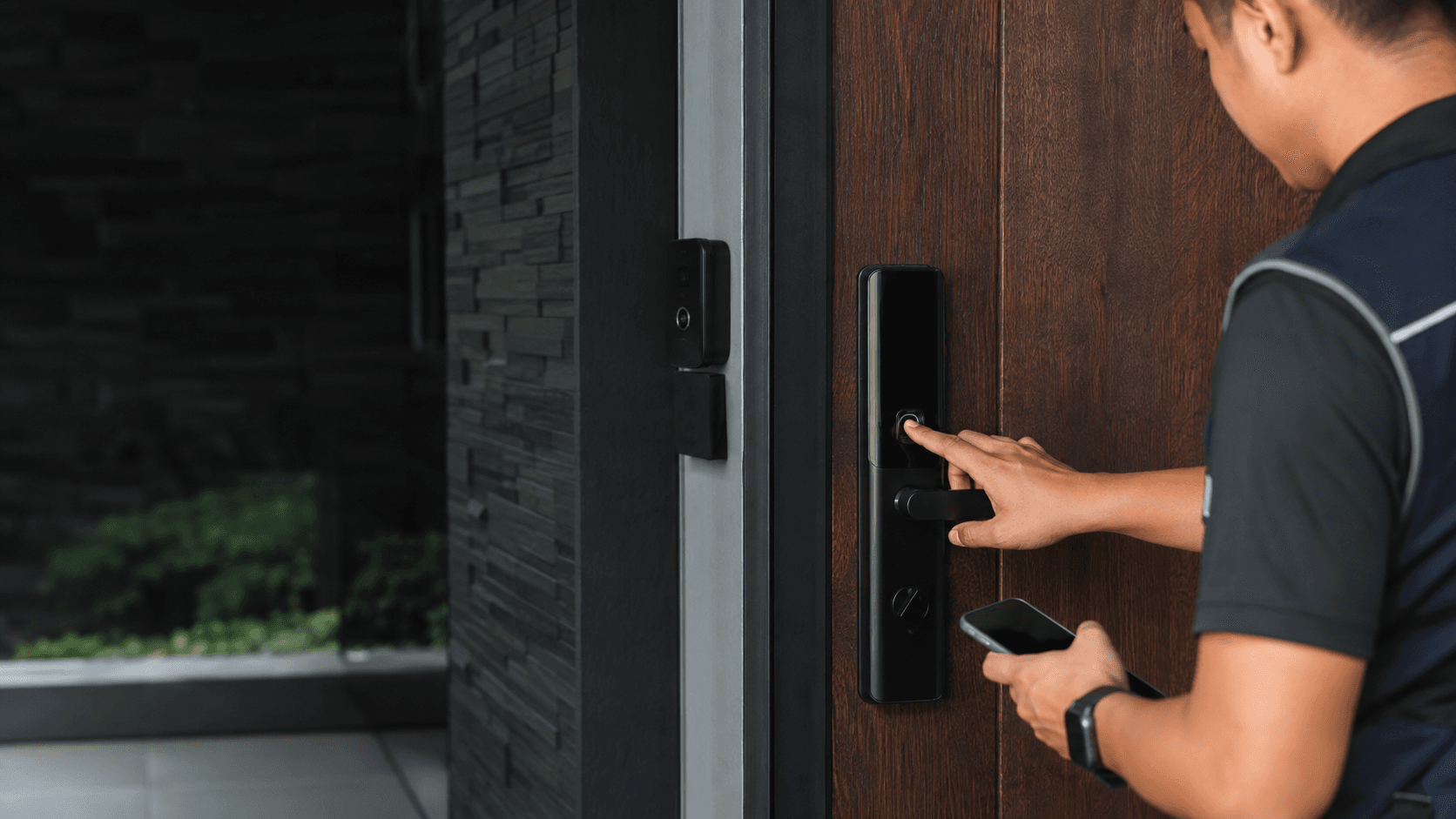
The deadbolt is the part that actually holds the door shut. Electronics only decide who is allowed to move it. That split matters in Malaysia, where a lock may sit on a metal gate, a timber office door or a glass entrance, and where the same unit has to work for a household, a shop lot or a factory floor.
Eyonic Sdn Bhd, a security system supplier in Sarawak, reviews door condition, user roles and backup method before recommending smart lock door access, and checks whether a standalone lock or an access-control panel suits business use. The same review logic applies to any digital door lock with deadbolt.
Digital Door Lock With Deadbolt: What Matters Before You Choose
A deadbolt is a bolt that extends into the door frame or strike plate. It does not rely on a spring latch that can be slipped. When a digital lock keeps that bolt, the security of the door still rests on physical hardware rather than on firmware.
The electronic side adds the access decision. A keypad, card reader, fingerprint sensor or mobile credential replaces the key cylinder as the everyday entry method. The bolt still has to be thrown and withdrawn, either by a motor, by a thumbturn, or by hand.
That distinction separates two product families. A deadbolt replacement lock removes the existing deadbolt and fits an electronic unit in its place. A deadbolt adapter lock sits over the existing interior thumbturn and turns it, leaving the original key cylinder and bolt untouched. Adapter designs suit rented premises because the original lock stays in the door. Replacement designs give a cleaner single unit but commit the door to that hardware.
Neither approach changes what the bolt is made of. Bolt material, throw length and strike reinforcement are physical properties, and no supplied evidence in this review states those figures for any specific model. Buyers comparing units should ask the supplier for the datasheet rather than assume that a connected lock is a stronger lock.
Door condition and user roles before choosing a unit
Door condition decides whether a digital door lock with deadbolt can be fitted at all. A door that already carries a deadbolt has the mortise or bore preparation the hardware expects. A door with only a latch, a narrow stile, or a non-standard thickness may need additional preparation or a different product category.
Frame alignment matters as much as the door leaf. A bolt that binds because the frame has shifted will strain a motor and drain batteries faster. Any survey should test the existing bolt by hand before electronics are added.
User roles decide the access model. A home typically needs a small number of permanent credentials plus a way to admit a visitor or a contractor temporarily. An office needs staff credentials that can be added and removed as people join and leave, plus a record of who entered. A shop or industrial site may need one credential for a shift and another for a manager.
Eyonic's stated position is that smart locks work best when door condition, user roles and backup method are reviewed before installation, and that for business use the choice between a standalone smart lock and an access-control panel should be checked first. A standalone lock manages one door and its own user list. A panel manages multiple doors, schedules and central records, and is the more sensible route once a site has several controlled openings.
Access methods and backup entry
Access method is the daily experience. Keypad codes suit shared use because a code can be given and changed without hardware. Cards and fobs suit offices where staff already carry a badge. Fingerprint readers remove the need to carry anything but depend on a clean, registered print. App and mobile credentials suit households that want remote control and entry history.
Backup entry is the part that decides whether a failure becomes an inconvenience or a lockout. Three routes exist in practice. A mechanical key cylinder allows the door to be opened with a physical key. An external power point allows a depleted lock to be energised from a battery pack. A mechanical override inside the premises allows the bolt to be withdrawn from within.
Each route has a limit. A key cylinder is only useful if the key is stored somewhere reachable but not inside the premises. An external power point only helps if the electronics, not the mechanism, are the problem. An internal override only helps someone already inside. A site should know which of the three applies before the lock is installed, and should test it while the installer is still present.
Battery behaviour is the other edge case. No supplied evidence in this review states battery life for any digital door lock with deadbolt, so the honest position is that runtime depends on the model, the number of daily operations and how freely the bolt moves. A binding bolt is the most common reason a lock reports low battery early.
Installation and handover steps
Eyonic's documented installation process runs through four stages, and the same sequence applies to lock work. The order matters because each stage depends on the one before it.
- Site survey. inspect the door, frame, existing bolt and strike, confirm the door type and thickness, and note how the door is used through the day.
- System proposal. set out the recommended unit or panel, the access methods, the user roles and the backup entry route, so the scope is agreed before work starts.
- Installation. fit the hardware, align the bolt and strike, wire or mount any external power point, and configure credentials and permissions.
- Handover. test every access method and the backup route, register the initial users, and explain how credentials are added or removed afterwards.
Handover is where most problems surface. A lock that opens on a keypad but binds on the thumbturn has an alignment issue, not a software issue. A lock whose backup key is stored inside the premises has no backup at all. Testing both while the installer is on site is cheaper than a return visit.
For multi-door sites, the handover should also cover who administers the user list. If one person holds that responsibility and leaves, the site needs a documented way to transfer it.
Where Eyonic fits in Sarawak
Eyonic Sdn Bhd plans, supplies and installs security and ELV systems for homes, offices, shops and industrial sites in Sarawak. Its product range includes Hikvision cameras and smart locks, and its review position on smart lock door access is that the technology suits controlled convenience when user permissions and backup entry are planned properly.
The company's project record shows the kind of site where access and movement are planned together. At the Kuching Immigration Office, the work focused on arrival flow, staff areas, visitor movement and dependable daily operation. At KTA Sarawak Sdn Bhd, an engineering consultancy site in Kuching, the scope covered staff movement, visitor handling, tidy cabling and clearer daily site control. Both are the conditions that shape a lock decision: who arrives, who is staff, who is a visitor, and how the door behaves every day.
Eric Yong founded Eyonic Security Systems and has worked in the industry for more than ten years, with experience in technical installation of digital security solutions for commercial businesses in Sarawak.
Eyonic's published packages cover Hikvision CCTV, a Hikvision alarm system and autogate at RM 1,599 each. No supplied evidence states a price for a digital door lock with deadbolt, so lock pricing has to be confirmed directly rather than inferred from those packages.
A lock is also rarely the only controlled opening on a site. Where a gate, an intercom or a camera already exists, the lock decision should be made alongside them so credentials, monitoring and visitor handling do not end up on separate systems. Eyonic's service range covers CCTV, alarm, autogate, keyphone intercom and Starlink installation in Sarawak, which allows those elements to be planned as one scope.
Share your location, property type and required system with Eyonic on WhatsApp at +60 11-5111 7959 for the next practical step.