
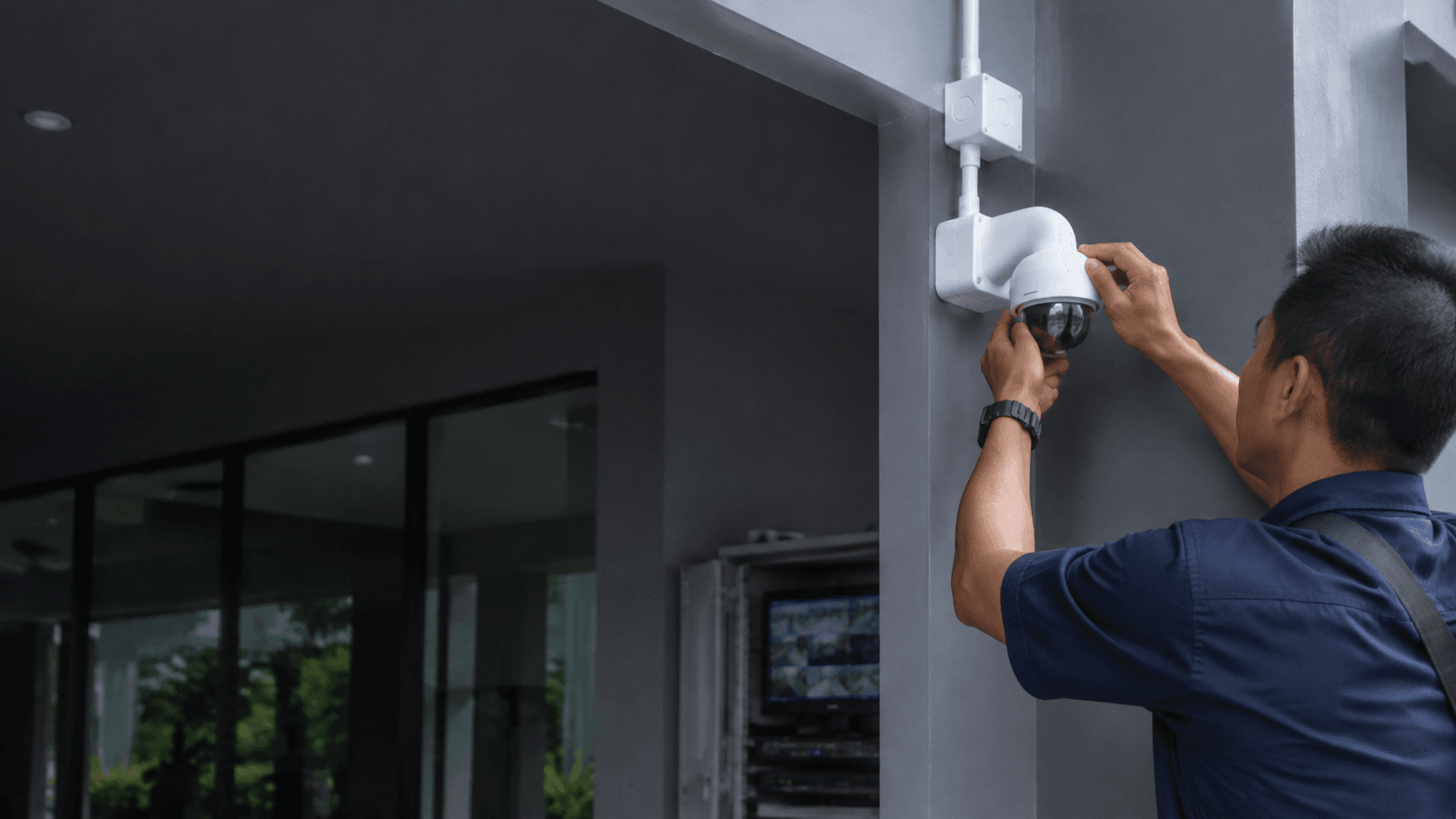
The brand behind the hardware is Shenzhen TVT Digital Technology Co., Ltd, which lists HD IP cameras, HD coaxial cameras, HD NVRs and HD DVRs among its product lines. Independent discussion of the brand has centred on reliability, firmware cadence, pricing against Hikvision and Dahua, and repair turnaround.
What a TVT CCTV camera actually is
A TVT CCTV camera is a surveillance camera sold under the TVT brand, which is owned by Shenzhen TVT Digital Technology Co., Ltd. The range is not a single product. Distributor catalogues list analogue and IP cameras side by side, including 4MP and 5MP eyeball and bullet models, motorised varifocal units, auto-tracking PTZ cameras, a licence plate recognition bullet, and dual-illumination models that combine infrared with white light.
TVT also manufactures the recording and management layer. Catalogue listings include 4, 8, 16 and 32 channel NVRs with PoE, hybrid AI DVRs that accept both analogue and IP inputs, and NVMS software in Lite, Standard and Professional editions. That matters because a TVT CCTV camera can be paired with TVT recording hardware, or run into a third-party recorder where ONVIF support exists.
Third-party integration is documented rather than assumed. Agent DVR lists 11 TVT camera models with RTSP and HTTP connection URLs, using port 554 as the default RTSP port. That gives a practical fallback when a recorder from another brand is already installed.
Choosing the right TVT CCTV camera
Selection starts with the recording platform, not the camera. A site already running an analogue DVR needs a coaxial camera; a site building a new network needs an IP camera and PoE switching. The numbered sequence below follows the order that avoids rework.
- Confirm whether the existing recorder accepts analogue, IP, or both, since TVT sells hybrid DVRs and PoE NVRs as separate lines.
- Match resolution to the recording and storage budget, choosing between the 4MP and 5MP tiers rather than defaulting to the highest number.
- Pick the housing for the position: turret or eyeball for ceilings, bullet for walls and long corridors, PTZ where a single unit must cover a wide area.
- Check the lighting at the actual position before confirming a dual-illumination or full-colour model.
- Verify the connection method, using documented RTSP and ONVIF support where the camera will not sit on a TVT recorder.
- Plan the recording retention period and confirm the NVR or DVR channel count and drive bays cover it.
Lighting is the step most often skipped. A camera rated for low light still depends on what light is genuinely present at night, and a position that looks bright during a daytime survey can be almost dark after business hours. Checking the real conditions before fixing the position is cheaper than relocating a camera later.
Analogue, IP, or hybrid
Analogue models suit sites with existing coaxial cabling and a working DVR, because the cable run and recorder stay in place. IP models suit new builds and sites that need higher resolution, PoE power over one cable, or analytics at the camera. Hybrid DVRs exist for the middle case, where some channels are reused and others are new.
The trade-off is not only image quality. IP systems concentrate cost in switches, cable and configuration; analogue systems concentrate cost in the recorder and keep the cabling simple. A site with long existing coax runs usually finds analogue or hybrid cheaper to extend than to replace.
Resolution and lens choice
Distributor listings show fixed 2.8mm lenses on most eyeball and bullet models, with 2.8–12mm motorised varifocal options on selected units. A fixed wide lens covers a broad area but identifies less detail at distance. A motorised varifocal allows the field of view to be adjusted remotely after installation, which reduces the risk of a badly framed shot.
Resolution tiers in the catalogue run from 2MP through 4MP, 5MP and 8MP. Higher resolution increases storage and bandwidth requirements, so the retention period and drive capacity should be settled alongside the camera choice rather than after it.
Should I buy TVT products? What the discussion record shows
The most detailed public discussion of the brand sits on IPVM, where contributors have debated reliability, firmware and hardware update timing, factory quality control, RMA and repair service, and pricing relative to Hikvision and Dahua. The thread also covers HD analogue formats including TVI and AHD, and DVR and NVR performance.
That discussion is a record of practitioner opinion, not a specification. It is useful for knowing which questions to ask a supplier, and it does not settle whether the brand suits a particular site. A buyer weighing a TVT CCTV camera against better-known alternatives should treat the thread as a list of concerns to verify locally: firmware availability, spare parts, and who handles a warranty claim.
Where TVT fits well
TVT suits projects that need a broad catalogue from one manufacturer. The range covers cameras, recorders, PTZ, ANPR, thermal and access control terminals, which simplifies procurement and keeps the management software consistent across a site. Sites that value a single supplier for cameras and recorders, and that are comfortable with a brand that is less widely stocked than the largest competitors, are the natural fit.
Where it needs more care
Brands with a smaller local presence put more weight on the installer. Firmware updates, replacement units and technical support depend on the distributor's stock and responsiveness. A site that cannot tolerate a slow replacement should confirm local spares and warranty handling before committing, and should ask what happens if a specific model is discontinued.
Practical considerations before committing
Camera placement decides more outcomes than brand. A well-positioned mid-range camera identifies a face or a plate; a poorly positioned high-resolution camera does neither. Placement should follow the actual movement of people and vehicles through the site, not a symmetrical plan drawn on paper.
Recording retention is the second constraint. Channel count, drive bays and resolution together determine how many days of footage remain available, and a retention target set after installation often forces a resolution or channel reduction. Setting the target first keeps the hardware choice honest.
Installation quality affects reliability as much as the hardware does. A documented process moves through site survey, system proposal, installation and handover, which keeps cabling tidy and confirms the system works before the installer leaves. Public and commercial sites benefit most from that structure, because the handover step is where staff learn to review footage and manage users.
Budget expectations vary widely with scope. Documented project budgets for office and public-building work in Sarawak have ranged from RM 8,000 to RM 18,000 for an engineering consultancy office setup and RM 12,000 to RM 28,000 for a public office, depending on camera count, cabling and recording requirements. Package pricing for smaller installations starts lower, with a Hikvision CCTV package listed at RM 1,599 covering camera supply, basic recording configuration and mobile viewing handover.
Questions worth asking a supplier
Which TVT CCTV camera models are held in local stock, and what is the lead time on a model that is not? Which recorder is proposed, and does it accept both analogue and IP inputs if the site may expand? What retention period does the proposed storage deliver at the chosen resolution? Who handles a warranty claim, and what is the typical turnaround? Is the camera ONVIF-compliant if it will run on a non-TVT recorder?
These questions surface the constraints that matter after installation. They also separate a supplier who stocks the brand from one who orders it per project.
Making an informed choice about a
The decision rests on three things: whether the existing or planned recorder matches the camera type, whether the lighting and position support the identification the site needs, and whether local support can respond when something fails. TVT covers a wide product range, and the catalogue depth is an advantage only when the specific model is available and supported locally.
For sites in Sarawak, Eyonic Sdn Bhd plans, supplies and installs monitoring systems with camera placement, recording and remote viewing for homes, offices, shops and industrial sites. The company's founder, Eric Yong, has worked in the industry for more than 10 years, with a focus on technical installation of digital security solutions for commercial businesses in Sarawak. Completed work includes the Kuching Immigration Office, where the focus was arrival flow, staff areas, visitor movement and dependable daily operation, and KTA Sarawak Sdn Bhd, an engineering consultancy office setup covering staff movement, visitor handling, tidy cabling and clearer daily site control.
Share the location, property type and required system with Eyonic on WhatsApp at +60 11-5111 7959 for the next practical step.