
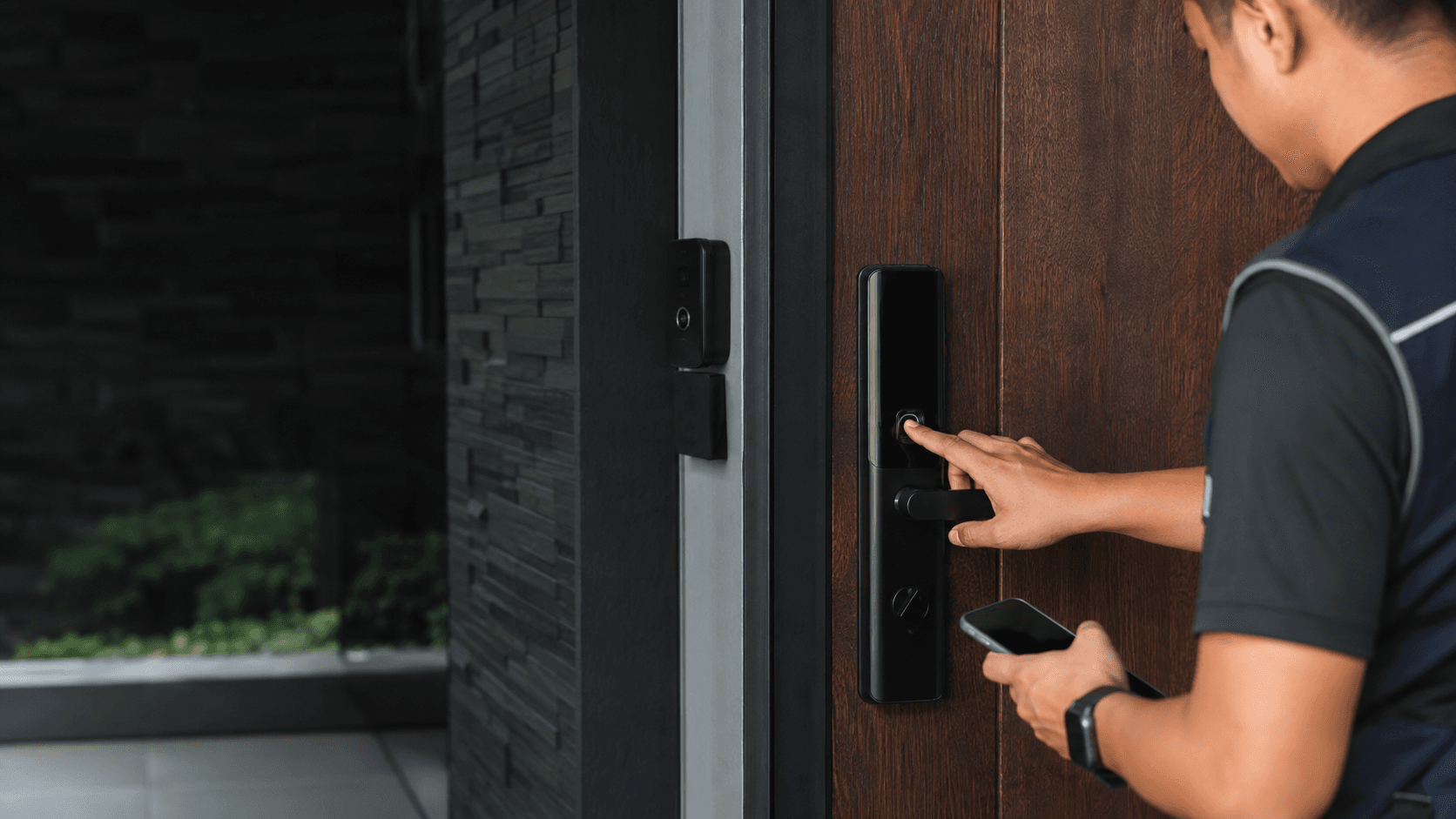
That pairing is the whole point of the search. One half is the electronic deadbolt that reads a fingerprint and connects over Wi-Fi. The other half is the Halifax lever, a mechanical handle that does the pushing and pulling while the deadbolt does the locking. Buyers researching the kwikset halo touch smart lock with halifax levers are usually trying to work out whether this is one purchase or two, and what has to be true about the door before either part goes on.
Eyonic Sdn Bhd is a security system supplier in Sarawak that plans, supplies and installs monitoring and access hardware for homes, offices, shops and industrial sites. Smart lock door access sits inside that range, and the company's own product review notes that smart locks work best when door condition, user roles and backup method are reviewed before installation. For business use, the same review says the choice between a standalone smart lock and an access-control panel is worth checking first.
Kwikset Halo Touch Smart Lock With Halifax Levers: what the pairing covers
The combination covers two separate jobs on one door. The Halo Touch handles identity and locking: a fingerprint is presented, the deadbolt throws or retracts, and the lock reports its state through the Kwikset app. The Halifax lever handles the everyday mechanical action of opening and closing the door itself.
Because those are two different functions, they are also two different decisions. A deadbolt is chosen for entry method, connectivity and how access is managed. A lever is chosen for handing, finish and how it looks beside the rest of the door hardware. Getting one right does not automatically get the other right.
What the pairing does not cover is equally worth stating. Nothing in the available evidence confirms that the Halo Touch deadbolt and the Halifax lever ship as a single boxed combination, and nothing confirms Malaysian pricing, local stock, warranty terms or a local distributor for the pair. Those are questions for whoever supplies the hardware, not assumptions to carry into a purchase.
Fingerprint entry and the Kwikset app in daily use
Fingerprint entry removes the key from the routine. The deadbolt is operated by touch rather than by turning a cylinder, which matters on a door that gets used by several people through the day. The Kwikset app is the management layer: it is where access is administered rather than where the door is physically opened.
That split shapes daily use. Regular users interact with the lock at the door. Whoever administers the property interacts with the app, and only when something changes — a new person, a removed person, a schedule that no longer matches how the building is actually used.
Two limits are worth naming plainly. App-based management depends on the lock's connection being healthy, so a door with weak Wi-Fi coverage is a poor candidate regardless of how good the hardware is. And a fingerprint lock still needs a fallback. The evidence available here does not verify which backup methods the Halo Touch supports, so the backup question should be settled with the supplier before installation rather than after.
Halifax lever styles and finish matching
The Halifax lever is the visible half of the pairing. It is the part that gets touched on every entry and the part that has to sit comfortably beside whatever handle, hinges and trim already exist on the door.
Finish matching is the practical constraint. A lever that reads as a different tone from the deadbolt above it looks like two purchases rather than one deliberate choice, and that impression is hard to undo once the holes are drilled. The available evidence does not verify which finishes the Halifax lever is offered in, so the finish should be confirmed against the actual product listing rather than assumed from a photograph.
Handing matters for the same reason. A lever is fitted for the side the door swings toward, and a lever specified for the wrong side is a return, not an adjustment. Confirming handing before ordering costs nothing; correcting it afterwards costs a second delivery.
Door condition, user roles and backup entry checks
These three checks decide whether the installation is straightforward or whether the door needs work first. They are also the checks most often skipped when a lock is bought online and fitted later.
- Confirm the door thickness and backset against the lock's requirements, because a deadbolt sized for a different preparation will not seat correctly.
- Confirm the lever handing and finish so the handle matches the door's swing and the existing hardware.
- Confirm who needs access and at what times, since a household and a staffed office have different answers.
- Confirm the backup entry method before installation, so a dead battery or a failed reader is an inconvenience rather than a lockout.
- Confirm Wi-Fi coverage at the door, because app-based management depends on a connection that actually reaches that position.
User roles are where a residential and a commercial installation diverge most. A home usually needs a small, stable set of people with permanent access. An office, a shop or a site typically needs access that changes — staff who join and leave, visitors who need a door for an afternoon, cleaners who need it outside normal hours. The lock's access model has to match that pattern, and the Eyonic product review notes that for business use the choice between a standalone smart lock and an access-control panel is worth checking, because a panel handles changing roles differently from a single door lock.
Backup entry is the check that protects everything else. Whatever the primary method is, there has to be a second way in that does not depend on the same battery, the same reader or the same network. The evidence available here does not verify the Halo Touch's backup options, so this is a question to put to the supplier directly.
Installation and handover steps for a Malaysian home or office
Eyonic's installation process runs through site survey, system proposal, installation and handover. Applied to a smart lock, that sequence keeps the hardware decision tied to the door rather than to a product page.
The survey stage is where door condition, user roles and backup entry get settled. The proposal stage is where the choice between a standalone smart lock and an access-control panel is made explicit for a business site. Installation is the physical fitting. Handover is where the people who will actually use the door learn how it behaves — what happens when a fingerprint is not recognised, what the lock does when the battery is low, and who to contact when access needs to change.
Handover is also where the honest limits get stated. A fingerprint lock is convenient, not infallible. A door that is misaligned, a frame that has moved, or a lever fitted for the wrong side will all produce the same symptom — a lock that seems unreliable — when the fault is in the door or the fitting rather than the electronics.
Eyonic's project work in Sarawak has included the Kuching Immigration Office, where the focus was arrival flow, staff areas, visitor movement and dependable daily operation, and KTA Sarawak Sdn Bhd, where the requirement was a practical office setup supporting staff movement, visitor handling and clearer daily site control. Both are examples of the same underlying question: who moves through a door, and how is that movement managed.
Cost, package and next practical step
Eyonic's published packages are priced at RM 1,599 each for a Hikvision CCTV package, a Hikvision alarm system and an autogate package. Those figures cover those three systems and do not represent smart lock pricing, which is not verified in the available evidence for this combination.
Budgeting for the kwikset halo touch smart lock with halifax levers therefore means separating the hardware from the fitting. The hardware cost depends on what the supplier actually stocks and whether the deadbolt and lever are bought together or separately. The fitting cost depends on the door — a door that is already prepared for a deadbolt is a different job from one that is not.
For a business site, the comparison worth making is between a single smart lock on one door and an access-control approach that covers several. A standalone lock is the simpler answer for one entrance with a stable set of users. A panel-based approach makes more sense where access changes often or where several doors need to be managed together.
Before committing, three things are worth confirming in writing: the door's thickness and backset against the lock's requirements, the lever's handing and finish, and the backup entry method. Those three answers determine whether the installation is a straightforward fitting or a door-preparation job.
Eyonic is based in Sarawak and works across homes, offices, shops and industrial sites. Sharing the location, property type and required system is the practical starting point for a smart lock or access-control installation, and the company can be reached on WhatsApp at +60 11-5111 7959.