
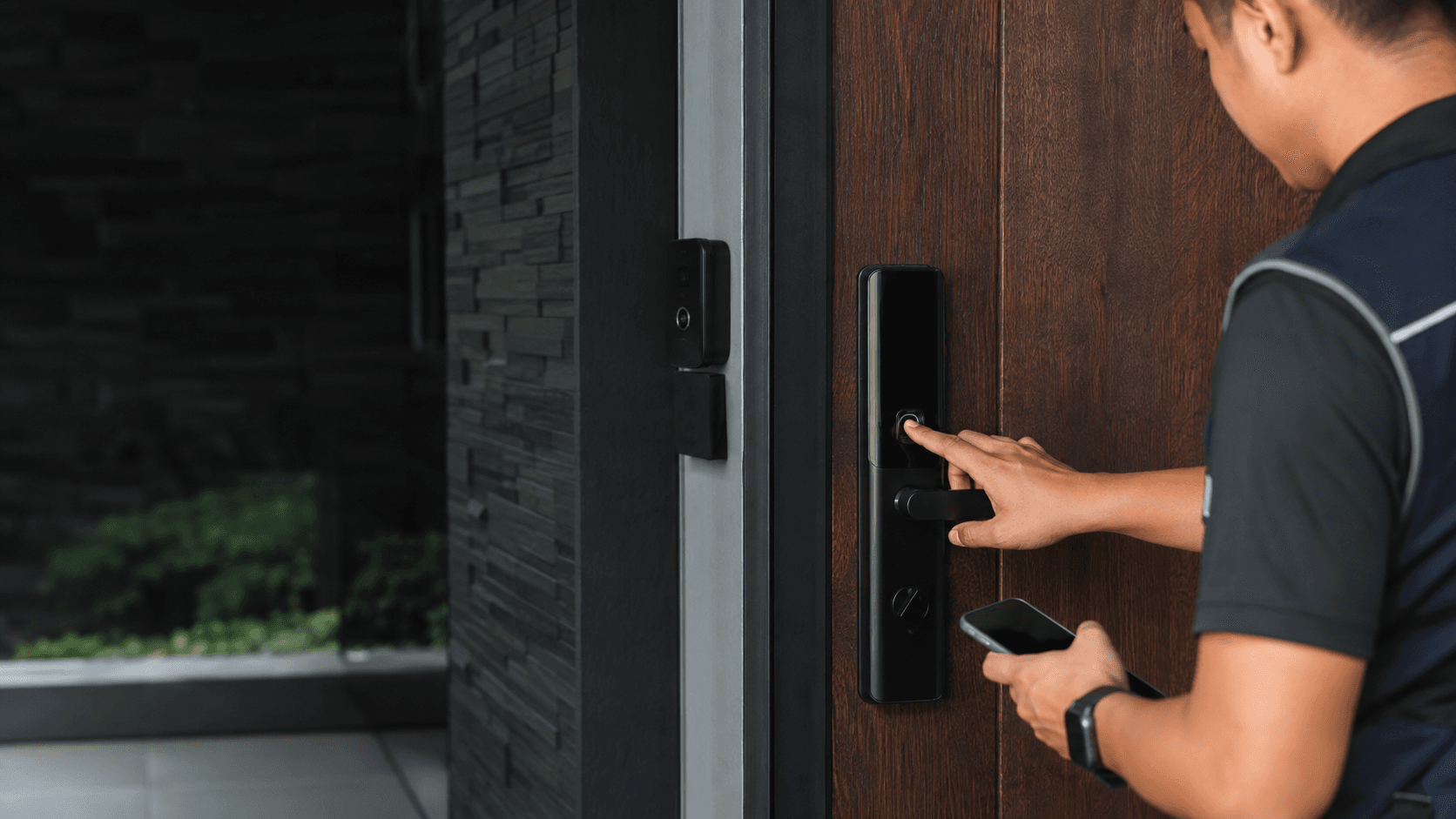
The exact-match query weiser keypad covers a narrow family of hardware: an electronic deadbolt with a numeric pad on the outside face, a motorised or turn-piece bolt inside, and a code memory that decides who gets in. Most searches stop at the product page. The harder questions start after purchase, because a keypad lock only behaves well when the door, the user list and the backup entry method are settled before the box is opened.
Eyonic's own product review notes that smart locks work best when door condition, user roles and backup method are reviewed before installation, and that for business use the choice between a standalone smart lock and an access-control panel should be checked first. That single sentence explains why a keypad lock that feels effortless in a showroom can become a daily irritation on a poorly fitted door.
What a Weiser Keypad does at the door
A keypad lock replaces the key cylinder as the primary way in. The outside face carries the buttons; the inside face carries the thumb turn or motor that throws the bolt. Between them sits the electronics that compare an entered code against stored codes and drive the bolt.
Three behaviours matter more than any feature list.
The first is that the bolt still has to move. A keypad changes how the lock is told to open, not how much force the door frame demands. A door that has dropped on its hinges, or a strike plate set too deep, will resist a motorised bolt exactly as it resists a key.
The second is that codes are a permission system, not a convenience. Every code added is a person who can enter. Every code left active after a tenant leaves, a contractor finishes or a staff member resigns is an open door. The value of a keypad lock in a rental or a small office comes from being able to remove access without changing hardware.
The third is the backup path. Batteries flatten, and electronics fail. A lock with no mechanical override and no second entrance turns a flat battery into a locksmith call. Eyonic's review guidance treats backup entry as a planning item rather than an afterthought, which is the correct order.
Weiser Keypad codes and daily entry
Daily use of a keypad lock is a short loop: enter the code, the bolt retracts, the door opens, the bolt re-throws. The friction sits in the details around that loop.
Code sharing is the first practical decision. A household can run on one shared code, but a shared code cannot be revoked from one person without disrupting everyone. Separate codes per adult, per cleaner, per tenant or per staff member keep the audit trail meaningful. The trade-off is administration. someone has to remember which code belongs to whom and remove it when the relationship ends.
Code length and memorability pull against each other. Short codes are easy to shoulder-surf at a doorway. Long codes get written on a note beside the door, which defeats the purpose. The practical middle is a code that is not a birthday, not a repeated digit, and not shared with the gate or the alarm.
Battery behaviour is the second daily concern. Keypad locks draw power on every unlock, and cold or humid conditions shorten cell life. A lock that gives no low-battery warning before it stops responding is a lock that will eventually strand someone. Where the model provides a warning, acting on it the same week is cheaper than acting on it after a lockout.
Entry lighting matters more than it sounds. A backlit pad is usable at night; an unlit pad on a dark porch is not. This is the same principle Eyonic applies to camera placement, where actual lighting conditions are checked before a position is confirmed rather than assumed from a specification sheet.
Installing a Weiser Keypad on Malaysian doors
Installation is where most keypad lock problems are created or avoided. The lock is a small component; the door is the system.
Malaysian homes and shops present a wide spread of door conditions. Timber doors, metal doors, security doors with their own integrated locks, and grille gates all behave differently. A keypad deadbolt needs a bore of the correct diameter, a backset that matches the existing preparation, and enough door thickness for the lock body to sit without binding. Where a door already carries a mortise lock set, a replacement deadbolt may not drop into the existing cutout at all.
Gate hardware is a separate question. A keypad deadbolt is designed for a swinging door leaf, not for a sliding gate or an autogate motor. Where the entry point is a gate, the appropriate hardware is gate-specific, and Eyonic's autogate work sits in that category rather than in the smart lock category.
For business premises, the choice between a standalone keypad lock and a wider access-control arrangement should be made before purchase. A single door with a handful of users suits a standalone lock. Multiple doors, staff turnover, time-based access or a need to review who entered when point towards a panel-based system, because a standalone lock keeps its records inside the lock.
The installation sequence Eyonic follows on its security work runs in four stages.
- Site survey, covering the door, frame, strike, existing hardware, lighting and the way people actually approach the entrance.
- System proposal, setting out what will be supplied and installed and how the entry will be managed day to day.
- Installation, including door preparation, mounting, wiring where required, and code or user setup.
- Handover, covering how the lock is operated, how codes are added and removed, and what to do when the battery or the electronics fail.
That sequence is drawn from Eyonic's documented CCTV installation process, which runs site survey, system proposal, installation and handover. The same order applies to door hardware because the failure modes are the same: hardware chosen before the site is understood, and users left without knowing how to manage what was fitted.
Support and handover after installation
Handover is the difference between a lock that works and a lock that is trusted. A short handover should cover four things: how to unlock normally, how to add and delete a code, what the low-battery signal looks like, and what the mechanical backup is.
Support questions tend to cluster. A code stops working because it was never saved or was overwritten. A bolt stops throwing because the door has moved with the seasons. A lock beeps without opening because the battery is failing. None of these need new hardware; all of them need someone who knows the specific unit.
For commercial sites, the handover should also name who holds the master code and where the record of issued codes is kept. Eyonic's project work for the Kuching Immigration Office centred on arrival flow, staff areas, visitor movement and dependable daily operation, which is the same set of concerns a keypad lock raises at a smaller scale: who arrives, how they get in, and whether the arrangement holds up on an ordinary working day.
Where a site runs multiple systems, the door lock should not be planned in isolation. Eyonic's work spans CCTV, alarm systems, autogate, keyphone intercom and Starlink installation, and a door entry decision made alongside those systems is easier to support than one made separately.
Practical next step
Before choosing a keypad lock, three facts decide most of the outcome: the door type and its existing preparation, the number of people who need their own entry, and the backup route if the electronics fail. A site survey answers all three in one visit.
Eyonic Sdn Bhd is based in Sarawak and plans, supplies and installs security and ELV systems for homes, offices, shops and industrial sites. Eric Yong, the founder, has worked in technical installation of digital security solutions for commercial businesses in Sarawak for more than ten years.
Share your location, property type and required system with Eyonic on WhatsApp at +60 11-5111 7959 for the next practical step.