
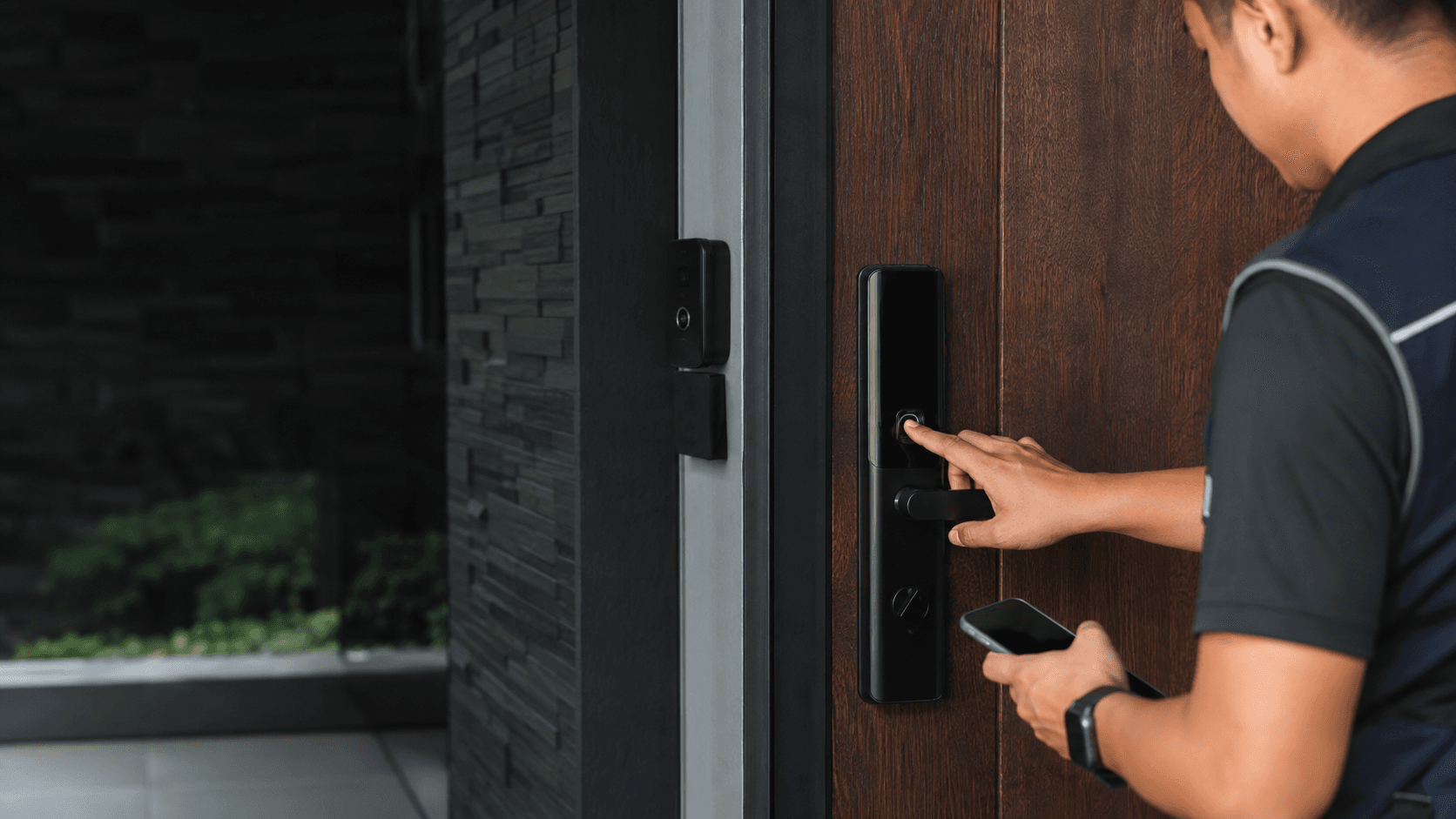
That single behaviour, called fail-safe operation, shapes almost every decision around this hardware. It explains why maglocks suit controlled entrances, why they need backup power for some sites, and why they behave differently from a motorised deadbolt. The sections below cover how the hardware works, how to choose holding force, and where the practical limits sit.
Smart Magnetic Door Lock. What Matters Before Choosing
Most buyers arrive expecting a battery-powered lock that talks to a phone. Electromagnetic hardware works on a different principle, and understanding that difference prevents an expensive mismatch.
A maglock holds a door shut with magnetic force rather than a thrown bolt. An electromagnet in the lock body pulls against a steel armature plate fixed to the door leaf. While current flows, the bond holds. Cut the current, and the door releases immediately.
That design produces three consequences worth weighing early:
- Confirm the door type and frame, because hollow frames, glass doors and narrow stiles each need different mounting hardware.
- Decide the holding force required, since a light interior door and a heavy external gate demand very different ratings.
- Choose the release method, whether keypad, RFID reader, smartphone app, exit button or a combination.
- Plan the power supply and any backup battery, because a maglock needs continuous current to stay locked.
- Check the exit path, since fail-safe hardware releases on power loss but local fire and building rules still govern egress.
Working through that sequence before purchase avoids the common situation where a kit arrives and the door cannot accept it.
Choosing the Right Smart Magnetic Door Lock
Holding force is the first specification that separates one unit from another. Published kits commonly cite ratings such as 400lb, 600lb and 1200lb, and those figures describe the magnetic pull the lock can resist, not the weight of the door.
Higher ratings generally mean a larger lock body and a heavier armature plate. That matters on narrow frames, where a bulky unit may not fit cleanly. A 600lb unit often suits an interior office door, while a 1200lb unit is aimed at heavier or higher-traffic openings.
Control method is the second decision. Many kits bundle a keypad or RFID reader with the magnet, and some add smartphone control through a Wi-Fi or wireless receiver. The receiver is what makes the lock "smart" in the app sense, since the magnet itself is a simple powered device.
Power behaviour is the third. Fail-safe locks release when power is cut, which is the usual choice for life-safety reasons on an exit route. Fail-secure hardware stays locked without power, which suits storage rooms and cabinets but is a poor fit for a main exit.
Electro Door Magnets and How They Differ From Motorised Locks
Electro door magnets are the core component inside a maglock. They generate the holding force, and everything else in the kit exists to switch that force on and off.
A motorised smart lock, by contrast, drives a bolt or latch with a motor and usually runs on batteries. It can be fitted to an existing door without continuous wiring, and it keeps working during a power cut. A maglock cannot do either of those things without a wired supply and a battery backup.
The trade-off runs the other way too. A maglock has no moving latch to wear out and no keyway to pick, and it releases instantly on command. A motorised lock offers mechanical security that does not depend on a live circuit.
For business premises, the choice often comes down to whether the door already has power and whether the site needs central control. Eyonic's own product guidance notes that smart locks work best when door condition, user roles and backup method are reviewed before installation, and that for business use the decision between a standalone smart lock and an access-control panel should be checked first.
What Is a Smart Magnetic Door Lock in Practice?
In practice, the term covers a kit rather than a single product. A typical package contains the electromagnetic lock body, an armature plate, mounting brackets, a power supply, and a controller such as a keypad, reader or wireless receiver.
Installation therefore involves more than screwing a lock to a door. The installer mounts the magnet on the frame side, aligns the armature plate on the door leaf so the two faces meet squarely, and runs low-voltage cable back to the power supply and controller.
Alignment is the part that decides long-term reliability. If the plate meets the magnet at an angle, holding force drops and the door may not seat properly. Bracket selection exists precisely to solve that geometry on different frame types.
Once wired, the lock behaves predictably. Power on means locked. A valid credential at the reader interrupts the circuit briefly, the magnet releases, and the door opens. Power off means the door is free.
Practical Considerations for Smart Magnetic Door Lock Installations
Several constraints show up repeatedly on real sites, and they are worth checking before committing to a kit.
Continuous power draw is the first. Because the magnet is energised whenever the door is locked, the supply runs constantly. That makes the quality of the power supply and the presence of a backup battery more important than on a battery-powered lock.
Door and frame condition is the second. A weak or misaligned frame may not hold the armature plate firmly, and a glass door usually needs specific brackets rather than a standard kit.
Exit requirements are the third. Fail-safe release on power loss is a safety feature, but it is not a substitute for compliant egress hardware, and local rules should be confirmed for any door on a public escape route.
Integration is the fourth. Where a site already runs CCTV, alarms or intercoms, the access controller may need to sit alongside those systems rather than operate alone. Eyonic's project work in Sarawak has covered arrival flow, staff areas and visitor movement for a public office in Kuching, and a practical office setup in Kuching supporting staff movement, visitor handling and tidy cabling for an engineering consultancy. Both illustrate the same point. access hardware is usually part of a wider site arrangement rather than a standalone purchase.
Budget is the fifth. Eyonic's published packages for CCTV, alarm and autogate work each sit at RM 1,599, which gives a sense of what a small installed system costs in this market. Larger project work has been quoted in the RM 8,000 to RM 18,000 range for an office setup and RM 12,000 to RM 28,000 for a public office installation.
Where a Smart Magnetic Door Lock Fits Best
Interior office doors with existing power are the most straightforward fit. The frame is usually standard, the run back to a supply is short, and a keypad or reader gives simple per-user control.
Storage rooms, server rooms and cabinets suit fail-secure configurations where the door should stay shut without power.
Main entrances on a public escape route need more care. Fail-safe release helps, but the door must still satisfy egress rules, and that usually means combining the magnet with compliant exit hardware.
Outdoor gates are the hardest case. Weather exposure, longer cable runs and heavier doors all push toward higher holding force and more robust mounting, and a maglock may not be the right answer at all.
Making an Informed Choice About a
The decision usually resolves into a short set of questions. Does the door already have power nearby? Is the opening on an escape route? How many people need access, and does access need to be logged or revoked remotely?
If the answers point to a wired door with controlled access and a need for central management, a maglock kit is a reasonable fit. If the door has no power, or the priority is a lock that keeps working through an outage without wiring, a motorised smart lock is the better match.
For sites in Sarawak that need the hardware planned alongside CCTV, alarms or intercoms, Eyonic handles site survey, system proposal, installation and handover. Sharing the location, property type and required system on WhatsApp at +60 11-5111 7959 is the practical next step.