
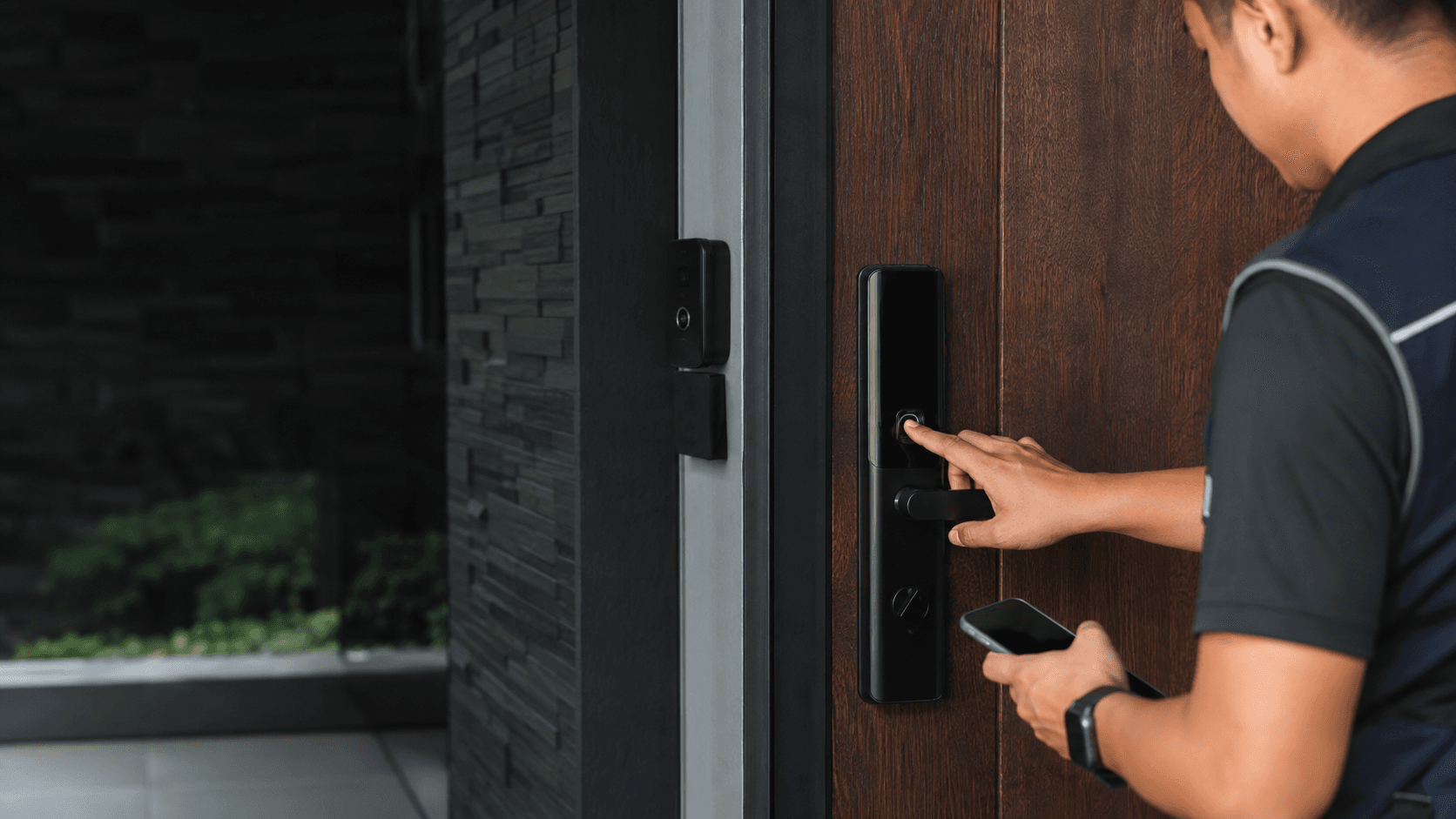
The company behind the name was founded in March 2018 to build smart door locks for the global market, and its own product description states that the lock runs in a total keyless entry mode and works with iOS and Android smartphones. That description also states the lock does not need electricity or home Wi-Fi to operate, which is the detail most readers in Malaysia ask about first, because it changes what happens during a power cut or an internet outage.
What the name does not carry is a Malaysian price, a Malaysian dealer list, or a Malaysian installation standard. Those gaps matter, because a lock that suits a Coimbatore apartment door may not suit a steel grille gate in Kuching or a glass office door in Kuala Lumpur without preparation.
Astrix Smart Lock. what the name refers to
Astrix Smart Lock is the product name used by Astrix Engineering Products Private Limited, an Indian manufacturer based in Coimbatore, Tamil Nadu. The company describes itself as a maker of smart door locks, and its product listing states the locks are made in India with components it sources for the build.
The same listing describes the intended settings as residences and commercial establishments such as hotels and service apartments. That is a wider brief than a single front door. It means the same product family is positioned for a home entrance and for a room that many different people need to enter on different schedules.
The published description also states that access can be controlled by who enters and exits and at what time. That is the core promise of the product line: the door records and restricts movement rather than simply locking and unlocking.
One limit is worth stating plainly. The available material does not confirm model-level specifications, unlock mode counts, materials, or warranty terms for Astrix Smart Lock, so any figure quoted elsewhere should be checked against the manufacturer's own documentation for the exact model before a purchase decision.
How keyless entry changes daily door use
Keyless entry removes the physical key from the routine. In practice that changes three things: who can open the door, what happens when someone loses access, and how the door behaves when nobody is standing at it.
The published Astrix description states the lock works with any smartphone model on both iOS and Android. That matters in a mixed household or a mixed workplace, where phones are not all the same brand. A lock that only works with one platform creates a second-class group of users.
The description also states the lock does not need electricity or home Wi-Fi to operate. For a Malaysian property this is a meaningful claim, because it means a power interruption or a router failure does not automatically lock people out or leave the door unsecured. It does not remove the need to plan a backup entry method, because a phone with a flat battery is a separate problem from a power cut.
Keyless entry also shifts the failure point. With a mechanical key, the risk is a lost key and a lock change. With a smart lock, the risk is a lost credential, a dead phone, or a forgotten code. The lock itself is not the weak link; the recovery plan is.
Door condition and user roles before choosing an Astrix Smart Lock
Two checks decide more outcomes than any feature comparison: whether the door can physically take the lock, and whether the people using it have clearly different levels of access.
Door condition covers thickness, existing cut-outs, the position of any current deadbolt, and whether the frame closes squarely. A door that has already been cut for a different lock body may need patching or a different model. A gate or grille may need a different fixing approach from a solid timber or metal door. None of this is visible from a product photo, and it is the most common reason a chosen lock does not fit on the day.
User roles cover the difference between a household and a workplace. In a home, the roles are usually family, regular visitors, and occasional help. In a hotel or service apartment, the roles are guests, cleaning staff, maintenance, and management, and each group needs a different level of access and a different way to be removed from the system when they leave.
Eyonic's own review of smart lock door access states that smart locks work best when door condition, user roles, and backup method are reviewed before installation, and that for business use the choice between a standalone smart lock and an access-control panel is usually checked first. That is the same sequence this article follows, and it is the reason the checks below come before any model discussion.
- Confirm the door type, thickness, and existing cut-outs, and whether the frame closes squarely enough for the lock body to seat.
- List every user group and what each group should be able to open, then decide who can add or remove a user.
- Agree the backup entry method before installation, including what happens when a phone is lost, flat, or replaced.
- Confirm power and connectivity expectations, including behaviour during an outage and who is responsible for restoring access.
Standalone lock or access-control panel for business doors
For a single home entrance, a standalone smart lock is usually the simpler answer. For a business door with staff turnover, shared rooms, or a need to review who entered and when, the decision is less obvious.
A standalone lock keeps the decision local to the door. It is easier to install, easier to replace, and does not depend on a central system staying online. Its limit is that each door is managed on its own, so a site with several doors accumulates several separate user lists.
An access-control panel centralises the user list and the record of movement. That suits a site where staff move between doors, where access must be revoked the same day someone leaves, or where management needs one view rather than several. Its cost is complexity. it needs planning, cabling or network provision, and someone responsible for the system after handover.
The published Astrix description positions the lock for commercial establishments including hotels and service apartments, which are exactly the settings where guest turnover is constant. In those settings the practical question is not whether the lock can be keyless, but who removes a departed guest's access and how quickly.
Eyonic's completed work for the Kuching Immigration Office focused on arrival flow, staff areas, visitor movement, and dependable daily operation. That is the shape of the problem a business door lock sits inside: not just locking a door, but keeping movement predictable across a working day.
Backup entry and power when the lock is offline
The published Astrix description states the lock does not need electricity or home Wi-Fi to operate. That removes two common failure points, but it does not remove all of them.
The remaining failure points are the credential and the device. A phone can be lost, replaced, or run out of charge. A code can be forgotten. A fingerprint reader can fail on a wet or damaged finger. Each of these needs a defined answer before the lock is fitted, not after.
A workable backup plan usually includes a mechanical or keyed override where the model supports one, a second registered device held by someone else in the household or the business, and a written record of who holds the override and where it is kept. The plan should also state who is allowed to add or remove users, because that authority is what actually controls the door over time.
For a business door, the backup plan should also cover the period after a staff member leaves. If their credential is not removed, the lock is doing its job while the access list is not.
Practical next step for a Malaysia property
Astrix Smart Lock is manufactured in India, and the available material does not confirm Malaysian pricing, authorised distribution, or local warranty support. That is the first thing to resolve, because a lock without a local support path becomes a problem the first time it needs service.
The second step is to match the lock to the actual door. A residential entrance, a shop lot shutter, an office glass door, and a hotel room door each present different fixing and access requirements, and the door survey decides which of them is straightforward.
Eyonic Sdn Bhd is a security system supplier in Sarawak that plans, supplies, and installs monitoring and ELV systems for homes, offices, shops, and industrial sites, and its product range includes smart locks. Its published review of smart lock door access notes that for business use the choice between a standalone smart lock and an access-control panel is checked before installation, which is the same decision this article has walked through.
For a property in Malaysia, the useful sequence is to confirm the door, confirm the user roles, confirm the backup entry method, and confirm who supports the lock after handover. Share the location, property type, and required system with Eyonic on WhatsApp at +60 11-5111 7959 to move that sequence forward.