
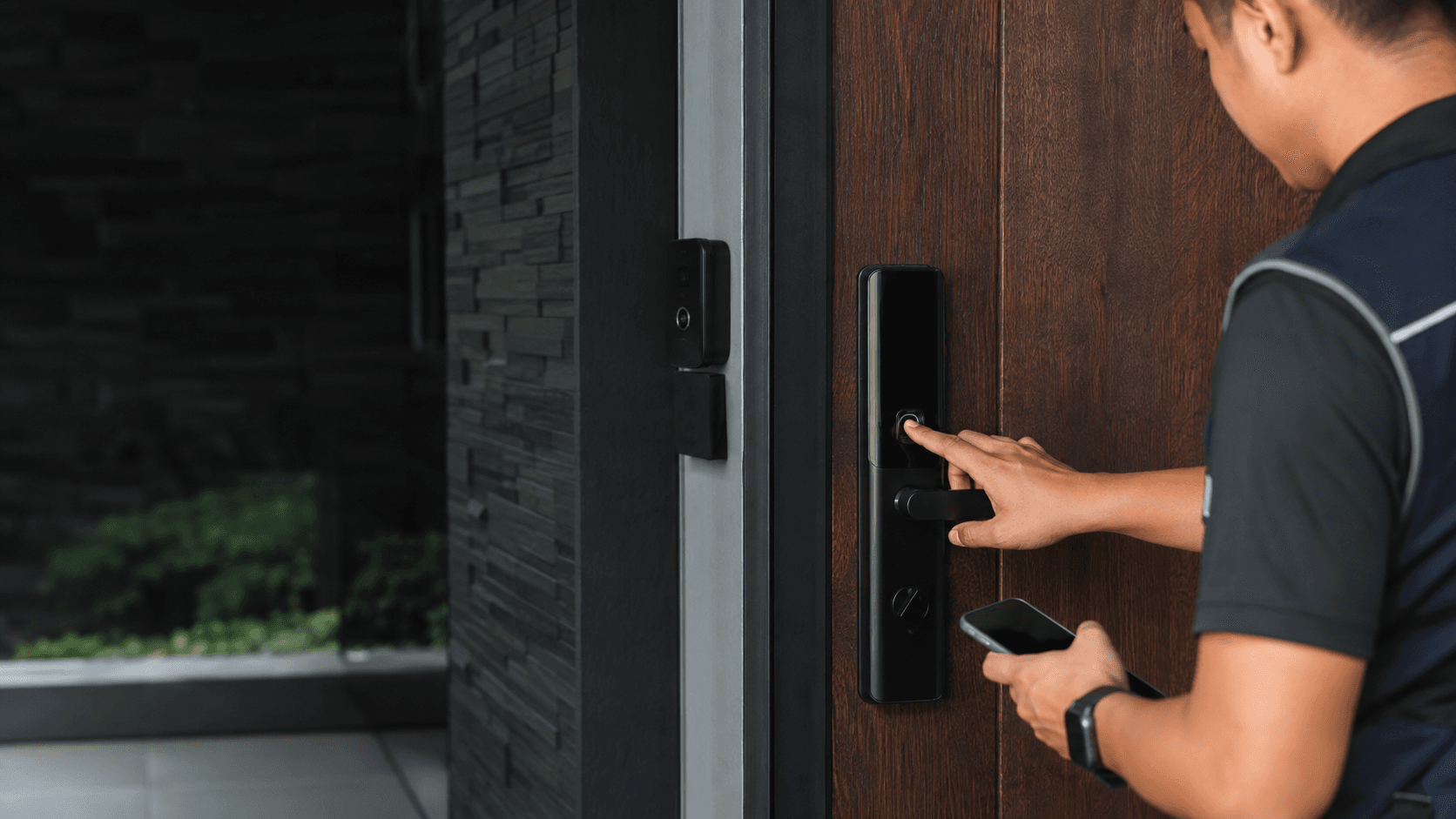
The term covers a broad family of hardware rather than one product. A keypad deadbolt, a fingerprint lever, a code-only rim lock and an app-controlled bolt all sit under the same everyday label, and each one solves a slightly different problem. What they share is the removal of a cut key as the primary way through a door.
Malaysia adds a practical layer to that choice. Shophouse doors, condominium units, office suites and rental properties each raise different questions about who holds a credential, who removes it, and what happens on the day the electronics stop working. The sections below work through those questions in the order they usually matter.
Digital Padlock For Door. what the term covers
The phrase describes door entry hardware that authenticates a person electronically instead of mechanically. A code typed on a keypad, a fingerprint read on a sensor, a card tapped on a reader or a command sent from a phone all count. The lock body still throws a bolt or latch; only the decision to release it changes.
Two broad shapes exist. A standalone unit carries its own keypad or reader and manages its own users. An access control panel sits separately and decides whether a door releases, which suits sites where several doors, staff groups and time rules need to be managed together. Eyonic's own product review notes that for business use, the company usually checks whether a standalone smart lock or an access control panel is more appropriate, because the two answer different questions.
That distinction matters more than brand or finish. A single office door with five regular users behaves very differently from a shop entrance with rotating staff, a delivery entrance and a rear fire route. The hardware that suits the first may be the wrong shape entirely for the second.
Where the term gets stretched
Some listings use the phrase for a padlock body that hangs on a hasp rather than a lock fitted into a door. Others use it for a full deadbolt replacement. The two are not interchangeable, and a buyer comparing them on price alone will usually end up with hardware that does not fit the door in front of them.
Keypad, fingerprint and app entry on one door
Most modern units combine more than one entry method, and the combination is what determines daily usability rather than any single feature.
A keypad suits shared doors because a code can be issued and withdrawn without handing over hardware. A fingerprint reader suits a small, stable group where the same people use the same door every day. An app suits remote control, temporary access and a record of who came through. When all three sit on one door, the practical question becomes which method is primary and which is the fallback.
Eyonic's smart lock review guidance puts user roles near the centre of that decision. A household, a shop with part-time staff and an office with visitors all need different permission structures, and a lock that cannot separate them will be managed by sharing one code among everyone. That works until someone leaves.
Credentials that need to be withdrawn
Every credential issued is a credential that eventually needs removing. Codes shared by message, fingerprints enrolled on a sensor and app accounts added to a household all need a clear owner and a clear removal step. Sites that skip this end up changing the whole code set whenever staffing changes, which is more disruptive than issuing individual credentials from the start.
Fitting the lock to the door and frame
Door condition is the constraint that decides most installations, and it is the one buyers most often discover too late. Eyonic's review guidance states plainly that smart locks work best when the door condition, user roles and backup method are reviewed before installation.
A door that has swollen, dropped on its hinges or been patched around an old lock body may not accept a replacement cleanly. A frame that has moved will not let a new bolt seat properly. A metal door, a glass door and a hollow-core internal door each present different fixing options. None of this is visible in a product listing.
Retrofit and full replacement are the two routes. A retrofit keeps the existing bolt and adds electronic control to it, which usually means less cutting and a faster job. A full replacement swaps the lock body, which gives more control over the mechanism but demands that the door and frame suit the new unit. The right route depends on what is already there.
What to check before ordering
The checks below are the ones that prevent a return or a second visit. They apply whether the door is in a Kuching shophouse, a Kuala Lumpur condominium or a Sarawak office suite.
- Confirm the door and frame condition, including whether the door closes squarely and whether the existing cut-out can accept new hardware.
- Decide who needs access and at what level, separating permanent household or staff users from temporary visitors and contractors.
- Agree the backup entry method before installation, so a dead battery or a dropped network does not lock out the people who need to get in.
- Confirm power and network behaviour, including what the lock does when the battery runs low and whether it still works without a connection.
Access for family staff and visitors
Permission design is where a digital padlock for door either earns its place or becomes a shared secret. The useful pattern is to separate people into groups with different rights rather than issuing one code to everyone.
Permanent users typically need full access at all hours. Staff may need access only during working hours. Visitors, cleaners and contractors usually need access that expires. A lock that supports separate credentials makes each of those groups manageable; a lock that supports one code forces the site to choose between convenience and control.
Eyonic's completed work at the Kuching Immigration Office focused on arrival flow, staff areas, visitor movement and dependable daily operation. That project used different systems, but the underlying pattern is the same one that applies to door access: separate the people who arrive, the people who work there and the people who visit, then give each group the access that matches their role.
Rental and shared building edge cases
A rental unit raises a question that owner-occupied homes do not: who controls the credential list. A tenant who manages the app controls access. A landlord who manages it retains control but takes on the administration. Neither arrangement is wrong, but it should be settled before the lock is fitted rather than after a dispute.
Shared buildings add a second constraint. A lock fitted to a unit door sits inside a building with its own management rules, and any change to a common-area or fire-route door usually sits outside the unit owner's authority. Internal unit doors are the simpler case.
Power network and backup entry
Electronic locks depend on power, and the failure mode is the part buyers underestimate. A lock that stops responding is not a security problem until it stops letting the right people in.
Battery-powered units eventually run down, and the warning period varies. Mains-powered units depend on the circuit staying live. Network-connected units depend on a connection that may drop without affecting the lock itself. Each of those is a different failure, and each needs a different answer.
The backup entry method is the answer that matters most. A mechanical key override, an external power point or a documented manual release all serve the same purpose: getting through the door when the electronics will not cooperate. Eyonic's guidance places backup entry alongside door condition and user roles as one of the three things to settle before installation, which reflects how often it is treated as an afterthought.
What happens when the network drops
A lock that stores credentials locally keeps working when the connection fails. A lock that depends on a live connection to verify a user may not. For a home, that is an inconvenience. For a shop or office, it can stop the working day. The behaviour should be confirmed for the specific unit rather than assumed from the category.
Installation and support in Malaysia
Installation is where the earlier decisions get tested. Eyonic's documented installation process for its security work runs through site survey, system proposal, installation and handover, and that sequence applies to door access hardware in the same way it applies to cameras and alarms.
The site survey is the step that catches door condition, frame alignment and routing before any cutting happens. The proposal sets out what will be supplied and fitted. Installation carries it out. Handover covers the part that determines whether the system is actually used: enrolling users, setting permissions, confirming the backup method and showing the people who use the door every day how it behaves.
Support matters more for door hardware than for many other security products because the door is used constantly. A camera that needs attention can wait a day. A door that will not open cannot. Local support means the difference between a same-week visit and a replacement unit shipped from elsewhere.
Eyonic Sdn Bhd is a security system supplier based in Sarawak, working across homes, offices, shops and industrial sites, with founder Eric Yong bringing more than 10 years in technical installation of digital security solutions for commercial businesses in Sarawak. The company's published packages cover Hikvision CCTV, Hikvision alarm and autogate systems at RM 1,599 each, which are separate product lines from door access hardware.
Questions that come up before a site visit
Does a digital padlock for door hardware suit a shophouse? It can, provided the door and frame are sound and the backup method is settled. Shophouse doors are often heavier and more exposed than internal doors, so the survey matters more, not less.
Can one lock cover both a home and a small office? A standalone unit can serve a small office if the user count is low and permissions are simple. Once several doors or staff groups are involved, an access control panel usually becomes the more practical structure.
What if the door is old or has been repaired before? That is exactly what the survey is for. A door that has been patched around an old lock may still accept new hardware, but the fit needs checking in person rather than assumed from a photograph.
Is a key still needed? A mechanical override is the most common backup, and keeping one is usually the safer arrangement. Removing every mechanical option leaves the door dependent on power and electronics with no fallback.
Share the location, property type and required system with Eyonic on WhatsApp at +60 11-5111 7959 to move from comparison to a practical next step.