
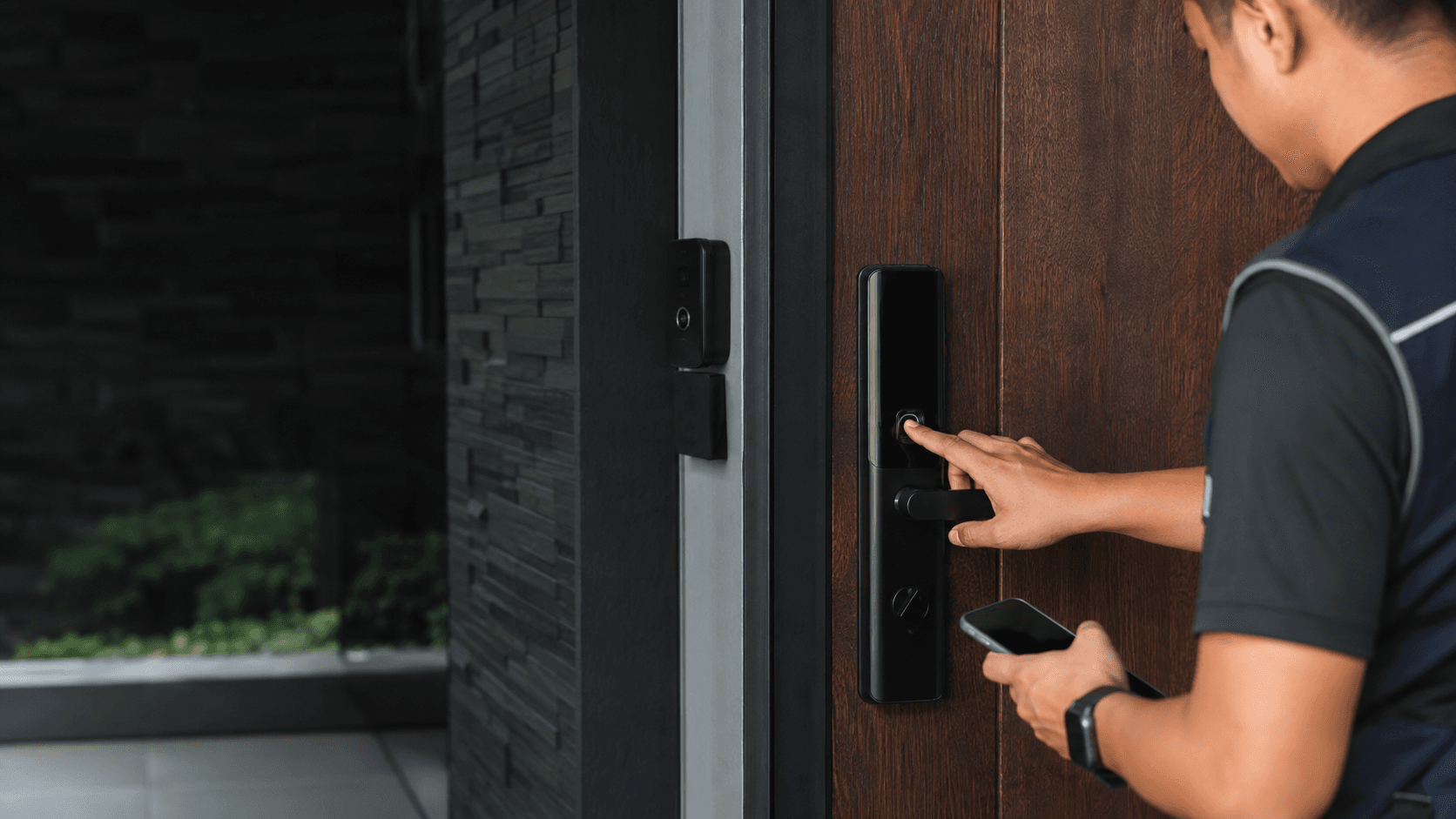
The exact-match query keyless deadbolt lock describes a deadbolt that is thrown and withdrawn without a physical key. The bolt itself still travels into the strike plate in the door frame, so the security job is unchanged. What changes is the credential. a numeric code, a fingerprint, a card, a phone, or a combination of these, instead of a cut key.
That single substitution reshapes daily life at a door. Codes can be issued to a family member, a tenant, a cleaner or a delivery contact, then removed when that access is no longer needed. No key needs to be copied, collected or tracked. The trade-off is that the lock now depends on power, electronics and a code that someone has to remember or store.
Keyless Deadbolt Lock. What the Lock Replaces
A conventional deadbolt is a mechanical assembly. A keyed cylinder on the outside turns a tailpiece that drives the bolt. A thumb turn on the inside does the same job by hand. Removing the key from the outside means replacing that cylinder with an electronic reader and a small motor or solenoid that drives the same bolt.
Three parts of the door therefore matter more than the electronics:
- The bore hole and cross bore already cut into the door, which determine whether a replacement body fits the existing preparation.
- The backset, the distance from the door edge to the centre of the bore, which must match the latch or bolt assembly supplied.
- The door thickness and the material of the door and frame, which affect how the bolt engages the strike.
On a metal gate, a glass door or a hollow-core internal door, the same lock body may not seat correctly, and the frame may not accept a strike plate without additional work. This is why a physical check of the door precedes any product decision.
For a business, the choice is not only which lock to buy. Eyonic's own review of smart lock door access notes that for business use the company usually checks whether a standalone smart lock or an access-control panel is more appropriate. A single office door with a handful of staff suits a standalone unit. A site with many doors, shift patterns and a need for central records points toward a panel-based system instead.
How a keyless deadbolt lock handles daily entry
Daily use is where the lock type earns or loses its place. A code entered on a keypad, a fingerprint read, or a command sent from a phone all end the same way: the bolt retracts and the door opens. The differences appear in the seconds around that moment.
Keypad entry suits a door used by several people who should not share one credential. Each person can hold a separate code, and a code can be deleted without rekeying anything. Fingerprint entry suits a door used mainly by one or two people who want to leave the house without carrying anything. App entry suits a door where the person granting access is not standing at it.
Auto-lock behaviour is a common reason people choose this lock type. The bolt can be set to throw itself after a short delay, which removes the human habit of forgetting to lock up at night. The cost is that a door left ajar, or a person stepping out briefly, can be locked against them.
Everyday reliability also depends on the reader. A keypad exposed to direct rain, salt air or heavy dust will behave differently from one under a porch roof. A fingerprint reader used by a person with wet or dirty hands may need a second attempt. These are physical constraints, not defects, and they shape which entry method belongs on which door.
Who should hold a code
Access should be issued by role, not by person, wherever the door serves more than a household. A household needs one code per adult and a temporary code for guests. A shop or office needs a code for each staff member, a separate code for a cleaner or contractor, and a rule for what happens when someone leaves.
The person who controls the lock should also control the list. If a code is created by a staff member rather than the owner or manager, revocation becomes guesswork. Before installation, it is worth deciding who adds codes, who removes them, and where the current list is kept.
What happens when a code is forgotten
A forgotten code is recoverable if the lock has an administrative code or an app that can reset it. It is not recoverable if the only credential was the forgotten one and no administrative route exists. This is a planning question, not a product question, and it belongs in the pre-installation conversation.
Door condition and user roles before installation
Eyonic's smart lock door access review states that smart locks work best when the door condition, user roles and backup method are reviewed before installation. Those three checks are the practical core of any keyless deadbolt lock project, and they are worth running in order.
- Check the door condition. confirm the door and frame are sound, the existing bore and backset match the intended lock body, the door closes squarely into the strike, and the door is sheltered enough for the reader being considered.
- Map the user roles. list every person or group who needs entry, decide whether each needs a permanent or temporary credential, and name the person who will add and remove codes.
- Agree the backup method. settle how the door is opened if the battery is flat, the code is forgotten or the electronics fail, and confirm that method is available at the door before the lock is relied on.
Running these three checks first avoids the most common disappointment, which is a lock that works perfectly on a bench and poorly on the actual door. A door that has swollen, dropped on its hinges or been patched around the old lock may need carpentry before any electronic hardware is fitted.
User roles also decide whether one lock is enough. A home with a single main entrance and a few residents fits a standalone unit. A workplace with a staff entrance, a store room and a visitor door is usually better served by a system that treats those doors as one access plan rather than three unrelated locks.
Backup entry and battery planning
Every electronic lock has a failure mode, and the useful question is what happens at the door when it occurs. The two predictable failures are a flat battery and a lost or forgotten credential.
Battery planning starts with knowing what the lock consumes and how it signals a low charge. A lock that warns early gives time to replace cells on a normal day. A lock that fails without warning turns a routine evening into a lockout. The warning behaviour, the cell type and the expected life all belong in the information supplied with the specific lock, and they should be confirmed for the exact model before purchase rather than assumed from a similar product.
Backup entry is the second half of the plan. Some locks retain a mechanical keyway for exactly this reason. Others rely on an external power contact or an administrative reset. Whichever route applies, it must be reachable from outside the door, and at least one person must know how to use it. A backup method that lives inside the house is not a backup method.
There is also a maintenance dimension. A lock on an exposed gate or an external door will need its battery checked more often than one on an internal door, and the reader surface will need occasional cleaning. Building that into a routine is cheaper than discovering it during a lockout.
in a Wider Security Setup
A door lock is one layer of a property's security, and it works best when the layers agree with each other. Eyonic plans, supplies and installs CCTV, alarm, autogate and keyphone intercom systems across Sarawak, and a door lock sits alongside those systems rather than replacing them.
The relationship is straightforward. A lock controls who passes through a door. A camera records what happened at that door. An alarm reports an intrusion when the door is forced or a zone is breached. An intercom lets someone inside speak to a visitor before deciding whether to open. An autogate handles vehicle entry at the perimeter.
Where these systems are planned together, the result is a coherent arrival sequence: a vehicle enters through the gate, a visitor is verified over the intercom, the door is opened with a code, and the camera records the movement. Where they are bought separately, each system still works, but the handovers between them are left to habit.
Eyonic's completed work for the Kuching Immigration Office focused on arrival flow, staff areas, visitor movement and dependable daily operation. That project illustrates the principle rather than the product: the value came from how movement through the site was organised, not from any single device. A keyless deadbolt lock belongs in the same kind of thinking, as one controlled point in a larger flow.
For a business, the access-control question sits above the lock question. A standalone smart lock is a reasonable answer for a small number of doors and a simple set of users. A site with many doors, contractors, shift changes and a need to review who entered and when is usually better served by a panel-based access-control system, with locks as the hardware at each door.
What to confirm before ordering
The information that decides whether a keyless deadbolt lock suits a particular door is mostly physical and administrative, and it can be gathered before any product is chosen.
On the door. the existing bore and backset, the door thickness, the material of the door and frame, whether the door closes squarely, and how much weather the outside face receives. On the users. how many people need entry, which of them need temporary access, and who will manage the code list. On the backup. how the door opens when the battery is flat or the code is forgotten, and whether that method is reachable from outside.
On the system. whether the lock will stand alone or connect to a wider access plan, and whether the site needs a record of who entered and when. On the installation. who will fit the lock, and whether the door needs preparation before it will accept the new body.
Two limits are worth stating plainly. The technical specifications of any specific keyless deadbolt lock, including cylinder type, door thickness range, backset, finish options and ingress rating, must come from that model's own documentation. The same applies to battery type and life, low-battery warning behaviour, emergency power method, security grading and warranty terms. None of those should be assumed from a similar product or from a general description of the lock type.
Where a property already has CCTV, an alarm, an autogate or an intercom, it is worth reviewing the door lock as part of that same setup rather than as an isolated purchase. Eyonic's installation work follows a site survey, a system proposal, installation and handover, and the same sequence applies to door access: the survey establishes what the door can accept, the proposal sets out what will be fitted, and the handover confirms that the codes, the backup method and the daily routine are understood by the people who will use them.
Share your location, property type and required system with Eyonic on WhatsApp at +60 11-5111 7959 for the next practical step.