
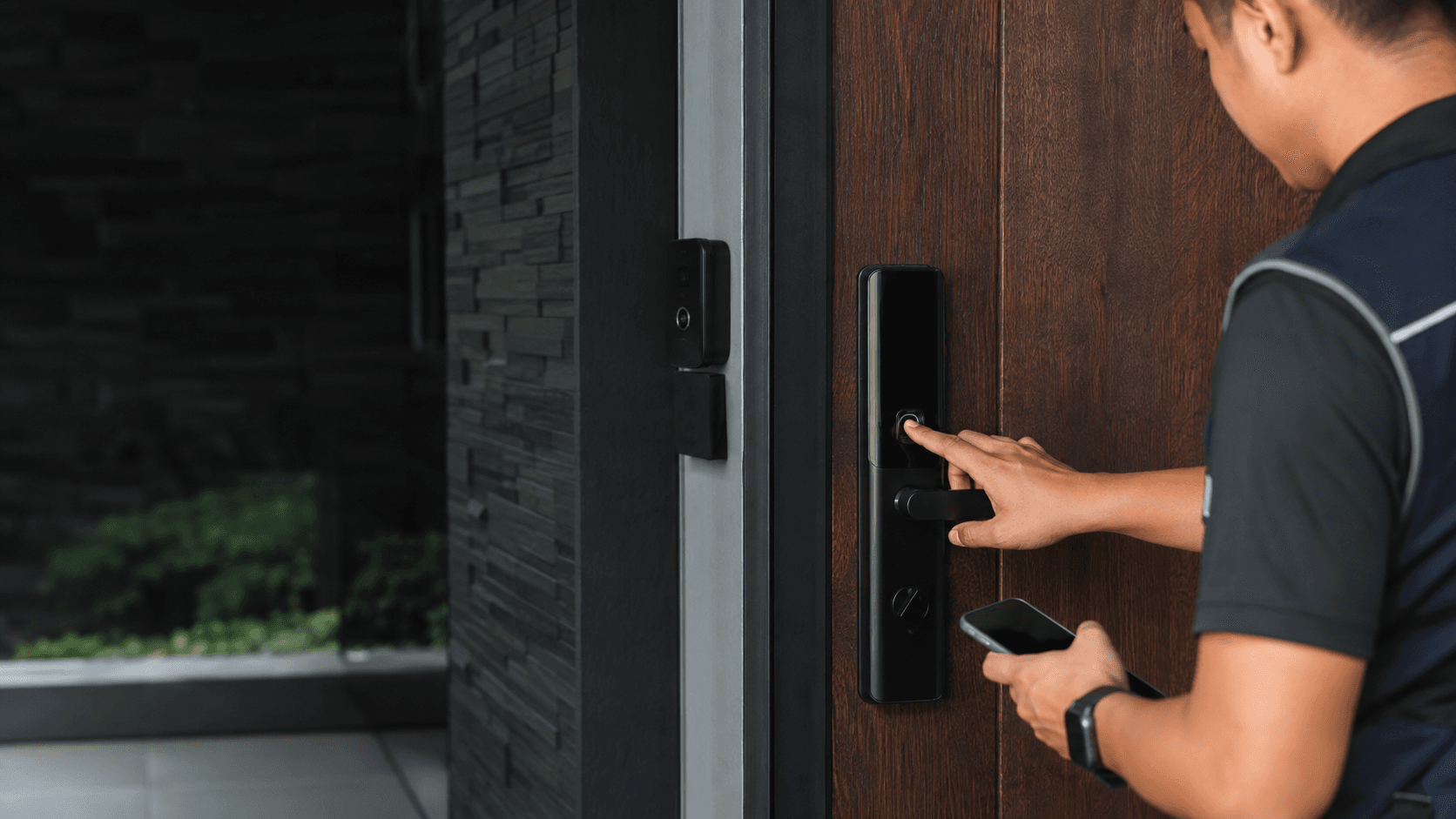
The exact-match query "digital keyless door lock" describes a lock that grants entry through a code or credential rather than a cut key. The category covers standalone keypad deadbolts, touchscreen levers, and locks that connect to a phone app or an access-control panel. Eyonic Sdn Bhd, a security system supplier in Sarawak, lists smart lock door access among its products and notes that smart locks work best when door condition, user roles, and backup entry are reviewed before installation.
Digital Keyless Door Lock. What Matters Before Choosing
Most buying mistakes in this category come from choosing the lock before checking the door. A digital keyless door lock has to fit the existing bore hole, the door thickness, and the frame alignment. If the door is warped or the strike plate sits poorly, even a well-made lock will bind.
Three practical checks come before any product comparison:
- Confirm the door type and existing hardware, since a deadbolt replacement and a lever replacement use different fittings.
- Decide how many people need entry and whether each person needs a separate code or credential.
- Agree on a backup entry method, because a lock that depends only on a keypad fails when the battery drains.
- Check whether the door is exposed to direct rain or strong sun, since that affects keypad durability and readability.
- Decide whether the lock stands alone or connects to a wider access-control system with logging and permissions.
Eyonic's own review guidance makes the same point: smart locks work best when the door condition, user roles, and backup method are reviewed before installation. For business use, the company usually checks whether a standalone smart lock or an access-control panel is more appropriate. That distinction matters because a shop with staff turnover needs different controls than a single home entrance.
Choosing the Right Digital Keyless Door Lock
The right choice depends on who needs entry and how often that group changes. A household with two or three regular users can work well with a standalone keypad deadbolt. A small office with visiting contractors, delivery staff, or short-term tenants usually needs per-user codes that can be added and removed without rekeying anything.
Access method is the next decision. Keypad and touchscreen locks rely on a memorised code. Card and fob locks suit workplaces where staff already carry an ID credential. App-based locks add remote control and entry history, but they depend on a working network and a charged phone.
Power and backup deserve attention before purchase. Battery-powered locks need a plan for replacement, and many models accept a temporary external power source when the battery is flat. A mechanical key override is common, but it reintroduces a physical key that can be copied or lost, which partly defeats the purpose of going keyless.
What is digital keyless door lock in practice?
In practice, a digital keyless door lock is a locking device that authenticates entry electronically instead of mechanically. The user presents a code, card, fingerprint, or phone credential, and the lock releases the bolt or latch. Some models store credentials locally on the device; others check with a panel or app before releasing.
This matters for two reasons. First, entry can be revoked without changing the lock, which is useful when a tenant moves out or an employee leaves. Second, the lock can record when entry happened, which supports accountability in a workplace. Neither benefit applies to a purely mechanical lock.
Practical Considerations for Digital Keyless Door Lock Installation
Installation difficulty varies more than product marketing suggests. A retrofit lock that fits over an existing deadbolt is usually the simplest path. A full replacement that changes the bore or the backset takes longer and may need carpentry work.
Eyonic's installation process for its security work follows a site survey, a system proposal, installation, and handover. The same sequence applies to door access: the survey confirms door condition and user roles, the proposal sets out the lock or panel choice, installation fits and configures the hardware, and handover covers codes, permissions, and backup entry.
Network dependence is a real constraint. A lock that relies on Wi-Fi or a hub will not respond to a phone command during an outage, though a keypad code stored on the device usually still works. For sites where entry must never depend on an internet connection, a locally stored code or a card credential is the safer design.
Battery life and environmental exposure are the two most common sources of complaints. A keypad facing afternoon sun in Sarawak reads differently from one under a shaded porch, and the same principle Eyonic applies to camera placement — checking actual conditions before confirming a position — applies to lock placement and keypad orientation.
Making an Informed Choice About Digital Keyless Door Lock Systems
The decision usually comes down to scale and control. A single home entrance is well served by a standalone keypad lock with a mechanical override and a spare battery on hand. A multi-door office, a shop with shift changes, or a site with visitor movement needs credential management, entry logs, and a clear process for adding and removing users.
Eyonic's completed work shows how that thinking plays out in practice. The Kuching Immigration Office project focused on arrival flow, staff areas, visitor movement, and dependable daily operation. The KTA Sarawak Sdn Bhd project supported staff movement, visitor handling, tidy cabling, and clearer daily site control. Both are access and movement problems rather than lock problems, which is why a standalone lock is sometimes the wrong answer for a business entrance.
Budget expectations should be set before specification. Eyonic's published packages for CCTV, alarm, and autogate work are each priced at RM 1,599, and its completed office projects fall in the RM 8,000 to RM 18,000 and RM 12,000 to RM 28,000 ranges depending on scope. Door access work sits within a similar planning logic: the hardware is one line, and survey, cabling, configuration, and handover make up the rest.
For readers comparing options, the useful next step is to gather the facts a supplier needs — door type, number of users, whether entry must work offline, and whether logs are required. Eyonic can be reached on WhatsApp at +60 11-5111 7959 with the location, property type, and required system.