
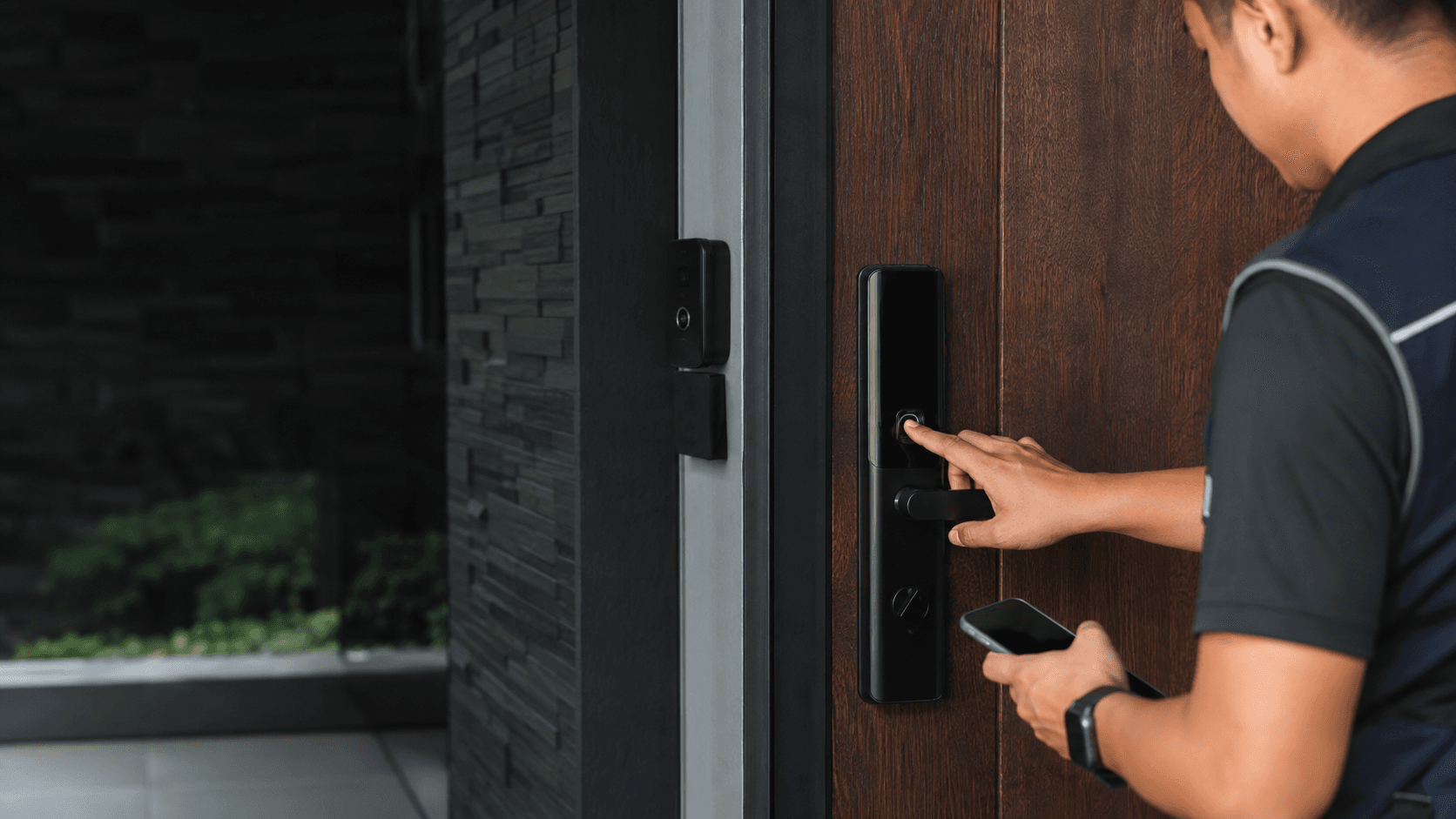
The exact-match query kwikset zwave lock describes hardware that talks to a controller rather than to the internet directly. That single design choice shapes everything else: which hub accepts it, how pairing runs, and what happens when the network drops.
Kwikset publishes support pages for the Home Connect 620 Traditional Keypad Connected Smart Lock with Z-Wave Technology and for the Kwikset Convert Smart Lock Conversion Kit with Z-Wave Technology. Both are named on Kwikset's own site, so both can be discussed as real products. What Kwikset does not publish in those pages is a Malaysian frequency statement, a local distributor list, or a warranty path for this market.
Kwikset Zwave Lock. What It Is and How It Connects
Z-Wave is a low-power mesh radio. Each mains-powered device on the network repeats signals for its neighbours, which is why a lock near the front door often reaches a hub at the back of the house through an intermediate device rather than directly.
A Kwikset Z-Wave lock is a battery device, not a repeater. It sleeps most of the time to preserve battery, wakes to send status, and returns to sleep. That behaviour explains the two things buyers notice first: lock commands can take a moment to register, and the lock's reported state can lag behind the physical bolt.
The lock does not need Wi-Fi. It needs a controller that speaks Z-Wave and a network the lock has been added to. Remote access arrives through the controller's own app, not through Kwikset.
Where the network boundary sits
Three layers matter. The lock is the end device. The hub or alarm panel is the controller. The app is a view onto the controller. If the controller is offline, the lock still works by keypad and key, but app control and status stop.
This is the practical difference between a Z-Wave lock and a Wi-Fi lock. A Wi-Fi lock depends on the home router. A Z-Wave lock depends on the controller and the mesh around it. Neither is automatically more reliable; they fail in different ways.
Which Kwikset Z-Wave Models Appear in Current Listings
Kwikset's own support and product pages name several Z-Wave items. The table below records only what those pages state, and marks the rest as unverified rather than filling gaps from reseller listings.
| Model named by Kwikset | Connection type stated | What still needs confirming |
|---|---|---|
| Home Connect 620 Traditional Keypad Connected Smart Lock | Z-Wave technology | Z-Wave generation, regional frequency, hub compatibility list |
| Kwikset Convert Smart Lock Conversion Kit | Z-Wave technology | Which existing deadbolts the kit fits, regional frequency |
| 918 HomeConnect Contemporary Electronic Deadbolt | Z-Wave technology | Current availability, regional frequency, hub compatibility list |
The Convert kit is the odd one out. It is not a full lock. It replaces the interior half of an existing deadbolt so the door keeps its exterior hardware. That makes it attractive where the outside finish must match the rest of the house, and awkward where the existing deadbolt is not a compatible model.
Reseller catalogues list further Z-Wave items, including SmartCode deadbolts and Home Connect lock modules sold separately. Those listings are useful as a map of what exists, but they are not Kwikset documentation. Treat any model not named on a Kwikset page as unconfirmed until the manufacturer or a supplier confirms it.
Pairing a Kwikset Z-Wave Lock to a Hub
Pairing is called inclusion. The order matters, and the most common failure is pressing the lock's button before the controller is listening.
- Put the controller into Z-Wave inclusion or add-device mode first, and keep it within radio range of the door.
- Press the learn button on the lock's interior assembly once, as directed by the lock's own instructions.
- Wait for the controller to confirm a new device has joined, then name the lock and assign it to a room.
- Test the bolt from the app, then test the keypad and the physical key separately.
If the controller never sees the lock, run exclusion before retrying. Exclusion clears a stale pairing record, and a lock that was previously joined to another network will refuse a fresh inclusion until that record is removed. Exclusion is a controller-side command; the lock only needs to be awake and in range.
What pairing does not fix
Inclusion does not improve radio range, and it does not make a jammed bolt retract. If the deadbolt binds in the strike plate, the lock will report a jam regardless of how cleanly it paired. Fix the door before blaming the network.
Pairing also does not create a user list. Codes and schedules live in the lock or in the controller depending on the model and the platform. Where the controller manages codes, the lock's own keypad programming may be limited. That distinction matters for anyone planning staff or tenant access.
Door, Deadbolt and Backup Entry Checks
Most failed smart lock installations are door problems, not electronics problems. The checks below are the ones that decide whether a Kwikset Z-Wave lock fits at all.
- Measure door thickness and the backset, the distance from the door edge to the centre of the bore hole, and compare against the lock's stated requirements.
- Inspect the existing deadbolt and confirm whether a full replacement or a conversion kit is the right route.
- Confirm the controller speaks Z-Wave and supports the lock, using the controller maker's compatibility list rather than a shop listing.
- Decide the backup entry method before installation, so a dead battery or a flat controller never leaves the property with no way in.
Backup entry deserves more attention than it usually gets. A keyed override cylinder is one option. A second entrance with a mechanical lock is another. What does not work is assuming the app will always be available, because the app depends on the controller, the network, and a charged phone.
Eyonic's own review of smart lock door access makes the same point in local terms: smart locks work best when door condition, user roles and backup method are reviewed before installation, and for business use the choice between a standalone smart lock and an access-control panel should be settled first. That guidance is about smart locks generally, not about Kwikset specifically, but the sequence applies.
Edge cases worth naming
Metal doors and metal frames can weaken radio performance. A lock on a steel gate or a metal-clad door may pair at close range and then behave inconsistently once the door is closed. Where that happens, the fix is usually a repeater or a different controller position, not a different lock.
Rental properties add a second constraint. Replacing a deadbolt changes the exterior hardware, which may not be permitted. A conversion kit avoids that, but only if the existing deadbolt is compatible.
Support and Installation in Malaysia
This is where the evidence runs out, and it is better to say so than to guess. No Malaysian pricing, stock, warranty or distributor information for Kwikset Z-Wave locks was supplied for this article, and no evidence confirms whether the brand is officially supported in Malaysia or which Z-Wave frequency applies locally.
Z-Wave radios are region-locked by frequency. A lock built for one market does not necessarily join a controller built for another. That single fact is the reason a buyer in Malaysia should confirm frequency and controller compatibility in writing before paying for hardware, rather than after it arrives.
Installation itself is ordinary locksmith work plus a network step. The mechanical fitting follows the door checks above. The network step follows the pairing sequence. Neither is exotic, but both need someone who will test the bolt, the keypad, the key and the app before signing off.
Eyonic plans, supplies and installs security systems across Sarawak, covering site survey, camera placement, NVR setup and remote viewing, and it has completed work for the Kuching Immigration Office focused on arrival flow, staff areas, visitor movement and dependable daily operation. That project is CCTV and access work, not a Kwikset installation, and it should not be read as brand-specific experience. What it does show is the working method: survey first, then a proposal, then installation and handover.
For a property in Malaysia considering a Kwikset Z-Wave lock, the honest position is that the lock is a real product with published support pages, and the local supply, frequency and warranty path are the parts that need confirming case by case.
Costs Timelines and What to Prepare
No verified Malaysian price for a Kwikset Z-Wave lock was supplied, so no figure is quoted here. Local pricing depends on the model, the route it arrives through, and whether installation is bundled.
For context on what security work costs in this market, Eyonic's published packages sit at RM 1,599 for a Hikvision CCTV package, RM 1,599 for a Hikvision alarm system, and RM 1,599 for an autogate package. Those are different product categories and do not price a smart lock. They are useful only as a sense of the local market's package pricing.
Timelines split into two parts. Sourcing the lock is the variable, because it depends on stock and shipping. Fitting and pairing is the predictable part, and it is usually a single visit once the door checks are done and the controller is on site.
Prepare four things before anyone arrives: the door thickness and backset measurements, the make and model of the existing deadbolt, the controller's make and model, and a decision on backup entry. With those four answers, the fit question is settled quickly. Without them, the visit becomes a survey.
Share the location, property type and required system with Eyonic on WhatsApp at +60 11-5111 7959 for the next practical step.