
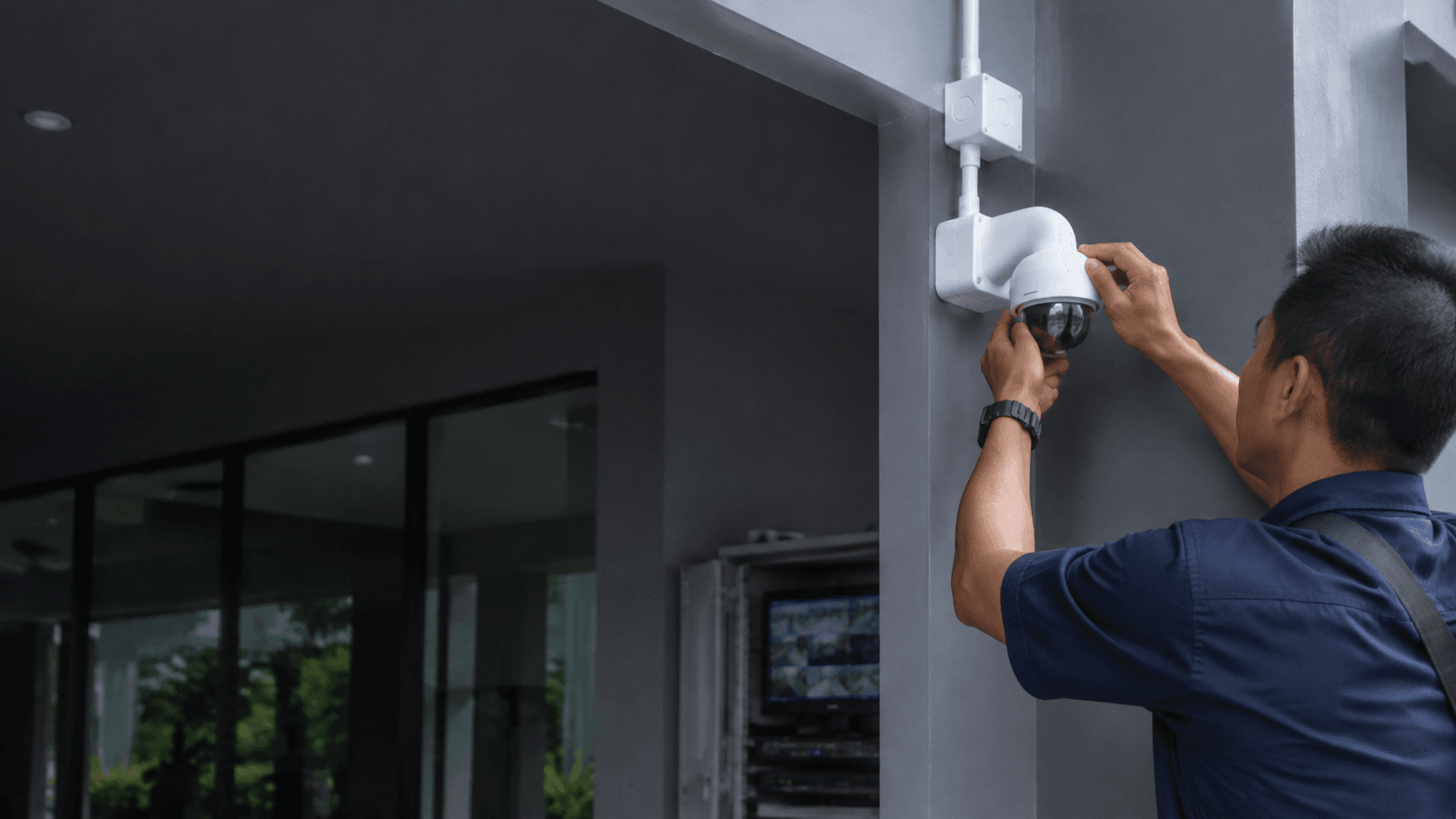
The trade-off is straightforward: freedom from cabling in exchange for a charging routine and a placement plan that keeps the camera within reach. Eyonic Sdn Bhd, a security system supplier in Sarawak, plans, supplies and installs monitoring systems with camera placement, recording and remote viewing for homes, offices, shops and industrial sites.
Rechargeable CCTV Camera. What It Changes for a Site Without Cabling
A wired camera draws power continuously from a fixed circuit. A rechargeable CCTV camera carries its own power source, so the installation question shifts from "where can a cable reach" to "where can the camera see, and how will it be charged."
That shift matters most on sites where running cable is difficult, disruptive or visually unacceptable. A rented shop unit, a heritage building frontage, a temporary site office or a boundary wall far from any power point are all cases where a wire-free camera avoids trenching, conduit runs and the permission that cabling work can require.
The cost of that flexibility is maintenance. Every battery-powered camera eventually needs charging, and the charging routine has to be planned before the camera is mounted, not after. A camera fixed high on a wall with no safe access becomes a problem the first time the battery runs down.
How a rechargeable CCTV camera handles power, charging and recording
Power, charging and recording are three separate decisions, and each one affects the others.
- Confirm the power source. an internal rechargeable battery, a battery paired with a solar panel, or a removable battery pack that can be swapped.
- Decide how the camera will be charged and who will do it, including whether the mounting height allows safe access.
- Check the recording setup. local storage on a memory card, a network recorder, or a cloud subscription, and whether recording runs continuously or only on motion.
- Verify remote viewing works on the property's actual internet connection before the camera position is finalised.
- Agree who reviews the site and confirms placement before any bracket is fixed to the wall.
Recording behaviour directly affects how long a charge lasts. A camera that records continuously draws far more power than one that wakes on motion, so the recording setup and the charging interval are linked. Where a camera is expected to run continuously, a wired connection or a solar-assisted setup is usually the more realistic choice.
Remote viewing depends on the camera reaching the network. A position with strong sightlines but weak signal will deliver poor live view and unreliable alerts, so signal strength belongs in the placement decision alongside the field of view.
Where a rechargeable CCTV camera suits homes, shops and offices
Battery-powered cameras fit situations where cabling is the main obstacle rather than the main requirement.
For homes, the common cases are gate areas, back lanes and outbuildings where no power point exists. For shops, a wire-free camera can cover a rear entrance or a stockyard without shutting down trading for a cable run. For offices, a battery camera can cover a corridor, a server room door or a visitor entrance where drilling through finished walls is undesirable.
Eyonic's completed work shows the range of environments involved. A project for the Kuching Immigration Office focused on arrival flow, staff areas, visitor movement and dependable daily operation. A separate project for KTA Sarawak Sdn Bhd supported staff movement, visitor handling, tidy cabling and clearer daily site control. Both are the kind of sites where coverage has to be planned around how people actually move, not just where a cable can be pulled.
Battery power is a weaker fit where continuous recording is required around the clock, where the camera must sit beyond safe reach, or where the site already has power and cabling routes available. In those cases a wired camera removes the charging routine entirely.
What to compare before choosing a rechargeable CCTV camera
The comparison that matters is not battery versus cable in the abstract, but which constraint the site can live with.
| Consideration | Rechargeable CCTV camera | Wired camera |
|---|---|---|
| Power source | Internal rechargeable battery | Fixed power circuit |
| Cabling needed | None for power | Power and video cabling |
| Routine | Charging or battery swap | No charging routine |
| Placement limit | Must stay reachable and within signal range | Must stay within cable route |
Two further points decide most projects. The first is whether the camera position can be reached safely for charging, because a battery camera that cannot be serviced is not a practical installation. The second is whether the site's lighting suits the camera being considered. Eyonic recommends checking actual lighting conditions before confirming placement for ColorVu-style cameras, and the same discipline applies to any camera chosen for night coverage.
Where a site already has power and a cable route, the documented Hikvision CCTV package at RM 1,599 covers camera supply and setup, basic recording configuration and mobile viewing handover. That package is a wired option, not a rechargeable one, and it is the appropriate reference point when cabling is available.
Placement checks that decide whether a rechargeable CCTV camera works
Placement is where a battery camera succeeds or fails. The checks below are the ones that change the outcome.
- Lighting conditions at the actual position, checked on site rather than assumed from a product description.
- Camera position relative to the entry, exit or asset being covered, including whether the angle captures faces or only movement.
- Charging access, including mounting height, ladder safety and whether a solar panel would reduce the charging frequency.
- Recording setup, matched to how long the camera is expected to run between charges.
- Network signal at the mounting point, tested before the bracket is fixed.
- Who reviews the site and signs off the final position before installation begins.
Eyonic's CCTV installation process runs through site survey, system proposal, installation and handover. The survey stage is where placement, charging access and lighting are settled, which is why it comes before any equipment is confirmed.
Planning a rechargeable CCTV camera installation in Sarawak
Sarawak sites bring their own conditions into the decision. Long rainy periods, dense vegetation and buildings that were not designed with cable routes in mind all affect where a camera can go and how often it will need charging.
For a property in Kuching or elsewhere in Sarawak, the practical sequence is to survey first, confirm placement and charging access second, and choose the power method last. That order prevents the common mistake of buying a battery camera for a position that turns out to be unreachable, or wiring a camera into a spot where a battery unit would have been simpler.
Eric Yong, founder of Eyonic Security Systems, has worked in the industry for more than ten years and is experienced in technical installation of digital security solutions for commercial businesses in Sarawak.
Share your location, property type and required system with Eyonic on WhatsApp at +60 11-5111 7959 for the next practical step.