
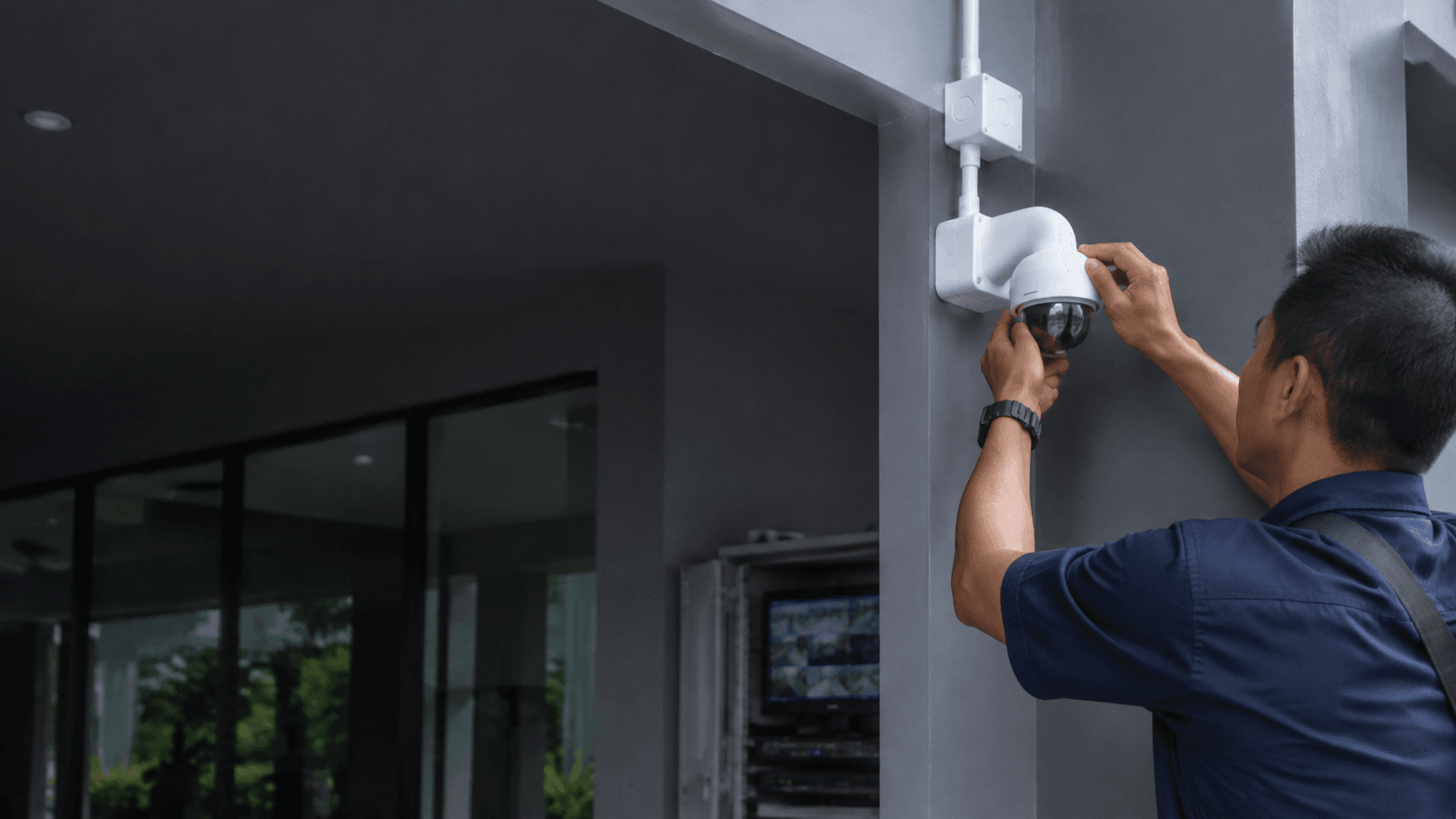
The exact-match query eufy cctv sits in a crowded field. Six analysed pages rank for it, and none of them uses the phrase in the H1 or in body text. That leaves the term effectively unclaimed, which is why this page treats it as the organising subject rather than a keyword to sprinkle.
Two things shape the decision. First, how the cameras get power and send video. Second, where the recordings live and who can retrieve them. Everything else — resolution, app design, detection rules — follows from those two.
eufy cctv: What the Wire-Free Camera Range Covers
Wire-free security cameras are the core of the range. A camera holds its own battery, or draws from a small solar panel, and sends video over Wi-Fi to a hub rather than down a video cable to a recorder.
That single design choice changes the rest of the system. There is no cable run to each camera position, so a camera can sit where a cable would be awkward: a gate pillar, a rented shopfront, a corner of a car porch with no trunking route back to a cabinet.
The trade-off is equally clear. A wire-free camera depends on its battery and on the wireless link holding up. A wired camera depends on the cable, which either works or is physically damaged. Neither is universally better; they fail in different ways.
Indoor and outdoor models exist in the same family, along with doorbell cameras and floodlight-style units. The practical difference between them is mostly mounting position and how much light the position receives.
How Eufy Cctv Cameras Are Powered and Connected
Power and connection are the two questions that decide whether a position is viable. A camera that cannot be reached for charging, or that sits behind a thick wall from the hub, will disappoint regardless of its image quality.
Battery and solar power suit positions where no mains supply exists. A solar panel extends the interval between manual charges, but only where the panel gets consistent daylight. A shaded wall defeats it.
PoE connection is the other route. Power over Ethernet carries both electricity and data down one cable, which removes battery charging from the maintenance list entirely. It also requires a cable run, which is the same constraint a conventional CCTV system carries.
Wireless range is the quiet constraint. A hub placed in a front room may serve the porch well and the rear extension poorly. Moving the hub, or adding a camera with a wired backhaul, often solves what looks like a camera fault.
Local Storage and Subscription Questions Around Eufy Cctv
Local storage is the feature that pulls most readers toward this range. Footage is written to storage attached to the HomeBase hub rather than to a cloud account, and subscription-free recording means the system keeps working without a monthly fee.
That matters over a multi-year horizon. A subscription is a recurring cost that continues for as long as the recordings are wanted. Local storage is a one-time capacity decision: buy enough, and the cost stops there.
Capacity is the limit to plan around. Recordings overwrite the oldest footage once storage fills, so retention depends on how many cameras run, how often they trigger, and how long each clip is. A busy shopfront fills storage far faster than a quiet residential gate.
Remote viewing still works with local storage. The recordings live on the hub, and the app reaches them over the network. The difference is where the file sits, not whether it can be seen from elsewhere.
Eufy Cctv Placement. Lighting, Coverage and Entry Points
Placement decides whether the footage is useful. A camera pointed at a dark corner records a dark corner, and no amount of resolution fixes that.
Eyonic recommends checking actual lighting conditions before confirming placement for ColorVu-style cameras. The same discipline applies to any camera choice: stand at the position at night and look at what the lens would see.
Entry points deserve priority over wide views. A gate, a side door, and a back lane access point each carry more value than a sweeping shot of an empty yard. Coverage that includes the approach to a door is more useful than coverage of the door alone.
Night vision performance varies with the light available at the position. A camera with a nearby streetlight behaves differently from one facing an unlit field, and the position should be chosen with that difference in mind.
Planning a setup follows a predictable sequence:
- Confirm the areas that need coverage, ranking entry points above general views.
- Check power and network reach at each proposed position, noting where mains or PoE is available.
- Decide local storage capacity based on camera count and expected daily recording volume.
- Verify lighting at each position after dark, not from a daytime walkthrough.
- Confirm who installs the system and who hands over the app, recording settings, and remote viewing access.
Eufy Cctv Compared With an Installed CCTV System in Malaysia
The comparison that matters for a Malaysian property is not brand against brand. It is self-installed wire-free kit against a locally installed system with a site survey, cabling, and handover.
| Consideration | Eufy Cctv | Installed CCTV system |
|---|---|---|
| Power source | Battery, solar, or PoE depending on model | Wired power at each camera position |
| Storage location | Local storage at the hub | Recorder on site |
| Subscription requirement | Subscription-free recording | No subscription needed for local recording |
| Installation route | Self-installed, or arranged separately | Site survey, system proposal, installation, handover |
| Who handles setup | Buyer, unless installation is arranged | Installer, with handover of app and recording settings |
The installation route is where the two diverge most. Eyonic's CCTV installation process includes site survey, system proposal, installation, and handover. A self-installed kit skips all four steps, which is faster and cheaper up front and leaves the buyer responsible for camera angles, storage settings, and remote viewing setup.
For a home with a clear line of sight and a willing owner, the wire-free route is straightforward. For a shop, office, or industrial site where cabling must be tidy and the system must survive staff changes, the installed route carries less ongoing risk.
Eyonic's completed work shows what the installed route looks like in practice. The Kuching Immigration Office project focused on arrival flow, staff areas, visitor movement, and dependable daily operation. A KTA Sarawak Sdn Bhd project covered staff movement, visitor handling, tidy cabling, and clearer daily site control. Both are public-office and consultancy settings rather than residential installs, and both point to the same thing: the value sits in placement and handover, not in the box.
Budget expectations differ too. Eyonic's published packages start at RM 1,599 for a Hikvision CCTV package covering camera supply and setup, basic recording configuration, and mobile viewing handover. Comparable project work has run in the RM 8,000 to RM 18,000 range for an office setup and RM 12,000 to RM 28,000 for a larger public-office installation. No supplied evidence confirms Eufy Cctv pricing, availability, warranty, or local distributor support in Malaysia, so that side of the comparison cannot be costed here.
What to Confirm Before Choosing Eufy Cctv
Four checks settle most of the decision before any purchase.
Confirm the property type and who controls it. A rented shop unit and an owned home carry different constraints on drilling, cabling, and who removes the equipment at the end of a tenancy. No supplied evidence establishes Malaysian regulatory, strata, or landlord requirements for wire-free camera installation, so those questions belong with the building owner or management.
Confirm the power reality at each position. A camera that needs a ladder and an indoor charge every few months is a different commitment from one wired to a permanent supply.
Confirm storage capacity against expected recording volume. Under-sizing storage shortens retention, and retention is usually the reason the system was bought.
Confirm who installs and who hands over. A self-installed kit leaves that with the buyer. An installed system should end with the app working, recording configured, and remote viewing tested before the installer leaves.
Where the property is in Sarawak and the requirement includes cabling, placement, and handover, Eyonic plans, supplies, and installs monitoring systems with camera placement, recording, and remote viewing for homes, offices, shops, and industrial sites. Share the location, property type, and required system on WhatsApp at +60 11-5111 7959 for the next practical step.