
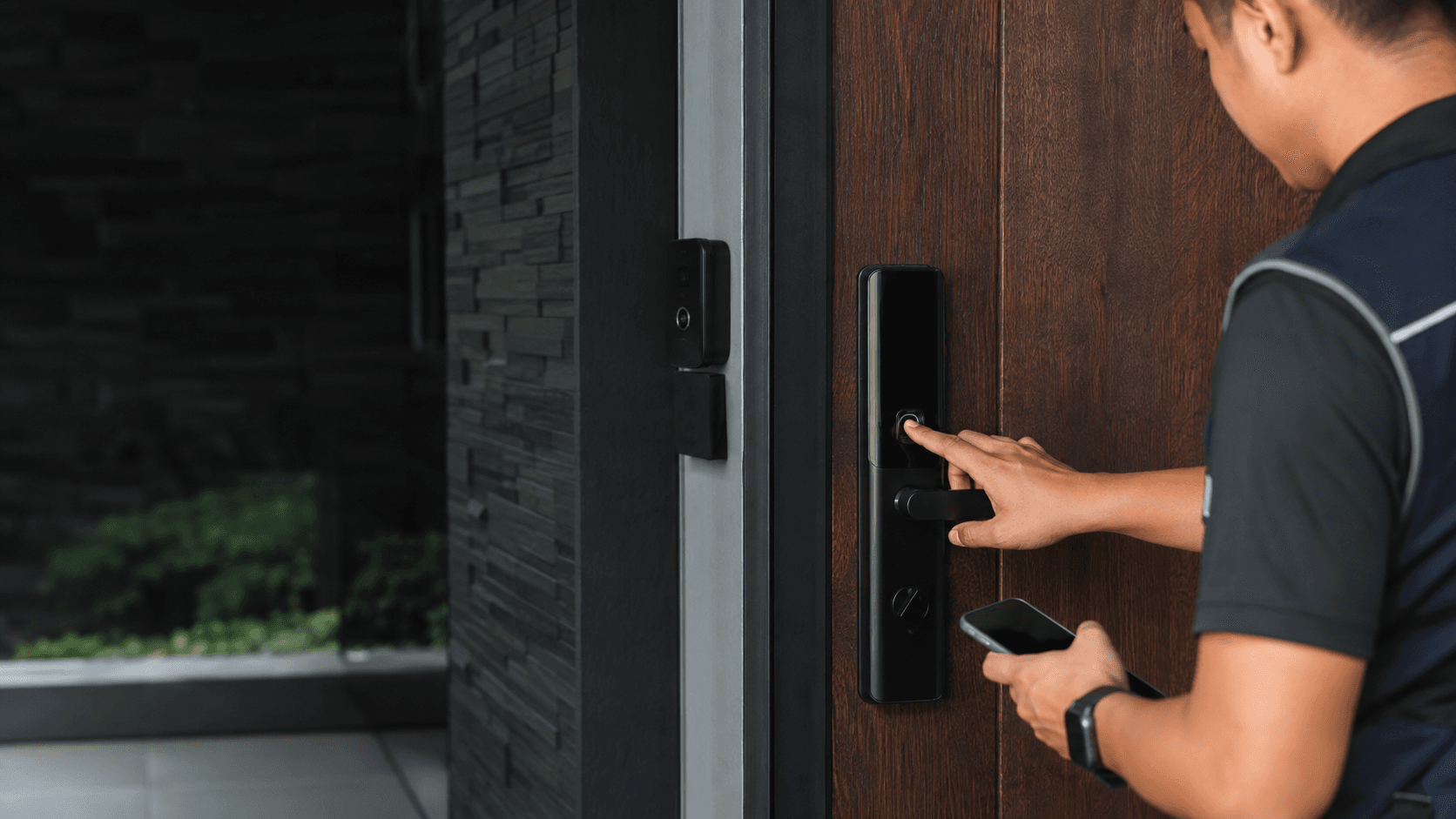
The brand sits inside a group that owns several lock makers, so two buyers can ask for the same thing and end up looking at different hardware. That is why the useful question is not which badge is on the box, but whether a given lock suits a given door, who will hold access, and what happens when the electronics stop cooperating.
What an Assa Abloy Smart Lock Covers
ASSA ABLOY is a lock group rather than a single product line. Its published smart and digital lock pages describe keyless locking for homes and multi-residential buildings, and the same pages name Yale and Lockwood as brands within the range. A shopper searching for an Assa Abloy Smart Lock is therefore usually looking at one of several sub-brands, not one universal model.
That matters in Malaysia because the badge on the box does not tell anyone which credential types are supported, how the lock is powered, or whether it can be managed as part of a wider door access setup. Those are model-level facts, and they have to be confirmed against the specific product documentation before anything is ordered.
For business premises, the practical split is between a standalone smart lock and an access control panel. A standalone lock handles one door and a modest set of users. A panel-based system handles multiple doors, shared rules, and a record of who entered. Eyonic's own product review notes that for business use it usually checks whether a standalone smart lock or an access-control panel is more appropriate, which is the same fork any buyer faces.
Door and Property Conditions That Decide the Model
Door condition decides more than brand preference. A lock that fits a solid timber door may not suit a narrow aluminium frame, a glass door, or a fire-rated door leaf, and the reverse is also true. Because no verified door thickness range or dimension set is available for specific models here, the honest position is that the door must be assessed before a model is chosen.
Three conditions do most of the filtering:
- Door leaf and frame material. Timber, metal, aluminium, and glass doors accept different fixing methods and different lock bodies.
- Existing cutout and mortise. A door already prepared for a mechanical lock may need modification, or may suit a retrofit body better than a full replacement.
- Closing behaviour. A door that does not latch cleanly on its own will not be fixed by adding electronics; alignment and strike position come first.
Property type changes the requirement too. A single residential entrance has one user group and one door. A shop, office, or multi-residential block has staff, visitors, contractors, and sometimes tenants, each needing different levels of access. The Kuching Immigration Office project Eyonic completed centred on arrival flow, staff areas, visitor movement, and dependable daily operation, which is the same set of concerns a commercial door access decision has to answer.
Access Roles, Backup Entry and Power
Access roles are the part buyers most often leave until after installation. A lock that works perfectly for a household of four becomes a problem when a shop needs to add and remove staff access, or when a cleaner needs entry on two evenings a week and nothing more.
Before ordering, it helps to write down who needs access and at what level: permanent residents or staff, recurring visitors, one-off contractors, and anyone who needs temporary access that expires. If that list is long or changes often, a lock managed through a panel or software is usually a better fit than a lock managed at the door.
Backup entry is the second decision. Every electronic lock eventually faces a flat battery, a failed reader, or a lost phone, and the recovery method has to be settled in advance. Options generally fall into a mechanical key override, a physical keypad code, or an external power point. Whichever is chosen, the backup path should not depend on the same component that has failed.
Power and connectivity follow from the same logic. Battery-powered locks avoid cabling but introduce a maintenance cycle. Mains-powered or networked locks avoid battery changes but need a cable route and a stable network. Where the lock is expected to report events or be managed remotely, connectivity is not optional, and a site with weak Wi-Fi at the door will behave differently from one with a wired connection.
Installation and Handover in Malaysia
Installation quality decides whether a good lock performs well. Eyonic's CCTV installation process runs through site survey, system proposal, installation, and handover, and the same sequence applies to door access work: the survey establishes what the door can take, the proposal fixes the scope, installation fits and configures it, and handover transfers the working system and its credentials to the people who will run it.
Handover is where most problems are prevented. It should cover how each user is added and removed, how the backup entry method works, what the low-battery or fault indication looks like, and who to contact when something fails. A lock handed over without that information tends to be bypassed within weeks.
Local support matters for the same reason. A lock that needs a replacement part or a firmware change is only as useful as the party able to attend to it. Buyers in Sarawak and elsewhere in Malaysia should confirm who provides support, what the response path is, and whether the installer or the supplier holds that responsibility.
What to Confirm Before Ordering
Work through these checks in order. Each one can eliminate a model before money changes hands.
- Confirm the door and frame condition, including material, thickness, existing cutout, and whether the door latches cleanly.
- Confirm who needs access and at what level, separating permanent users from recurring visitors and one-off contractors.
- Confirm the backup entry method and make sure it does not rely on the component most likely to fail.
- Confirm power and connectivity, including battery maintenance or cable routing and network stability at the door.
- Confirm installation and handover responsibilities, including who configures users and who provides support afterwards.
Two further points are worth settling at the same time. First, whether the lock will ever need to work with other systems, such as an intercom, an alarm, or a wider access platform, because that requirement narrows the field quickly. Second, whether the property is a single entrance or part of a larger site, since a multi-door requirement is usually better served by a panel-based approach than by several independent locks.
Where the door is unusual, the building is tenanted, or the access list changes regularly, a site survey before purchase is the cheaper path. It converts an uncertain product decision into a defined scope, and it prevents the common outcome where a lock is bought first and the door is found unsuitable afterwards.
Share your location, property type and required system with Eyonic on WhatsApp at +60 11-5111 7959 for the next practical step.