
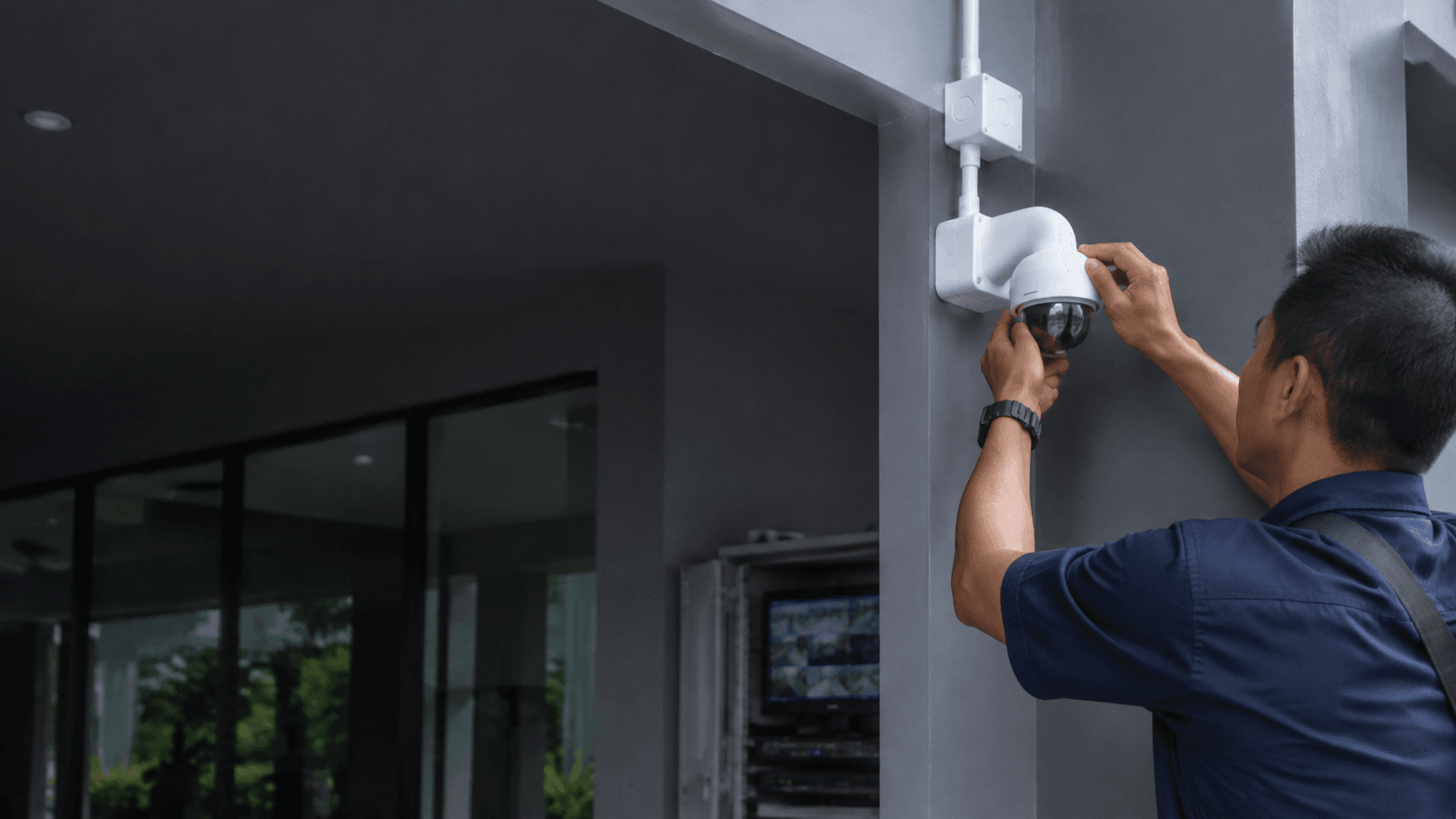
The appeal is straightforward. a household buys the equipment, mounts it without a contractor, and watches the feed from a phone. The trade-off is that placement, lighting and recording settings decide whether the footage is actually useful, and those decisions are usually made by whoever installs the kit.
Diy Home Security Systems With Cameras: What Matters Before You Choose
A typical kit is not one product. It is a small collection of parts that must work together, and the parts differ depending on whether the goal is recording, alerting, or both.
Cameras form the visible layer. Indoor models sit on shelves or brackets; outdoor models need a mounting point, weather cover and a cable or power route. Entry sensors cover doors and windows. A siren or strobe adds a local deterrent. The hub or recorder ties the devices together and stores footage or event logs.
Eyonic's own service description covers camera placement, recording and remote viewing for homes, offices, shops and industrial sites, which maps onto the same three layers a self-install kit reproduces in miniature. The difference is who decides where each camera points.
Cameras, sensors and hubs
Camera choice drives most of the cost and most of the disappointment. A camera aimed at a bright doorway will silhouette anyone walking through it; a camera aimed at a dark corner may record nothing usable at night. Eyonic's guidance on ColorVu-style cameras is to check actual lighting conditions before confirming placement, because the installed result depends on the scene rather than the model name alone.
Sensors are simpler. Door and window contacts report open and closed states. Motion sensors report movement in a defined area. Both are only as good as their mounting height and angle, and both generate false alerts when placed near heat sources, pets or moving curtains.
The hub or recorder is the part buyers underestimate. It determines how many cameras can be added, how long footage is kept, and whether the system still records when the internet drops. A kit with no local storage depends entirely on a live connection.
How a self-installed setup is put together
The sequence below reflects the order that avoids rework. Skipping ahead to app setup before cameras are aimed usually means climbing back up to adjust them.
- Confirm coverage points. list the entry routes, the approach path and any blind spots, then match each point to a camera or sensor.
- Mount and aim cameras. fix brackets, run power or cable, and check the live view at the actual time of day the area is used.
- Connect the hub or recorder. pair cameras and sensors, confirm each device reports, and set storage or recording behaviour.
- Set app alerts. choose which events trigger notifications and which are logged silently, to avoid alert fatigue.
- Test recording and playback. trigger each sensor and walk each camera's field of view, then confirm the footage is retrievable.
Step five is the one most often skipped. A camera that streams live but fails to record is a monitoring tool, not an evidence tool.
Camera placement decides most outcomes
Placement is where self-install kits succeed or fail. A camera at head height facing an entrance captures faces; a camera mounted high looking down captures the tops of heads. A camera covering a gate needs to see the plate or the person, not both at once.
Lighting matters as much as angle. A position that looks clear at midday can be unusable at night if a nearby lamp blows out the exposure or leaves the subject in shadow. Checking the scene under real conditions before drilling is the cheapest correction available.
Monitoring, app alerts and recording choices
After installation, the day-to-day experience depends on three settings: what triggers an alert, what gets recorded, and who responds.
Self-monitoring means the household receives the alert and decides what to do. That suits people who are home often or who want visibility rather than intervention. Professional monitoring routes alerts to a third party, which adds a recurring cost and a contract arrangement that varies by provider.
Recording choices split between local storage and cloud storage. Local storage keeps footage on site and usually avoids a subscription, but the recorder itself becomes a device someone could remove. Cloud storage survives the loss of the recorder but depends on upload bandwidth and a subscription.
Alert settings deserve more attention than they usually get. A camera that notifies on every passing car trains the household to ignore notifications, which defeats the purpose. Narrowing alerts to specific zones and specific hours keeps the signal meaningful.
Costs, packages and what a surveyed installation adds
Eyonic lists three packages at RM 1,599 each: a Hikvision CCTV Package covering camera supply and setup, basic recording configuration and mobile viewing handover; a Hikvision Alarm System covering the control panel, sensors, siren and zone setup, plus user testing and handover; and an Autogate Package covering motor recommendation, remote-control setup and safety testing.
Those figures describe a supplied and installed package, not a bare self-install kit. A household assembling its own kit buys equipment separately and supplies its own labour, so the comparison is not like for like. The installed price includes the decisions that determine whether the system works.
Eyonic's documented process runs through site survey, system proposal, installation and handover. The survey is the step a self-install kit omits, and it is where coverage gaps, cable routes and lighting problems surface before equipment is bought.
Larger surveyed work sits in a different bracket. Eyonic records an approximate budget of RM 12,000 to RM 28,000 for the Kuching Immigration Office project, which covered arrival flow, staff areas, visitor movement and dependable daily operation, and RM 8,000 to RM 18,000 for the KTA Sarawak Sdn Bhd office setup in Kuching, which supported staff movement, visitor handling, tidy cabling and clearer daily site control.
Where self install kits reach their limits
Self-install kits work well for a single house with clear entry points, a household willing to test and adjust, and a tolerance for occasional false alerts. They struggle when the property has multiple buildings, shared access, long cable runs, or a requirement that footage be retained and retrievable for a defined period.
They also struggle when nobody owns the system after installation. A kit installed once and never reviewed drifts out of alignment, fills its storage, or accumulates alerts nobody reads.
Commercial and public premises usually cross that line. The Kuching Immigration Office project needed dependable daily operation across arrival flow, staff areas and visitor movement, which is a continuity requirement rather than a single-camera task. The KTA Sarawak project needed tidy cabling and clearer daily site control, which points to installation quality as much as equipment choice.
Where a self-install kit is genuinely competitive is in cost control and speed. Where it is not is in accountability: if a camera misses an incident, there is no survey record, no handover test and no second party who checked the coverage.
Eyonic Sdn Bhd is a security system supplier in Sarawak working across CCTV and ELV systems, and its founder Eric Yong has more than ten years in technical installation of digital security solutions for commercial businesses in Sarawak. That background is relevant mainly to the surveyed end of the market, where placement and cabling decisions carry more consequence.
For a household weighing the two paths, the practical question is whether the property's coverage points are obvious and stable. If they are, a self-install kit is a reasonable starting point. If the property is complex, shared, or needs footage that holds up later, the survey step is the part worth paying for.
Share the location, property type and required system with Eyonic on WhatsApp at +60 11-5111 7959 for the next practical step.