
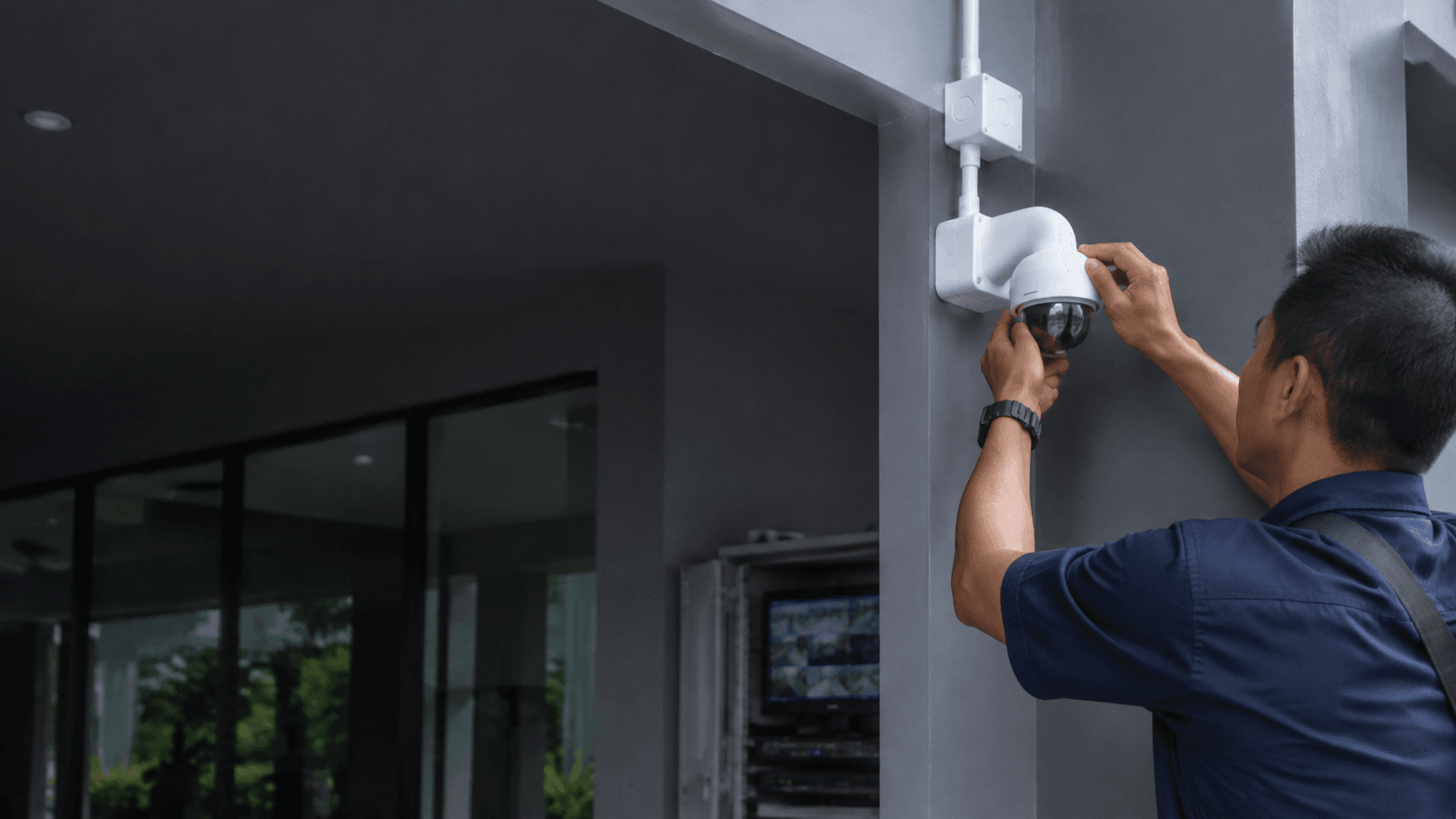
The exact-match query dahua bullet camera 2mp describes a product family rather than one fixed specification. Dahua builds 2MP bullet cameras in more than one signal type, and the model chosen changes what the rest of the system has to be. That is why the useful question is not only which camera, but which camera for which site.
What a 2MP bullet camera is used for on Malaysian premises
A bullet camera is a long, cylindrical housing mounted on a bracket. The shape suits outdoor walls, gate posts, perimeter fencing and building corners because the body can be angled along a boundary rather than looking straight down. A 2MP sensor produces 1080p-class video, which is the resolution most small and mid-sized sites in Malaysia still record at.
Typical placements include shop frontages, office entrances, factory perimeters, residential gates and back lanes. The Kuching Immigration Office project handled by Eyonic covered arrival flow, staff areas, visitor movement and dependable daily operation, which is the kind of mixed indoor and outdoor coverage a bullet camera is often chosen for.
Resolution is only one variable. Two 2MP cameras can behave very differently at night depending on the sensor, the lens and the illumination built into the housing. Dahua sells 2MP bullet models across different series, and the series affects low-light behaviour, deterrence features and how the camera connects to the recorder.
Signal type decides the rest of the system
Dahua 2MP bullet cameras exist in both HDCVI analogue and IP versions. An HDCVI camera runs over coaxial cable to an XVR recorder. An IP camera runs over network cable to an NVR, usually with PoE supplying power and data on one cable. The two are not interchangeable at the recorder end.
For a site that already has coaxial cable in the walls, an HDCVI 2MP bullet camera can reuse that cabling. For a new build or a site being rewired, an IP camera gives more flexibility later. This decision is usually made before any model number is discussed, because it determines the recorder, the cabling and the labour.
Where 2MP is enough and where it is not
2MP is generally adequate for seeing that someone is present, what they are wearing and which direction they moved. It is weaker for reading a number plate at distance or identifying a face across a wide open area. Sites that need identification at range often move to higher resolution or add a camera with a longer lens rather than relying on one wide 2MP unit.
Coverage width matters as much as resolution. A wide lens covers more ground but puts fewer pixels on each person. A narrower lens puts more detail on a smaller area. The right choice depends on what the footage needs to prove.
Lighting and placement checks before a Dahua bullet camera 2mp is confirmed
Placement is decided on site, not from a catalogue. Eyonic recommends checking actual lighting conditions before confirming placement for cameras chosen for their low-light behaviour, and the same discipline applies to any 2MP bullet camera.
Lighting is the most common reason a camera underperforms after installation. A position that looks fine in daylight can be useless at night if it faces a bright light source, sits in deep shadow, or covers an area with no ambient light at all. Reflected light from wet ground, glass or polished floors can also wash out part of the frame.
Practical checks before a position is locked in:
- Site survey to walk the property, confirm what needs to be covered and identify where cabling can run.
- System proposal setting out camera positions, recorder, storage and viewing method for approval.
- Installation of cameras, cabling, recorder and power, with each view checked against the agreed coverage.
- Handover covering live view, playback, mobile viewing and basic user operation.
That sequence is the process Eyonic follows for CCTV installation in Sarawak. It matters for a 2MP bullet camera because the survey is where lighting, mounting height and cable route are settled, and those three decisions limit what the finished system can do.
Mounting height and angle
Higher mounting reduces the chance of tampering but pushes the view further from face level. A camera mounted well above head height looking down a gate will show the top of a head rather than a face. Lower mounting gives better identification but is easier to reach. Most sites settle somewhere between the two and accept the trade-off.
Angle matters for a bullet camera specifically. Because the housing is directional, it can be aimed along a fence line or down a driveway. That is an advantage over a dome, but it also means a badly aimed bullet camera can leave a gap that a wider dome would have covered.
Cabling and power
Every camera position needs a cable route and a power decision. IP cameras with PoE need one network cable back to a PoE switch or NVR. HDCVI cameras need coaxial video cable plus a power feed, unless the recorder supports power over coax. Cable length, conduit, and whether the route crosses a public area all affect the installation.
Positions chosen without checking the cable route often get revised during installation. Confirming the route during the survey avoids that.
How a fits into a full CCTV installation
A camera is one part of a system. The recorder determines how many cameras can be connected, how long footage is kept and how it is viewed. Storage is set by the number of cameras, the resolution and the retention period the site needs.
Remote viewing is configured at handover so the site can check live and recorded footage from a phone. That step depends on the recorder and the network at the premises, not on the camera alone. A site with unstable internet will have unstable remote viewing regardless of which 2MP bullet camera is installed.
For sites that need more than cameras, Eyonic also handles alarm systems, autogate packages and keyphone intercom installation in Sarawak. Those are separate systems, but they are often planned together so that cabling and equipment locations are coordinated rather than added later.
Matching cameras to the recorder
Mixing signal types on one recorder is not possible. An XVR takes HDCVI and some analogue formats. An NVR takes IP cameras. A site that starts with one 2MP bullet camera and expects to add more later should confirm the recorder can take the additional channels and the same signal type.
Retention and storage
Retention is a storage decision. More cameras, higher resolution and longer retention all increase the disk requirement. A single 2MP bullet camera recording continuously needs far less storage than eight of them, and a site that only records on motion needs less again. Retention expectations should be agreed before the recorder is specified, because adding storage later is possible but adding it after handover is an extra visit.
Cost and scope questions around a
Camera cost is only part of the total. A single camera installation includes the camera, the bracket, the cable, the labour, and the recorder and storage if the site does not already have them. Sites that already run a compatible recorder are usually adding a camera rather than building a system.
Eyonic publishes package pricing for Hikvision CCTV, alarm and autogate at RM 1,599 each. Those figures cover different systems and are not a Dahua camera price. Project budgets vary with scope. the Kuching Immigration Office project sat in an approximate range of RM 12,000 to RM 28,000, and the KTA Sarawak Sdn Bhd office project sat in an approximate range of RM 8,000 to RM 18,000. Both were multi-camera office installations rather than single-camera additions.
Scope questions worth settling before a figure is quoted:
- Is this a new system or an addition to an existing recorder?
- How many camera positions are needed, and are they indoor, outdoor or both?
- Is the cabling route clear, or does it need conduit, trunking or new runs?
- How long does footage need to be kept?
- Does the site need remote viewing, and is the internet connection reliable enough for it?
Answering those five points turns a camera enquiry into a scope that can be priced. Without them, any figure is a guess.
Supply only versus supply and install
Some buyers want the camera supplied and will install it themselves. Others want the full job handled. The two paths carry different risks. Self-installation puts cabling, aiming, recorder configuration and remote viewing setup on the buyer, and a camera that is correctly wired but badly aimed still produces poor footage. Supply and install puts those decisions with the installer, which is why the survey step exists.
Getting a supplied and installed
Eyonic Sdn Bhd is a security system supplier in Sarawak handling planning, supply and installation for homes, offices, shops and industrial sites. The founder, Eric Yong, has worked in the industry for more than ten years, with experience in technical installation of digital security solutions for commercial businesses in Sarawak.
Because Dahua 2MP bullet cameras come in several models, the practical first step is confirming which model suits the site rather than choosing from a listing. Signal type, lens, lighting at the position and recorder compatibility all narrow the options before price becomes the deciding factor.
For sites in Kuching and elsewhere in Sarawak, the work starts with a site survey and a system proposal. That is also where the honest limits get established: what the cameras will cover well, what they will not, and what the site needs to do to get the most from the installation.
Share your location, property type and required system with Eyonic on WhatsApp at +60 11-5111 7959 for the next practical step.