
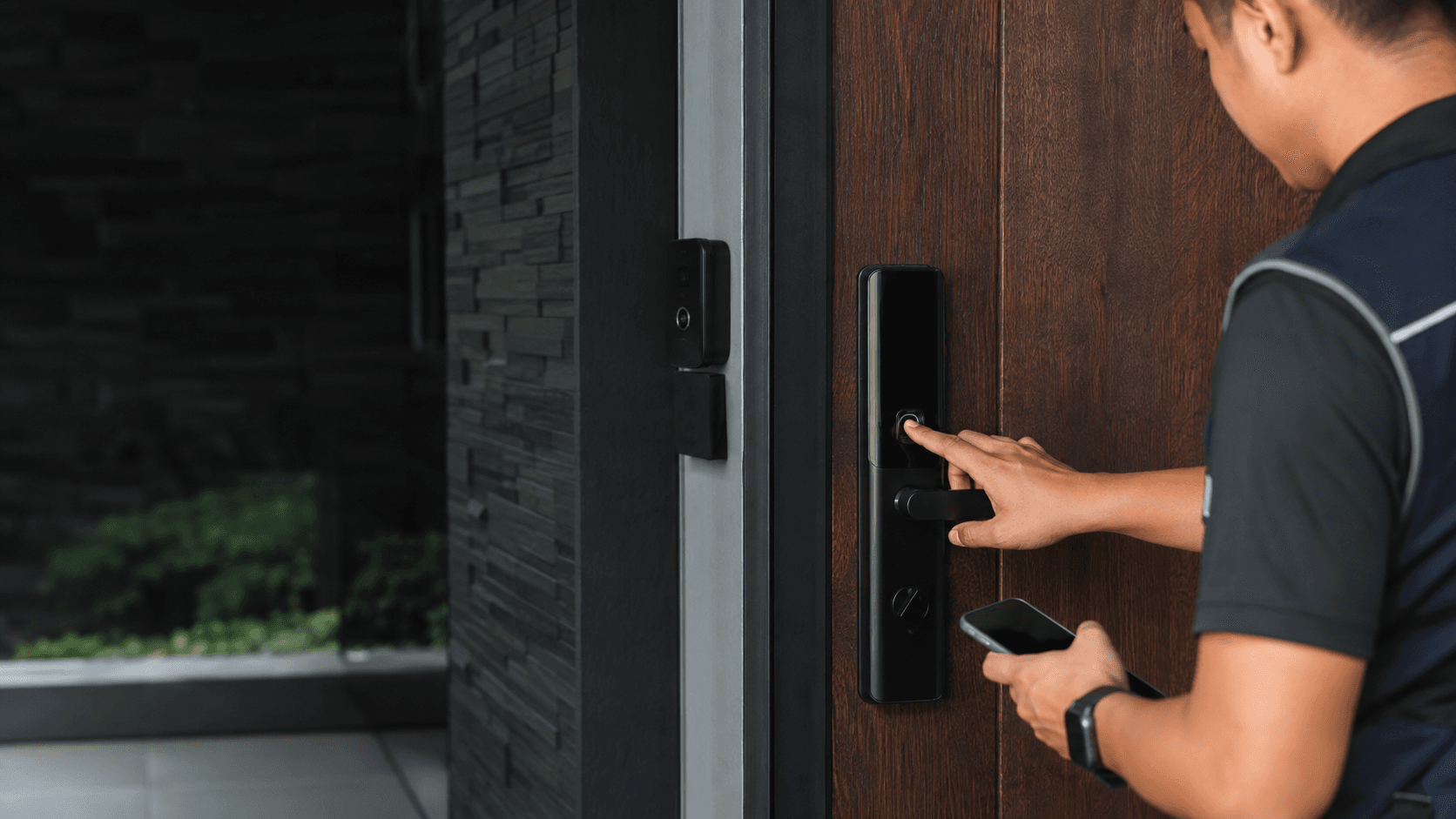
The card itself is a small passive credential. It carries no battery and no wiring, so it either works with a lock that reads it or it does not. That binary outcome is why compatibility checks matter more than the card's appearance, and why the same card can be sold as a spare for one lock and be useless on another.
What a Yale Key Card does on a Yale lock
On a supported lock, the card acts as one of several entry methods alongside a keypad code, a phone app, and a physical key. Yale's own support documentation covers adding a key card or tag to a Keyless Connected lock, which confirms the card is a registered credential rather than a factory-paired accessory. The card is presented to the lock's reader instead of typing a code.
Two practical consequences follow from that design. First, the card is only as useful as the lock's reader, so a card bought for one model may not be recognised by another. Second, because the card is a credential rather than a key, it can be removed from the lock's user list without changing the lock's mechanical cylinder. That separation is what makes cards attractive for staff, tenants, or family members whose access needs to change.
Yale's product naming shows the card is sold as a lock accessory rather than a standalone security device. Retail listings describe packs of smart door lock key cards and accessory bundles that combine a key card, a key tag, and a phone tag. The bundle format is a signal about how these credentials are used in practice: one person may carry a card, another may prefer a tag on a keyring, and a third may use a phone.
Yale Key Card compatibility checks before buying
Compatibility is the single decision that determines whether a purchase is useful. The card must match the lock, and the lock must be one that supports card or tag credentials at all. A lock that only accepts codes and keys will not gain card support because a card is present.
Yale's support content is organised by lock family, and the Keyless Connected support section is where the add-a-card instructions live. That structure is the clearest available signal that card support is model-specific. Buyers should identify the exact lock model before ordering cards, because the model name is what determines whether the credential can be registered.
Three checks reduce the risk of buying the wrong item:
- Confirm the lock model from the lock body, the packaging, or the app's device list.
- Check whether that model's documentation includes a card or tag registration procedure.
- Confirm the card is sold for that lock family rather than for a different Yale range.
Where a lock is used commercially, the decision is not only about the card. Eyonic's smart lock review notes that smart locks work best when door condition, user roles, and backup entry are reviewed before installation, and that for business use the choice between a standalone smart lock and an access-control panel should be checked. A single door with a handful of users and a card-based lock is a different problem from a building with many doors, shifting staff, and a need for audit trails. In the second case, cards may still be the right credential, but the lock may not be the right platform.
Backup entry deserves its own check. If every user relies on a card and the lock's reader fails, the fallback is a mechanical key, a code, or a second credential type. Planning that fallback before installation is cheaper than discovering its absence afterwards.
How to add or register a Yale Key Card
Registration is a lock-side operation. The card is presented to the lock during a programming sequence, and the lock stores it as an authorised credential. Yale's support page for the Keyless Connected lock is titled around adding a key card or tag, and a widely viewed registration video describes the same principle for the Yale 3109A and 3109+ models: new cards must be registered to the lock before use, and the process applies across those models.
Because the exact button sequence differs by model, the reliable approach is to follow the documentation for the specific lock rather than a generic routine. The general shape of the task is consistent:
- Put the lock into its registration or programming mode using the method in that model's manual.
- Present the new card to the lock's reader when the lock signals it is ready.
- Confirm the lock acknowledges the card, then exit programming mode.
- Test the card by locking and unlocking before relying on it.
- Repeat for each additional card, then record which card belongs to which user.
Two edge cases cause most failed registrations. A card that is already registered to the lock may be rejected when presented again, so a card moved between users should be removed first. A card held at the wrong distance or moved too quickly past the reader may not be detected, which is a presentation problem rather than a compatibility problem.
Record-keeping matters more than it appears. Once several cards are in circulation, the lock's user list is the only reliable record of who holds which credential. Labelling cards and noting the holder at registration keeps that list accurate when someone leaves.
Replacing or removing a Yale Key Card
Removing a card is the reverse of registering it: the credential is deleted from the lock's user list, and the card stops working immediately. The card itself is not damaged or altered, which is why a removed card should be stored securely rather than left in circulation. A card that is deleted and later re-registered becomes active again.
Replacement follows the same logic. A lost card is removed from the list so it can no longer open the door, and a new card is registered in its place. The lock's mechanical keying does not change, so replacing a card is a lighter operation than replacing a lock. That is the main operational advantage of card credentials in a rental or staff setting.
One limitation is worth stating plainly. A card that is lost and not removed remains a working credential for whoever finds it. Prompt removal is the control that matters, and it depends on knowing which card was lost. This is the practical reason registration records should link each card to a named holder.
Yale Key Card support in Sarawak and Malaysia
Local support for card-based door access sits inside the broader access-control and smart-lock work that security installers already handle. Eyonic Sdn Bhd plans, supplies, and installs security systems in Sarawak for homes, offices, shops, and industrial sites, and its smart lock review treats door condition, user roles, and backup entry as the checks that come before installation. For a site where cards are the intended credential, those checks determine whether a standalone smart lock is sufficient or whether an access-control panel is the better fit.
Eyonic's project work shows the kind of environment where credential planning matters. The Kuching Immigration Office project focused on arrival flow, staff areas, visitor movement, and dependable daily operation, and the KTA Sarawak Sdn Bhd project supported staff movement, visitor handling, tidy cabling, and clearer daily site control. Both are settings where access is shared across staff and visitors rather than held by one person, which is exactly where card credentials and a maintained user list earn their place.
Eyonic's installation process runs through site survey, system proposal, installation, and handover, so the door, the lock, and the credential method are settled before hardware is fixed in place. Eric Yong, the founder, has more than ten years in technical installation of digital security solutions for commercial businesses in Sarawak.
For a site in Malaysia, the practical sequence is to identify the lock model, confirm card support for that model, decide how many credentials are needed and who holds them, and confirm the backup entry method. Where the door is part of a wider access requirement, the survey stage is the point to raise it.
Share your location, property type and required system with Eyonic on WhatsApp at +60 11-5111 7959 for the next practical step.