
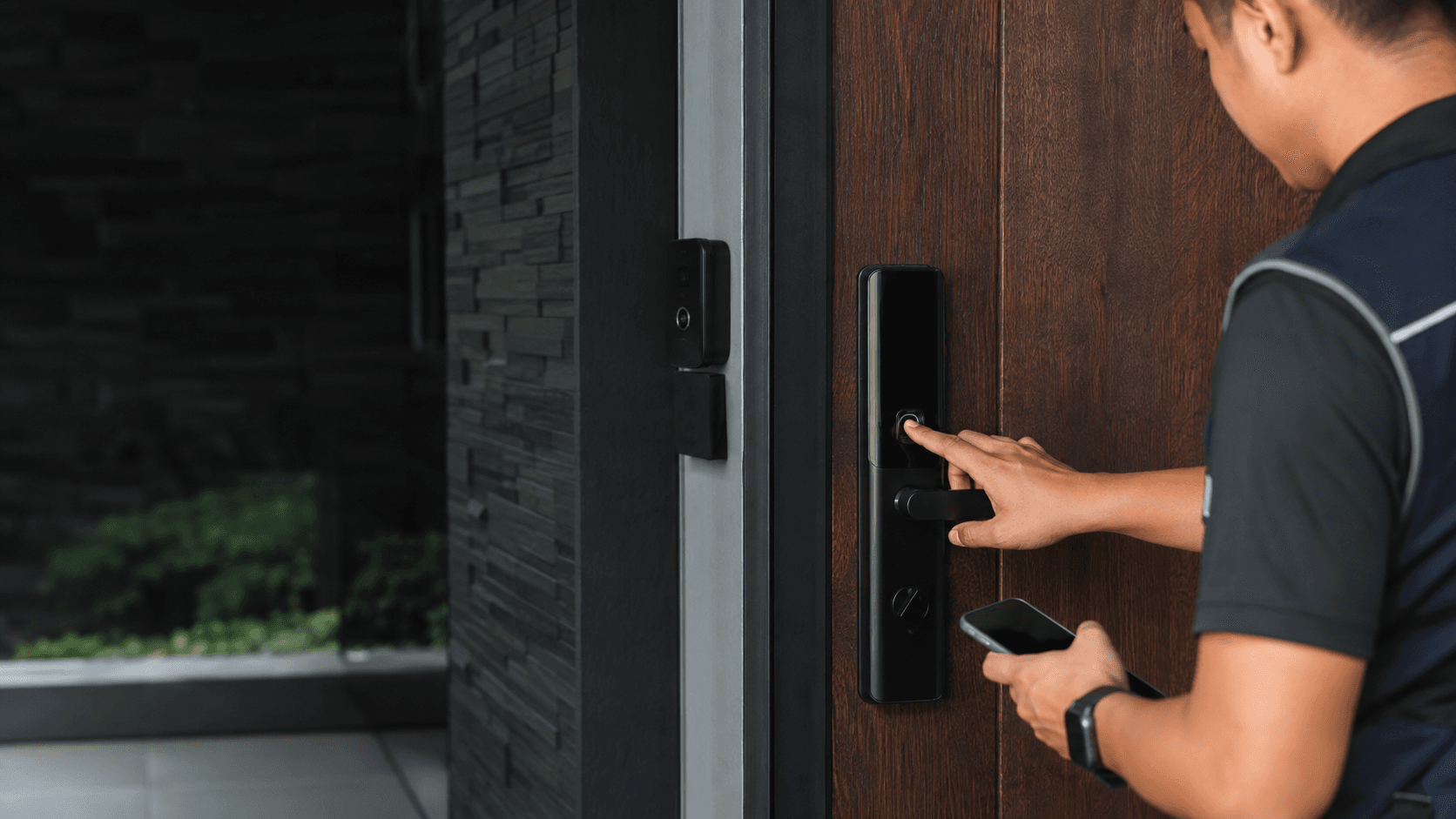
The Ultraloq Smart Door Lock U Bolt sits in a category that looks simple from the outside and gets complicated at the door. A deadbolt either fits the existing bore and strike or it does not. A fingerprint reader either reads the people who live there or it does not. Access sharing either matches how a household or office actually hands out entry, or it creates a second problem. Eyonic's own product review position is that smart locks work best when door condition, user roles and backup method are reviewed before installation, and that for business use the choice between a standalone smart lock and an access-control panel should be checked first.
Ultraloq Smart Door Lock U Bolt: What Matters Before You Choose
The Ultraloq Smart Door Lock U Bolt replaces a mechanical deadbolt with a motorised one that can be opened by credential rather than by turning a key. The practical change is at the threshold: entry becomes a deliberate act that can be logged, shared and revoked, instead of a key that is copied without record.
That shift matters most where keys are the weak point. A rented shop unit with three former staff still holding keys is a different problem from a family home with two adults. The lock does not fix a weak door frame, a hollow core door or a strike plate held by short screws. It changes who can operate the bolt, not how much force the door assembly can resist.
Because the supplied evidence does not include verified dimensions, door thickness ranges, battery life figures or connectivity details for this model, those specifics should be confirmed against the manufacturer's own documentation for the exact variant before any purchase decision. Variants within a lock family commonly differ in radio technology and bridge requirements, and treating them as interchangeable is a common and expensive mistake.
Ways to unlock and manage daily access
Across the analysed competitor pages, the recurring unlock methods for this lock family are fingerprint, keypad code, smartphone app, and a mechanical key as physical backup. Some variants add watch-based unlocking, auto unlock and lock, and voice or smart-home control. Remote management and remote access sharing typically depend on a bridge or a Wi-Fi variant rather than the base Bluetooth model.
For daily use, the useful distinction is between credentials that live on the person and credentials that live on the lock. A fingerprint is on the person. A keypad code is on the lock and can be shared verbally, which is convenient and also the easiest credential to leak. An app-based virtual key sits between the two: it can be time-limited and revoked, but it depends on the phone, the app and the account.
Access sharing is where most real-world value and most real-world risk sit. A cleaner who needs Tuesday mornings only, a contractor who needs one week, a tenant who needs a defined period — these are the cases where a shareable, revocable credential beats a key. The same feature becomes a liability when codes are shared casually and never removed. Any household or business adopting the Ultraloq Smart Door Lock U Bolt should decide in advance who issues credentials, who removes them, and how often the list is reviewed.
Fingerprint access and its limits
Fingerprint access is the fastest routine method and the one most affected by the user. Dry skin, worn ridges, wet hands and dirty readers all reduce read reliability. A reader that works perfectly for one household member can be inconsistent for another. This is a reason to keep a keypad code and a mechanical key in the plan rather than treating biometrics as the only path in.
Backup entry when the primary method fails
Every electronic lock needs a way in when the electronics do not cooperate. A mechanical key cylinder is the traditional answer. A keypad code is a second answer. External power for a depleted battery is a third, and it is the one most often forgotten until it is needed. Backup entry should be tested deliberately, not assumed, and at least one backup method should be held by someone who is not dependent on the primary credential.
Door condition, user roles and backup entry
Eyonic's smart lock review guidance is direct on this point: smart locks work best when the door condition, user roles and backup method are reviewed before installation, and for business use the choice between a standalone smart lock and an access-control panel should be checked first. That sequence is not administrative padding. It is the difference between a lock that works for years and one that generates callbacks.
Door condition covers the bore diameter, backset, door thickness, the material of the door and frame, the alignment of the strike, and whether the door currently closes without force. A deadbolt that has to be pushed into place by hand will fight a motorised bolt. Warped timber, swollen frames in humid conditions, and metal gates with different preparation all change what is feasible.
User roles decide the feature set. A home with two adults and a helper needs simple credentials and a clear removal process. A shop with shift staff, a manager and occasional contractors needs role separation, time limits and a record of who entered. An office with visitor traffic may need a different category of product entirely, which is why the standalone-versus-panel question is asked before a model is recommended.
Backup entry is the third leg. If the plan is a keypad code plus a mechanical key, both should be tested after installation and both should be documented for the people who need them. If the plan relies on a phone, the phone's battery and the account's recovery path become part of the security design.
Installation and handover steps
The sequence below follows the same practical order Eyonic uses for security system work: survey first, proposal second, installation third, handover last. It is written for a deadbolt replacement on an existing door, which is the common case.
- Site survey. confirm the door type, thickness, bore and backset, check that the door closes and latches cleanly, and note whether the frame or strike needs adjustment before any lock is fitted.
- Door and user-role check. list who needs entry, how often, for how long, and which credentials suit each person; decide the backup entry method at this stage rather than after installation.
- System proposal. confirm whether a standalone smart lock is appropriate or whether an access-control panel suits the site better, and confirm the exact lock variant and any bridge or hub it requires.
- Installation. fit the deadbolt, align the strike, and verify that the bolt extends and retracts without binding across the full swing of the door.
- Testing. enrol fingerprints and codes, test every unlock method including the mechanical key and any external power option, and confirm auto lock behaviour if it is enabled.
- Handover. document the credentials issued, remove any test credentials, show the responsible person how to add and revoke access, and confirm what to do when a battery warning appears.
Two steps in that list are routinely skipped. The first is the door check before purchase, which is where incompatible doors are discovered. The second is credential cleanup at handover, which is where test codes and installer credentials are left active. Both are cheap to do and expensive to skip.
Where the fits in Malaysia
Malaysian entry doors vary more than product pages assume. Timber doors in older terrace houses, metal gates and grille doors, condominium fire-rated doors, and shoplot roller or glass entrances all present different preparation. Humidity and heat also affect timber movement, which changes strike alignment over time. A lock that performs well in a dry, stable climate may need more attention to alignment and battery behaviour in a humid one.
For residential use, the fit is usually straightforward: a single main entry door, a small number of regular users, and a preference for not carrying keys. For business use, the fit depends on scale. A small office with a handful of staff can work well with a standalone smart lock and disciplined credential management. A site with shift rotas, visitor logging requirements or multiple controlled doors is usually better served by an access-control approach, which is the check Eyonic applies before recommending a standalone lock.
Eyonic's project work in Sarawak has centred on movement and daily operation rather than on hardware for its own sake. The Kuching Immigration Office project focused on arrival flow, staff areas, visitor movement and dependable daily operation. The KTA Sarawak Sdn Bhd project supported staff movement, visitor handling, tidy cabling and clearer daily site control. Both are access and movement problems, and both illustrate why the door-level decision should follow the flow decision rather than precede it.
Local supply and support matter for the same reason. A lock bought online with no local installation path leaves the door preparation, alignment and credential setup to whoever is available. Eyonic's own service model runs from site survey through proposal, installation and handover, and the same sequence applies to a single deadbolt as it does to a larger system.
What to confirm before committing
Confirm the exact model variant and whether it needs a bridge or hub for remote features. Confirm the door's bore, backset and thickness against the manufacturer's stated range for that variant. Confirm who will install it and who will handle alignment if the door moves. Confirm the backup entry method and test it. Confirm who owns credential removal when a person leaves. Confirm what happens at the end of the battery's life and how the warning appears.
Where the supplied evidence does not cover Malaysian pricing, stock, warranty terms or a local distributor for this specific lock, those details should be confirmed directly with the supplier rather than assumed from overseas listings. Prices, bundles and availability differ by market, and a figure from another country is not a local figure.
Practical next step
The decision that matters is not which lock looks best on a product page. It is whether the door accepts it, whether the user roles suit it, and whether backup entry is genuinely covered. Share the location, property type and required system with Eyonic on WhatsApp at +60 11-5111 7959 to move from research to a site-specific answer.