
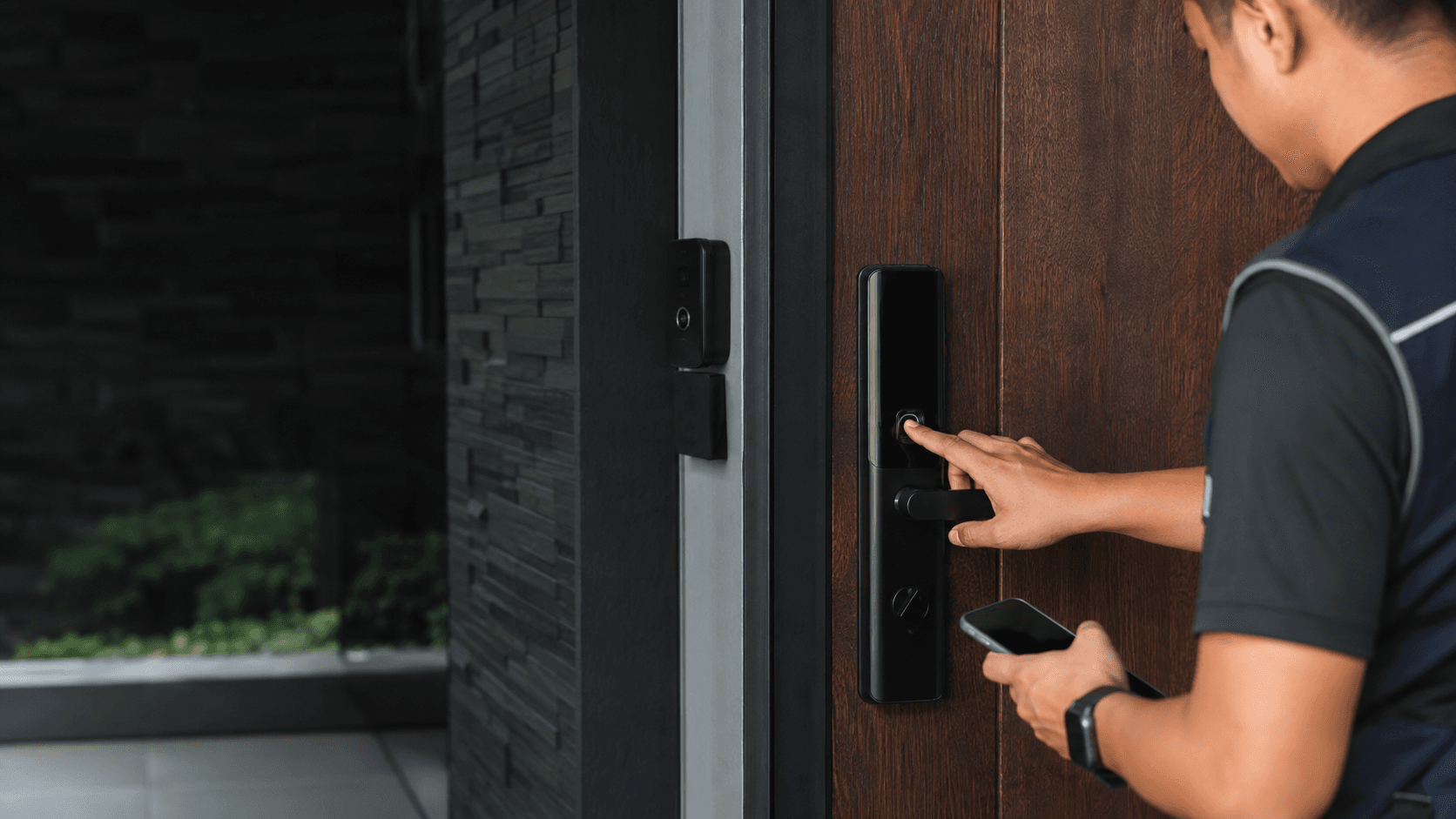
The exact-match query electric garage door lock describes hardware that works alongside an automatic opener rather than replacing it. Most powered doors already hold themselves shut through the opener's drive mechanism, but that holding force is not the same as a locked bolt. A separate lock closes that gap.
Three numbers frame the decision. A powered door typically travels a full open or close cycle in 10 to 15 seconds, which is the window a lock must not obstruct. A deadbolt throw of 25 mm or more gives meaningful resistance against prying. And any lock added to a powered door must clear the manual release, which is the cord or handle that disconnects the door from the opener.
Electric Garage Door Lock: What Matters Before You Choose
A garage door opener does not lock the door in the way a deadbolt does. When the motor stops, the gearbox and the door's own weight hold the panel in place. On a sectional door, the curved track and the horizontal section above the opening resist upward movement. That resistance is mechanical, not a lock.
This matters because a determined intruder can sometimes force a powered door upward by hand, especially on a lighter single-skin panel. The opener's holding force depends on the drive type. A belt or chain drive with a trolley arm holds differently from a direct-drive unit, and a screw drive behaves differently again. None of them is designed as a security bolt.
Some openers include an internal lock feature. When engaged, the opener ignores remote signals and refuses to run. That prevents the door being opened by a copied remote, but it does not add a physical bolt. It also creates a problem. if the internal lock is left on and the power fails, the door cannot be moved until the lock is disengaged.
What the Opener Already Does Well
The opener's real security value is convenience and control. Rolling-code remotes make signal copying difficult. Keyless entry pads let a code replace a lost remote. Modern openers can report door status to a phone. These are access-control features, not physical locking.
Eyonic's own product guidance makes the same distinction for smart locks generally: they work best when door condition, user roles and a backup method are reviewed before installation. The same review applies to a lock fitted to a powered garage door.
Locking Options for an Automatic Opener
There are four practical ways to add an electric garage door lock to a powered door. Each trades convenience against security in a different way.
An automatic deadbolt is the option most closely matched to a powered door. It mounts to the door or the frame and throws a bolt when the door closes. It retracts before the opener runs. The bolt is driven by its own motor or solenoid, so it needs power and a signal from the opener or a separate controller. The main constraint is sequencing: the bolt must be fully retracted before the door moves, or the opener will strain against it.
A slide bolt or surface latch is the simplest physical lock. It is operated by hand, by key, or by a small electric actuator. It is cheap and easy to understand. The trade-off is that it must be released before the door is opened, which breaks remote-only access.
A floor-mounted or ground anchor lock drops a bolt into a receiver set into the concrete. It resists lifting and prying well. It also needs a clear floor position and a door that closes consistently to the same point every time.
An electric strike or magnetic lock belongs to access control rather than garage hardware. These suit a side door into the garage more than the main vehicle door, because they are designed for pedestrian openings and controlled entry.
Matching the Lock to the Door Type
A sectional door with horizontal tracks gives the most mounting options, because the frame and the track both offer fixing points. A roller door rolls into a drum above the opening and leaves little room for a bolt, so locks for roller doors usually sit at the side or the base. A tilt or up-and-over door swings outward and needs a lock that does not foul the swing path.
Door condition decides whether any of this works. A door that has dropped on its hinges, or a frame that has moved, will not let a bolt seat reliably. Eyonic's smart lock guidance puts door condition first for exactly this reason.
What to Check Before Adding a Lock
Five checks cover most of the risk. They are worth doing in order, because each one can change the answer to the next.
- Door condition. Check that the door closes to the same position every time, that the panels are not bent, and that the frame is sound. A bolt needs a fixed, repeatable target.
- Opener compatibility. Confirm whether the opener can supply a lock signal, or whether the lock needs its own controller. Not every opener supports an automatic deadbolt, and this should be verified against the opener's own documentation before purchase.
- User roles. Decide who needs daily access and who needs occasional access. A household with one or two regular users can accept a manual release step. A site with staff, deliveries and visitors needs the lock to work without a person standing at the door.
- Backup entry method. Agree on a second way in before the lock is fitted. That could be a keyed external release, a side door, or a code held by someone off site.
- Release access. Make sure the manual release remains reachable and that the new lock does not block it. If the lock is engaged and the power fails, the release is the only way to move the door.
The compatibility check is the one most often skipped. A lock that needs a signal the opener cannot send will either sit unused or need a separate trigger, such as a relay wired to the opener's light circuit or a standalone keypad. That changes the wiring and the cost.
Where the Lock Should Sit
Position matters as much as the hardware. A bolt fitted at the centre of the door resists lifting but is easy to reach from outside if the panel is thin. Bolts at both sides of the door resist twisting and prying better, but they need two actuators or a linkage. A bolt at the base, dropping into the floor, resists lifting most directly.
On a door with windows, the lock position should not be visible from the street. A visible bolt tells an intruder where to apply force. This is the same logic behind obscuring garage windows, which several security guides recommend.
Power Failure and Manual Release
Power failure is the edge case that decides whether a lock is practical. An automatic deadbolt that stays engaged when the power drops will hold the door shut. If the opener also has no battery backup, the door cannot be opened until power returns or the bolt is released by hand.
There are three ways to handle this. The first is a lock with a keyed external release, so the bolt can be retracted from outside with a key. The second is a lock that fails safe, retracting when power is lost, though that removes the security benefit during an outage. The third is a battery backup on the opener, which keeps the door operable but does not release the bolt.
The manual release on the opener is separate from the lock. Pulling the release cord disconnects the door from the drive so it can be moved by hand. It does not retract a deadbolt. Anyone planning an electric garage door lock should confirm that the release and the lock can both be operated independently, and that the release cord is not trapped behind the lock hardware.
For a business site, the same question becomes an access-control question. If staff arrive before the person with the key, the lock needs a code or a credential that works without a physical key. Eyonic's work at the Kuching Immigration Office centred on arrival flow, staff areas and visitor movement, which is the same set of questions a locked garage raises at a smaller scale.
Planning the Lock With the Rest of the System
A lock is one part of a garage security setup. It works best when it is planned alongside the opener, the lighting and the cameras rather than added afterwards.
Lighting is the first companion. A motion light over the garage opening removes the cover that darkness gives an intruder and helps a camera record something usable. Eyonic's guidance on ColorVu-style cameras makes the related point that actual lighting conditions should be checked before confirming camera placement, because a camera's low-light performance depends on what light is really there.
Cameras are the second companion. A camera covering the garage opening records who approaches and when. It does not stop entry, but it changes the risk calculation for anyone considering it. For a home, one camera at the driveway and one covering the garage interior covers most of the useful angles.
Access control is the third. On a site with staff or regular visitors, a keypad or credential reader on a side door lets people in without distributing keys. This is where a standalone smart lock and a full access-control panel diverge, and the choice depends on how many people need access and how often it changes.
What This Costs and Who Fits It
Eyonic publishes package pricing for related work: a Hikvision CCTV package at RM 1,599, a Hikvision alarm system at RM 1,599, and an autogate package at RM 1,599. These cover camera supply and setup, alarm panel and sensor setup, and motor recommendation with remote-control and safety testing respectively. They are not prices for an electric garage door lock, and no verified price for that hardware in Malaysia is available here.
Installation scope for lock and access-control work follows the same shape as Eyonic's other installation work: site survey, system proposal, installation, and handover. The survey is where door condition, opener compatibility and release access get checked against the actual door rather than assumed.
For a single home with one powered door, a manual slide bolt plus a keyed external release is often enough, and it keeps the cost low. For a home that wants remote-only access, an automatic deadbolt with a keyed override is the better fit. For a business site with staff and visitors, the lock is usually one part of a wider access-control plan that includes a side door, a keypad and cameras.
The constraint that applies in every case is the same: the lock must not stop the door working normally. A lock that has to be released by hand before every remote open will be left disengaged within a week. A lock that traps someone outside during a power cut will be removed. The practical answer is a lock that engages automatically, releases before the door moves, and has a keyed or coded way in that does not depend on mains power.
Share your location, property type and required system with Eyonic on WhatsApp at +60 11-5111 7959 for the next practical step.