
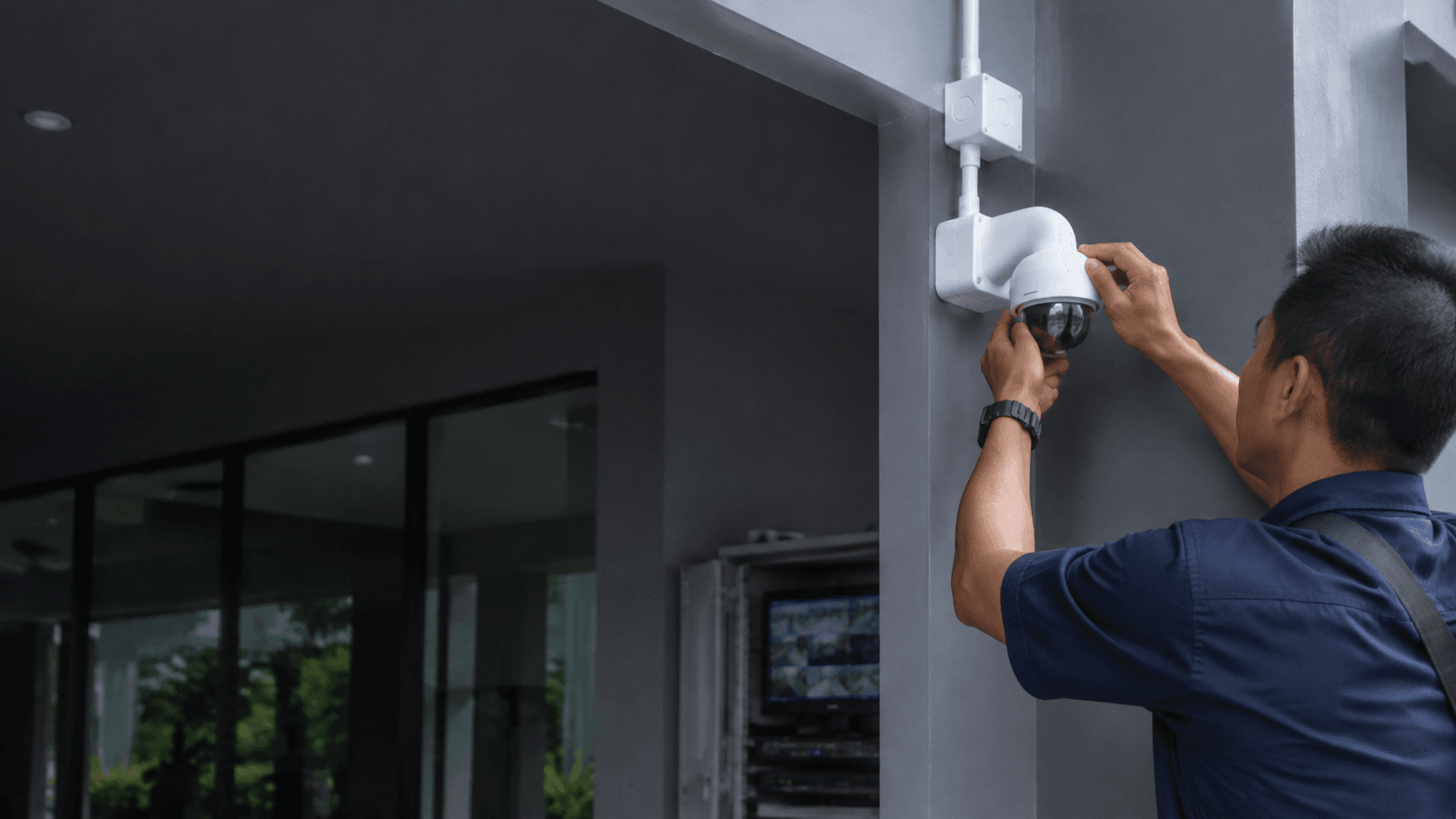
The exact-match query smart cctv camera describes a category that sits between two older ones: the always-recording CCTV system and the app-controlled consumer camera. The difference is not the lens. It is what happens to the video after capture — whether the camera decides what matters, and whether that decision is useful or noisy.
Eyonic Sdn Bhd plans, supplies and installs monitoring systems with camera placement, recording and remote viewing for homes, offices, shops and industrial sites in Sarawak. That work sits on the installation side of the category, where power, cabling, storage and lighting decide more outcomes than the camera model number.
Smart Cctv Camera. What Matters Before You Choose
Most buying pages lead with resolution. Resolution is the easiest specification to print and one of the least decisive in practice. A 4K camera pointed at a dark corridor at night produces a worse identification image than a 2MP camera with adequate light and a correctly framed field of view.
Four variables decide whether a smart cctv camera performs as expected:
- Light at the actual camera position, measured at night rather than assumed from daytime visits.
- Power and network path — PoE, plug-in, battery or solar — and whether that path survives a power cut.
- Storage location and retention period, whether on an NVR, a memory card or a cloud plan.
- Who reviews footage, how often, and whether alerts reach that person without becoming background noise.
Eyonic's CCTV installation process runs through site survey, system proposal, installation and handover, which places the first three variables before any hardware commitment. The company also advises checking actual lighting conditions before confirming placement for ColorVu-style cameras, because low-light performance claims depend on the scene, not the datasheet.
Choosing the Right Smart Cctv Camera
The category splits by how the camera is powered and where the intelligence sits. Consumer smart cameras typically carry analytics on the device and stream to an app. Professional systems push analytics to the camera or the recorder and keep footage on local storage. Both are legitimately "smart"; they fail in different ways.
Consumer models are quick to deploy and weak on retention. Professional models retain footage reliably and demand more planning. The choice usually follows from the answer to one question: does the footage need to exist three weeks after an incident, or only long enough to check a notification?
What is smart cctv camera technology actually doing?
Smart detection classifies objects before triggering a recording or alert. A conventional motion sensor reacts to any change in pixels, which is why trees, rain and headlights generate false alarms. Analytics trained on people and vehicles suppress most of that noise, so an alert means something moved that resembles a person or a car.
That classification is the whole value proposition, and it is also the main limitation. Analytics degrade in poor light, at extreme angles, and at long range. A camera that reliably detects people at eight metres may not classify them at twenty-five. Placement therefore matters more in a smart system than in a dumb one, because a badly placed smart camera produces confident, wrong alerts.
Where the category fits and where it does not
Smart analytics earn their cost where someone must act on alerts: a shop counter after closing, a warehouse gate, a home entry during travel. They add less value where footage is reviewed only after an incident, because retrospective review does not care whether the trigger was intelligent.
They also add little where the scene is already controlled. A well-lit corridor with a fixed camera and continuous recording needs reliable storage, not classification. Buying analytics for that scene spends budget on a feature nobody will use.
Practical Considerations for Smart Cctv Camera Systems
Three constraints decide most installations, and none of them appear in a product listing.
Light. Colour night vision depends on ambient light. A camera rated for full-colour night imaging in a genuinely dark yard will fall back to infrared, and the resulting image is monochrome. Checking the scene at night before fixing positions avoids this entirely.
Power and network. PoE cameras need a switch and a cable run. Wi-Fi cameras need signal at the mounting point, which is often the weakest corner of a building. Battery and solar cameras avoid cabling but introduce charging cycles and cold-weather performance limits.
Storage and retention. Local recording on an NVR or memory card keeps footage under the owner's control and avoids subscription dependence. Cloud recording survives theft of the recorder and adds a recurring cost. Retention period, not resolution, usually determines how much storage is required.
Eyonic's project work shows how these constraints resolve in practice. For the Kuching Immigration Office, the focus was arrival flow, staff areas, visitor movement and dependable daily operation — a brief about coverage and reliability rather than image specification. For KTA Sarawak Sdn Bhd, an engineering consultancy office in Kuching, the requirement was staff movement, visitor handling, tidy cabling and clearer daily site control. Both are cases where camera placement and cabling discipline carried the outcome.
Making an Informed Choice About Smart Cctv Camera
Budget expectations vary widely by scope. Eyonic's published packages list a Hikvision CCTV package at RM 1,599 covering camera supply and setup, basic recording configuration and mobile viewing handover. Larger project work sits far above that: the Kuching Immigration Office project carried an approximate budget of RM 12,000 to RM 28,000, and the KTA Sarawak Sdn Bhd project an approximate budget of RM 8,000 to RM 18,000. The gap between a package price and a project price reflects camera count, cabling, storage and site complexity rather than a difference in camera intelligence.
Two edge cases deserve attention before committing. First, mixed systems: adding one smart camera to an existing analogue or older IP system rarely delivers the analytics benefit, because the recorder may not support the camera's detection events. Second, tenancy: a rented property may restrict cabling and mounting, which pushes the decision toward plug-in or battery cameras with local storage.
Eric Yong, founder of Eyonic Security Systems, has worked in the industry for more than ten years, with technical installation experience in digital security solutions for commercial businesses in Sarawak. That experience is most useful at the survey stage, where lighting, cable routes and camera positions are settled before purchase.
For readers in Sarawak weighing a smart cctv camera against a conventional system, the practical next step is a site assessment rather than a product comparison. Share the location, property type and required system with Eyonic on WhatsApp at +60 11-5111 7959.