
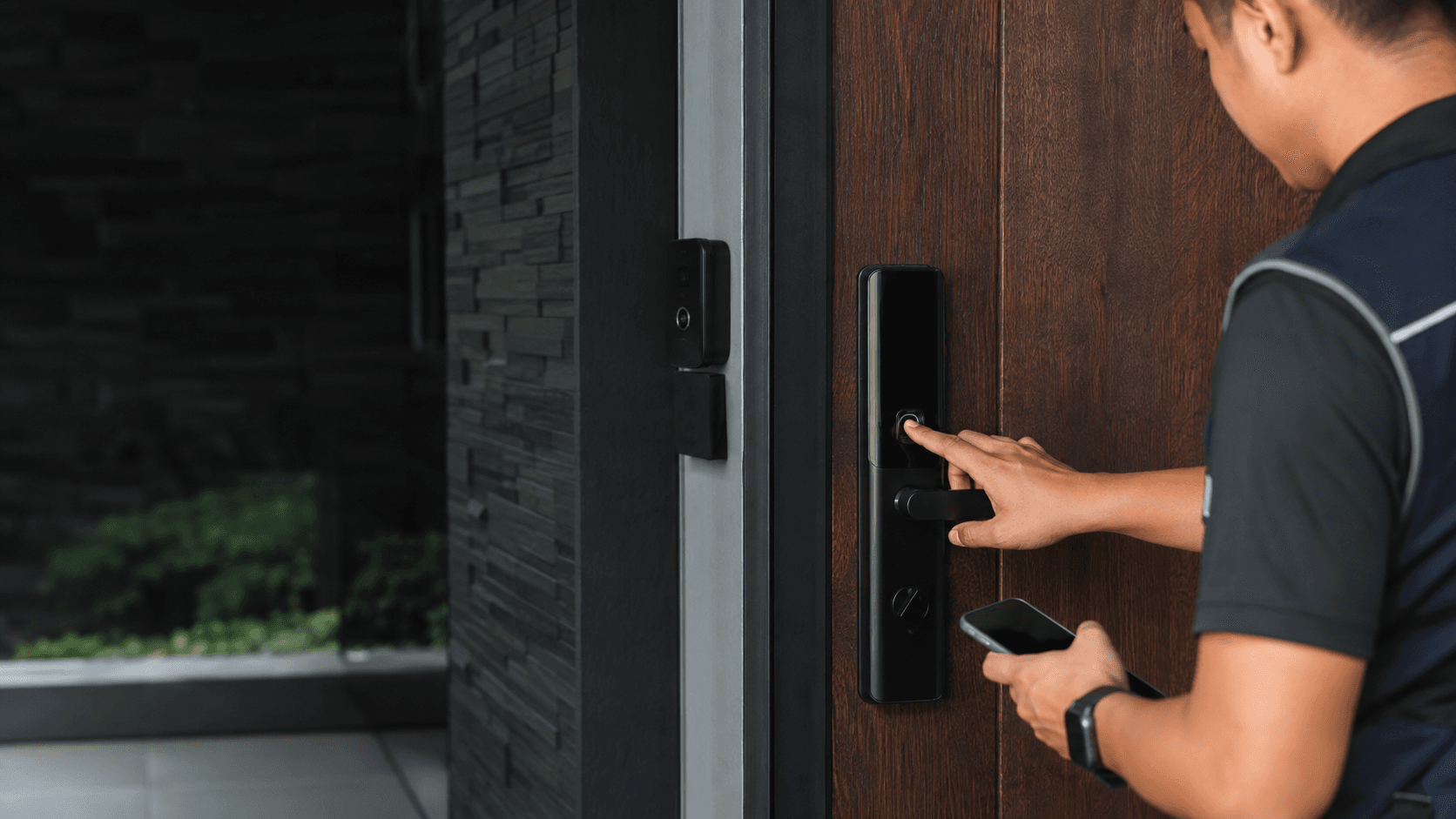
That single change reshapes how a building handles entry. A mechanical key can be copied without the owner knowing. An electronic lock records who entered, when, and through which door, and it can be re-credentialed in minutes when a staff member leaves. The trade-off is that the lock now depends on power, a credential method, and a plan for what happens when either fails.
Commercial Electronic Door Lock. What Matters Before Choosing
The decision rarely starts with the lock. It starts with the door and the people who use it. Eyonic's own review of smart lock door access notes that smart locks work best when the door condition, user roles, and backup method are reviewed before installation, and that for business use the choice between a standalone smart lock and an access-control panel should be settled first.
Four questions shape the answer.
- What kind of door is it — a wooden office door, an aluminium glass storefront, or a metal grille?
- Who needs entry, and do those people need different levels of access?
- How should entry be proven — a numeric code, a card, a phone, or a fingerprint?
- What happens during a power cut or a network outage?
Each answer narrows the hardware. A narrow-stile aluminium glass storefront takes different hardware from a solid timber door, and a door that must stay locked during a fire alarm needs a different wiring approach from one that simply needs to keep staff out after hours.
Standalone lock or access-control panel
A standalone electronic lock stores its own user list and needs no central controller. It suits a single door, a small office, or a site where running cable is impractical. An access-control panel suits multiple doors, shared credentials, and central records. The standalone option costs less to install and less to maintain; the panel option scales better and produces a single audit trail across the building.
Choosing the Right Commercial Electronic Door Lock
Hardware choice follows from the door and the credential. The table below maps common situations to the lock type that fits them, based on how these products are normally categorised by commercial hardware suppliers.
| Door and site situation | Lock type that fits | Main trade-off |
|---|---|---|
| Single office door, no cabling | Standalone keypad or card lock | User list managed at the door, not centrally |
| Multiple doors, shared staff credentials | Networked electronic lock with controller | Higher installation cost, central records |
| Aluminium glass storefront | Narrow-stile storefront lock hardware | Door preparation must match the lock body |
| Exit door that must release on alarm | Electrified lock wired to the fire system | Requires coordination with the alarm installer |
| Remote gate or outbuilding | Wireless or battery-powered lock | Battery replacement schedule |
Credential method matters as much as lock body. A keypad suits sites where staff turnover is high and codes can be changed quickly. A card or fob suits sites where staff already carry an ID card. A phone-based credential suits sites where staff prefer not to carry anything extra, but it introduces a dependency on the phone's battery and the building's network.
What is commercial electronic door lock hardware made of
The visible parts are the keypad or reader, the lever or knob, and the lock body inside the door. Behind them sit a controller, a power supply, and often a door position sensor. Commercial-grade hardware is built for higher traffic than a residential lock, which is why the same door that works fine at home can fail within months in an office corridor.
Keyless Door Locks - Commercial Door Hardware Supply
Suppliers in this category group products by door style, credential type, and finish. Commercial door hardware supply catalogues typically separate keyless door locks from mechanical locks, then subdivide by cylindrical, mortise, and exit-trim formats. That structure exists because the lock body must match the door preparation already cut into the door.
For a buyer in Sarawak, the practical consequence is that the lock cannot be chosen in isolation. The existing door, its frame, and its closing hardware determine which lock bodies will fit without modification. Where the door is being replaced at the same time, the choice widens considerably.
Electronic Commercial Door Locks and networked control
Networked electronic locks add a controller and software layer. They allow one credential to open several doors, allow access rights to be changed without visiting the door, and produce a record of entries. The cost is cabling, a power supply, and someone to administer the user list. Sites that never review their user list end up with the same problem as a lost key: credentials that should have been removed stay active.
Practical Considerations for Installation
Installation quality decides whether the lock works reliably a year later. Eyonic's installation process for security systems follows site survey, system proposal, installation, and handover, and the same sequence applies to access control. The survey is where door condition, cable routes, and power availability get settled.
Three constraints appear repeatedly on commercial sites:
- Power. A lock that needs mains power needs a route to the door, and that route may need to cross a ceiling, a wall, or a fire-rated partition.
- Egress. A door used as an exit must open freely from the inside regardless of what the electronic lock is doing.
- Backup entry. Every electronic lock needs a documented way in when the credential fails, the battery dies, or the network drops.
Eyonic's completed work for the Kuching Immigration Office focused on arrival flow, staff areas, visitor movement, and dependable daily operation — the same concerns that shape access control on any public-facing site. A public office cannot afford a door that locks out staff during a shift change, and it cannot afford a visitor entrance that is slow to clear.
Where electronic access fits alongside other systems
Access control rarely stands alone. A door lock, a CCTV camera covering the entrance, an alarm system, and an intercom at the gate all describe the same movement through a building. Eyonic supplies and installs CCTV, alarm systems, autogate systems, keyphone intercoms, and smart locks, which means the door hardware can be planned alongside the camera that watches it and the alarm that releases it.
Eric Yong, founder of Eyonic Security Systems, has worked in technical installation of digital security solutions for commercial businesses in Sarawak for more than 10 years. That experience shows up most clearly in the survey stage, where the difference between a lock that fits and one that needs the door modified is decided.
Making an Informed Choice About Hardware
The right choice depends less on brand than on fit. A lock that matches the door, the credential habit of the people using it, and a clear backup plan will outperform a more expensive lock that fights any of those three.
Eyonic's published package pricing for related security work sits at RM 1,599 for a Hikvision CCTV package, RM 1,599 for a Hikvision alarm system, and RM 1,599 for an autogate package. Access control is quoted per site because door count, door type, and cabling vary too much for a fixed figure. Completed project budgets on Eyonic's own project pages range from RM 8,000 to RM 18,000 for an office setup and RM 12,000 to RM 28,000 for a larger public office installation.
For a single door in a small office, a standalone keypad lock is usually enough. For a building with several controlled doors, staff turnover, and a need to review who entered, a networked system earns its cost. For a site where the door itself is aluminium and glazed, the lock must be chosen for that door type before anything else is decided.
Share the location, property type, and required system with Eyonic on WhatsApp at +60 11-5111 7959 for the next practical step.