
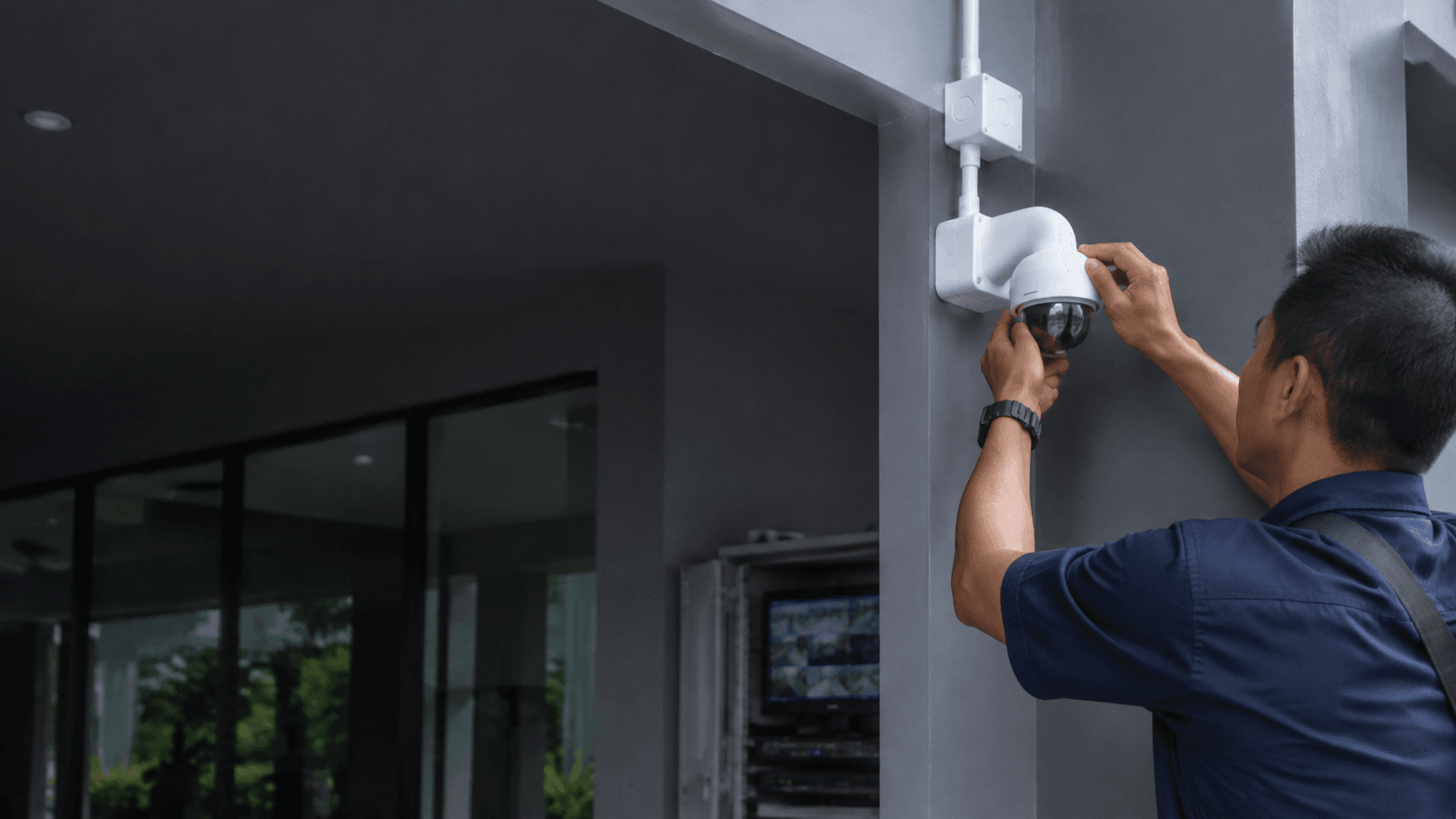
The exact-match query best poe security camera system is a comparison question, and comparison is where most buyers get stuck. The pages that rank for it lean on spec tables and brand rankings. Those tables cannot be verified for a Malaysian installation, and they say nothing about who runs the cable, where the recorder sits, or what happens when a camera points at a wall instead of a gate.
What follows is a comparison framework built on the parts of a wired camera setup that can actually be checked: how power and data travel, what the site looks like at night, how recording and remote viewing are configured, and what a quotation should state before it is approved.
Best Poe Security Camera System: What Matters Before You Choose
Power over Ethernet sends both electrical power and network data down a single cable. That is the whole mechanical difference between a PoE camera and a camera that needs a separate power point at the mounting position.
The practical consequence is that camera placement stops being limited by where the electrician can run a 240V supply. A camera can sit at the far end of a perimeter wall, under a soffit, or above a doorway, provided the network cable reaches it and the recorder or switch at the other end can power it.
Three constraints shape the design:
- Cable route. Every camera needs a continuous cable path back to the recorder or switch. Trunking, conduit, ceiling voids and wall penetrations decide whether that route is tidy or exposed.
- Power budget. The recorder or switch supplies power to every connected camera. The number of cameras and their power draw must fit within what that device can deliver.
- Run length. Ethernet has a practical distance limit per run. Long perimeter properties may need a switch positioned closer to the far cameras rather than one long cable from a single cabinet.
None of those three points can be settled from a product page. They are settled by looking at the building.
Camera placement and lighting checks before any order is placed
Placement is the decision that most often decides whether a system is useful or decorative. A camera that covers a gate, a driveway and a side lane in one wide frame will identify nothing at distance. A camera aimed at a narrow approach will identify a face or a plate.
Eyonic recommends checking actual lighting conditions before confirming placement for ColorVu-style cameras. That advice matters because a camera that performs well in a lit showroom behaves differently on an unlit back lane at 2am.
Before ordering, walk the site at the hours that matter and confirm the following:
- Which approach points need identification, and which only need general coverage.
- What light exists at each point after dark, and whether it is steady or switched off overnight.
- Whether trees, signage, parked vehicles or roof lines will block the view at the mounting height.
- Where the cable can physically reach without an exposed run across a walkway.
- Whether the recorder location is secure, ventilated and reachable for maintenance.
A camera mounted lower may capture a clearer face but becomes easier to reach. A camera mounted higher is harder to tamper with but may lose the angle needed for identification. That trade-off is a site decision, not a specification decision.
Recorder, storage and remote viewing decisions that shape daily use
The recorder is where a wired system either becomes manageable or becomes a chore. It holds the recordings, feeds the remote viewing app, and determines how far back footage can be reviewed.
Retention is the number most buyers underestimate. How many days of footage the system keeps depends on how many cameras are recording, the resolution and frame rate in use, whether recording is continuous or motion-triggered, and the size of the installed storage. A system sized for continuous recording across many cameras will hold fewer days than the same storage used with motion-triggered recording.
Remote viewing is the second daily-use decision. Mobile viewing handover is part of Eyonic's Hikvision CCTV Package at RM 1,599, which covers camera supply and setup, basic recording configuration, and mobile viewing handover. That package is a starting point for a basic setup, not a PoE system quotation, and the two should not be confused when comparing prices.
Two further points are worth settling before installation rather than after:
- Who holds the recorder password, and whether more than one person needs access.
- Whether the network the recorder sits on is shared with office or household traffic, and whether that matters for reliability.
How a Poe Security Camera System is surveyed, installed and handed over
Eyonic's CCTV installation process runs through four stages: site survey, system proposal, installation, and handover. The sequence exists because the survey produces the information the proposal depends on.
- Site survey. The property is reviewed for camera placement, cable routes, recorder location and lighting conditions at the points that need coverage.
- System proposal. The survey findings are turned into a proposed system covering camera positions, cabling, recording and remote viewing.
- Installation. Cabling is run, cameras are mounted, the recorder is configured, and recording and remote viewing are set up.
- Handover. The system is tested with the people who will use it, and mobile viewing access is passed over.
The value of that order shows up on sites where the building is already in use. Eyonic completed a project for the Kuching Immigration Office, focused on arrival flow, staff areas, visitor movement and dependable daily operation. A public office cannot shut down for a cabling exercise, so routes and mounting points have to be settled before work starts. The same constraint applies to shops, clinics and offices that trade during installation hours.
Eyonic also completed work for KTA Sarawak Sdn Bhd, an engineering consultancy site in Kuching that needed a practical office setup supporting staff movement, visitor handling, tidy cabling and clearer daily site control. Tidy cabling is not a cosmetic point. Exposed cable runs are the most common reason a working system still looks unfinished, and they are the first thing to be damaged during later building work.
For scale, the approximate budget for the Kuching Immigration Office project type was RM 12,000 to RM 28,000, and the KTA Sarawak Sdn Bhd project type was RM 8,000 to RM 18,000. Those figures describe completed project scopes, not a PoE camera package price.
What to confirm before approving a quotation
A quotation for a wired camera system should be readable without a datasheet open beside it. If it lists model numbers and resolution but not cable routes or recorder location, the installation scope is undefined.
Confirm these points in writing before approving:
- How many cameras, and the specific position each one covers.
- How the cable reaches each camera, and whether trunking or conduit is included.
- Where the recorder is installed and how it is powered.
- How many days of recording the proposed storage is expected to hold, and at what recording mode.
- What is included in handover, including mobile viewing setup and user testing.
- What happens if a camera position turns out to be wrong after installation.
On the question of which system is best, the honest answer is that no ranking survives contact with an unfamiliar building. A system that suits a single-storey terrace house in Kuching will not suit a three-storey shophouse with a rear lane, and neither will suit an industrial yard with a long perimeter. The comparison that matters is between proposals for the same site, judged on coverage, cabling, retention and handover.
Eyonic Sdn Bhd plans, supplies and installs monitoring systems with camera placement, recording and remote viewing for homes, offices, shops and industrial sites, and the founder, Eric Yong, has worked in technical installation of digital security solutions for commercial businesses in Sarawak for more than 10 years.
Share your location, property type and required system with Eyonic on WhatsApp at +60 11-5111 7959 for the next practical step.