
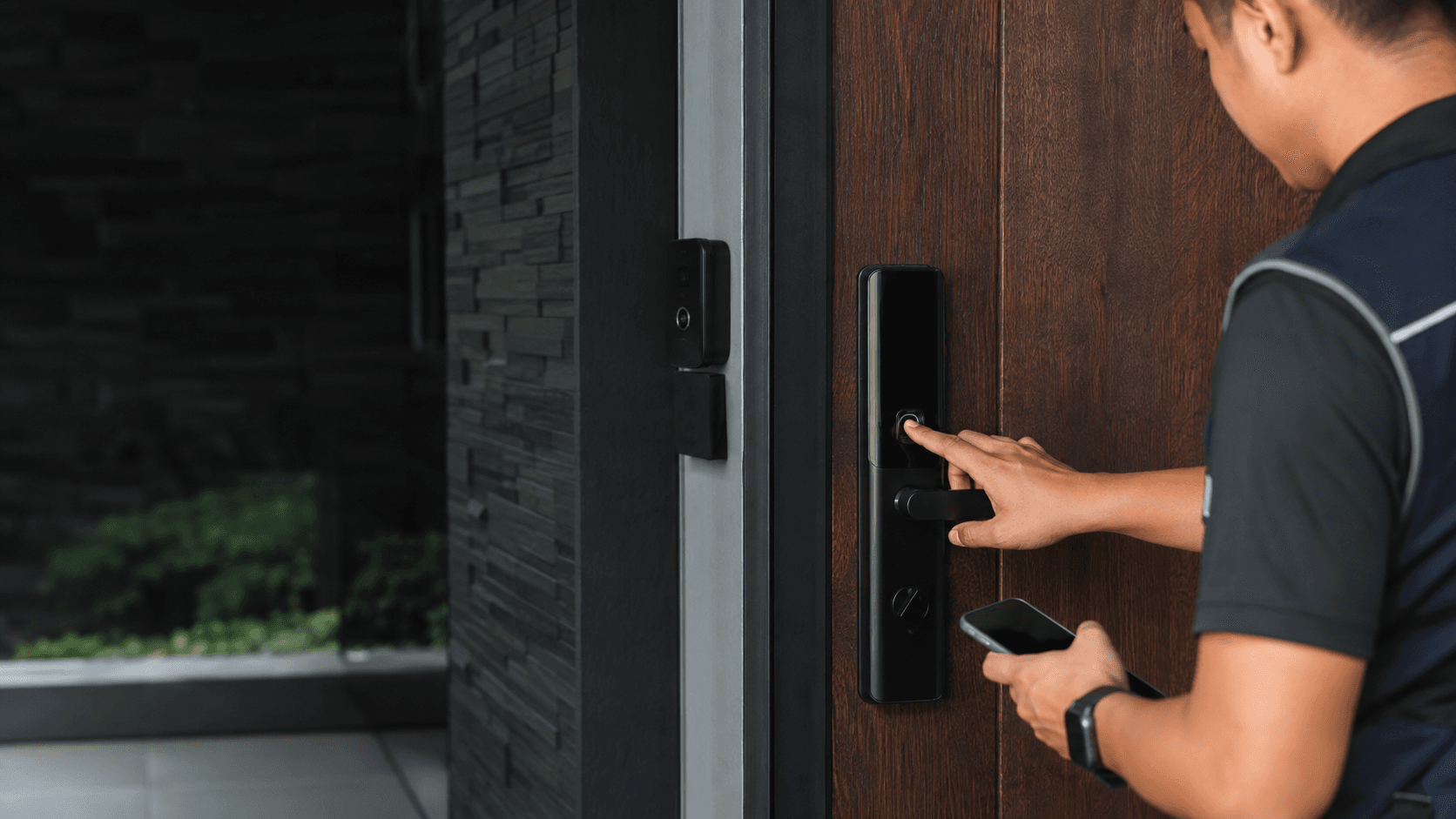
The exact-match query best commercial keypad door locks is a comparison question, not a product question. Decision-makers for offices, shops, and controlled-entry premises in Malaysia are usually weighing two different systems: a standalone keypad lock fitted to a single door, or a keypad reader connected to an access-control panel that manages many doors and many users. The right answer depends on the door itself, who needs to enter, and what happens when the keypad fails or the power drops.
Eyonic Sdn Bhd, a security system supplier in Sarawak, reviews smart lock door access on the basis that smart locks work best when door condition, user roles, and backup method are reviewed before installation. For business use, the same review checks whether a standalone smart lock or an access-control panel is more appropriate. That sequence — door, users, backup — is the practical filter behind most commercial keypad decisions.
Best Commercial Keypad Door Locks: What Malaysian Businesses Compare
Most commercial buyers in Malaysia compare three things before price: how the door is built, how many people need different levels of access, and how the door behaves during a power failure or a forgotten code. A keypad lock that satisfies all three on a glass shopfront door may be the wrong choice on a fire-rated stairwell door, and the reverse is also true.
The comparison usually narrows to two configurations.
- Standalone keypad lock — the keypad, the locking mechanism, and the code storage sit in one unit on the door. Suited to a single entrance with a small, stable group of users.
- Panel-based access control — the keypad acts as a reader, and a separate controller stores users, schedules, and permissions across one or more doors. Suited to premises where staff, contractors, and visitors need different access.
Both configurations appear in the competitor set analysed for this query, and both are treated as legitimate commercial options rather than one being universally superior. The deciding factor is operational, not technical prestige.
Why the door comes before the lock
A commercial door carries hardware that a residential door does not: closers, exit devices, and sometimes a fire rating. A keypad lock has to work with that hardware rather than replace it. On a narrow aluminium shopfront frame, the available space for a lock body is limited. On a solid timber office door, the constraint is different. On a door that already has a push bar for emergency egress, adding a keypad changes how the door is released, and that interaction has to be planned rather than assumed.
This is why a site survey precedes any recommendation. Eyonic's installation process for its security work follows site survey, system proposal, installation, and handover, and the same order applies to a door access job: the door is inspected first, the system is proposed second, and installation follows only after both are settled.
Commercial Keypad Door Locks and the Door They Must Fit
A keypad lock is only as good as its fit to the door. Three door conditions decide whether a standalone unit is viable or whether the door needs a different approach.
Frame material and thickness. Hollow metal, aluminium, timber, and glass doors each present different mounting and drilling constraints. A lock that suits one frame may not seat correctly on another, and retrofitting to an existing door is not always possible without modification.
Existing hardware. Closers, hinges, and exit devices occupy space and dictate how the door swings and closes. A keypad lock added to a door with a heavy closer has to tolerate that closing force repeatedly, every working day.
Traffic and wear. A back entrance used by a handful of staff places different demands on a lock than a main entrance used by every visitor. Higher traffic means more cycles, more code entries, and more chances for a mechanical or electronic fault to surface.
Where any of these conditions is unclear, the honest position is that the door should be inspected before a lock is specified. No specification sheet substitutes for looking at the actual door.
Standalone keypad locks versus panel-based access control
The table below contrasts the two configurations across the factors that most often decide a commercial installation. Cells describe the general character of each option rather than any specific product.
| Factor | Standalone keypad lock | Panel-based access control |
|---|---|---|
| Door condition | Best on a single door in reasonable condition | Suits multiple doors of mixed condition |
| User roles | Shared or limited codes | Individual users, schedules, permissions |
| Backup entry | Mechanical key or override method | Managed override plus audit trail |
| Typical premises | Small office, single shop entrance, storeroom | Offices with staff and visitor zones, multi-door premises |
The trade-off is straightforward. A standalone lock is simpler and involves less cabling, but it offers less control over who entered and when. A panel-based system gives that control but requires more planning, more wiring, and a clearer idea of how the premises are actually used.
User Permissions, Backup Entry and Daily Operation
Daily operation is where a keypad decision either holds up or becomes a nuisance. Two questions surface repeatedly after installation: who can change codes, and what happens when the keypad does not work.
User permissions. A standalone lock typically shares one or a few codes among a group. That is workable for a small team but becomes a problem when a staff member leaves and the code has to be changed for everyone. A panel-based system assigns individual credentials, so removing one person does not disturb the rest.
Backup entry. Every commercial keypad lock needs a way in when the keypad fails, the battery is flat, or a code is forgotten. That backup might be a mechanical key, a second credential type, or a managed override. The backup method should be decided before installation, not after the first lockout.
Daily operation. Codes get shared. Batteries run down. Keypads get pressed with wet or dirty hands. A lock chosen for a commercial entrance should be selected with that reality in mind, and the people who use the door every day should know how to raise a problem.
Pre-installation checks for a keypad lock
Before any commercial keypad lock is ordered, three checks prevent most later problems.
- Door condition — confirm the frame material, the existing hardware, and whether the door can accept the lock without compromising how it closes or releases.
- User roles — list who needs access, whether they need different levels, and how often that list changes.
- Backup method — agree on the fallback entry route and who is authorised to use it.
These checks are the same ones Eyonic applies when reviewing smart lock door access for business use, where the question is whether a standalone smart lock or an access-control panel is more appropriate.
Site Survey Installation and Handover for Commercial Premises
A commercial door access job follows a sequence, and skipping a stage usually shows up later as a door that does not close properly or a user who cannot get in.
- Site survey — inspect the door, the frame, the surrounding cabling route, and how the entrance is used through the day.
- System proposal — set out whether a standalone keypad lock or a panel-based setup fits the premises, and what the installation involves.
- Installation — fit the hardware, run any required cabling, and configure the codes or user credentials.
- Handover — test the door in normal use, confirm the backup entry method works, and show the responsible person how to manage codes or users.
This mirrors the process Eyonic follows for its security installations in Sarawak: site survey, system proposal, installation, and handover. The handover stage matters more than it is often given credit for, because a keypad lock that nobody on site knows how to administer tends to be bypassed within weeks.
For premises with more than one controlled entrance, the survey also establishes whether the doors should be managed together or separately. A single standalone lock on each door is simpler but leaves no shared record. A panel-based approach links the doors but requires the cabling and configuration to support it.
Where the decision usually lands
A single shop entrance with a small, stable team is usually well served by a standalone keypad lock with a clear backup method. An office with staff areas, visitor movement, and a changing roster usually needs the user-level control that a panel-based system provides. Premises that sit between the two — a small office with one main door and one back door — often start with a standalone lock on the less critical door and a managed system on the main entrance.
Eyonic's project work reflects this kind of practical scoping. The Kuching Immigration Office project focused on arrival flow, staff areas, visitor movement, and dependable daily operation. The KTA Sarawak Sdn Bhd project supported staff movement, visitor handling, tidy cabling, and clearer daily site control. Both are examples of matching the system to how a premises actually operates rather than applying one template everywhere.
Practical Budget Ranges and Project Examples in Sarawak
Budget for a commercial door access job depends on how many doors are involved, whether cabling is required, and whether the setup is standalone or panel-based. Published Eyonic package pricing covers other security systems rather than keypad locks: the Hikvision CCTV package, the Hikvision alarm system, and the autogate package are each listed at RM 1,599, covering supply, setup, and handover for those systems.
For larger integrated work, Eyonic's published project budgets give a sense of scale. The Kuching Immigration Office project carries an approximate budget of RM 12,000 to RM 28,000. The KTA Sarawak Sdn Bhd project carries an approximate budget of RM 8,000 to RM 18,000. These figures relate to the wider security and ELV scope of those projects, not to a keypad lock on its own, and they should be read as project-scale context rather than a price for door hardware.
Where a single door is the whole scope, the cost drivers are the lock itself, any door modification, and the labour to fit and configure it. Where several doors and a controller are involved, cabling and configuration become the larger share. A survey is what turns those variables into an actual figure.
Common questions about
Is a standalone keypad lock enough for a commercial door? It can be, where one entrance serves a small, stable group of users and a reliable backup entry method is in place. It becomes limiting when access needs to be granted and revoked per person, or when several doors must be managed together.
What happens when the keypad fails? The answer depends on the backup method chosen before installation. A mechanical key, a second credential, or a managed override each provide a route in, and the responsible person on site should know which applies.
Can a keypad lock be added to an existing commercial door? Often, but it depends on the frame material, the existing hardware, and whether the door can accept the lock without affecting how it closes or releases. This is settled during the site survey rather than assumed beforehand.
Does a keypad lock replace an exit device? No. Where a door already has a push bar or similar release hardware, the keypad controls entry from outside while the exit hardware continues to govern how people leave. The two have to be planned together.
How many codes are needed? That follows from the user roles. A small team may need one shared code; a premises with staff, contractors, and visitors needs individual credentials and a way to remove them when someone leaves.
Eric Yong, founder of Eyonic Security Systems, has worked in the industry for more than 10 years and is experienced in technical installation of digital security solutions for commercial businesses in Sarawak. That experience is applied at the survey stage, where the door and the operating pattern decide the recommendation.
Share your location, property type and required system with Eyonic on WhatsApp at +60 11-5111 7959 for the next practical step.