
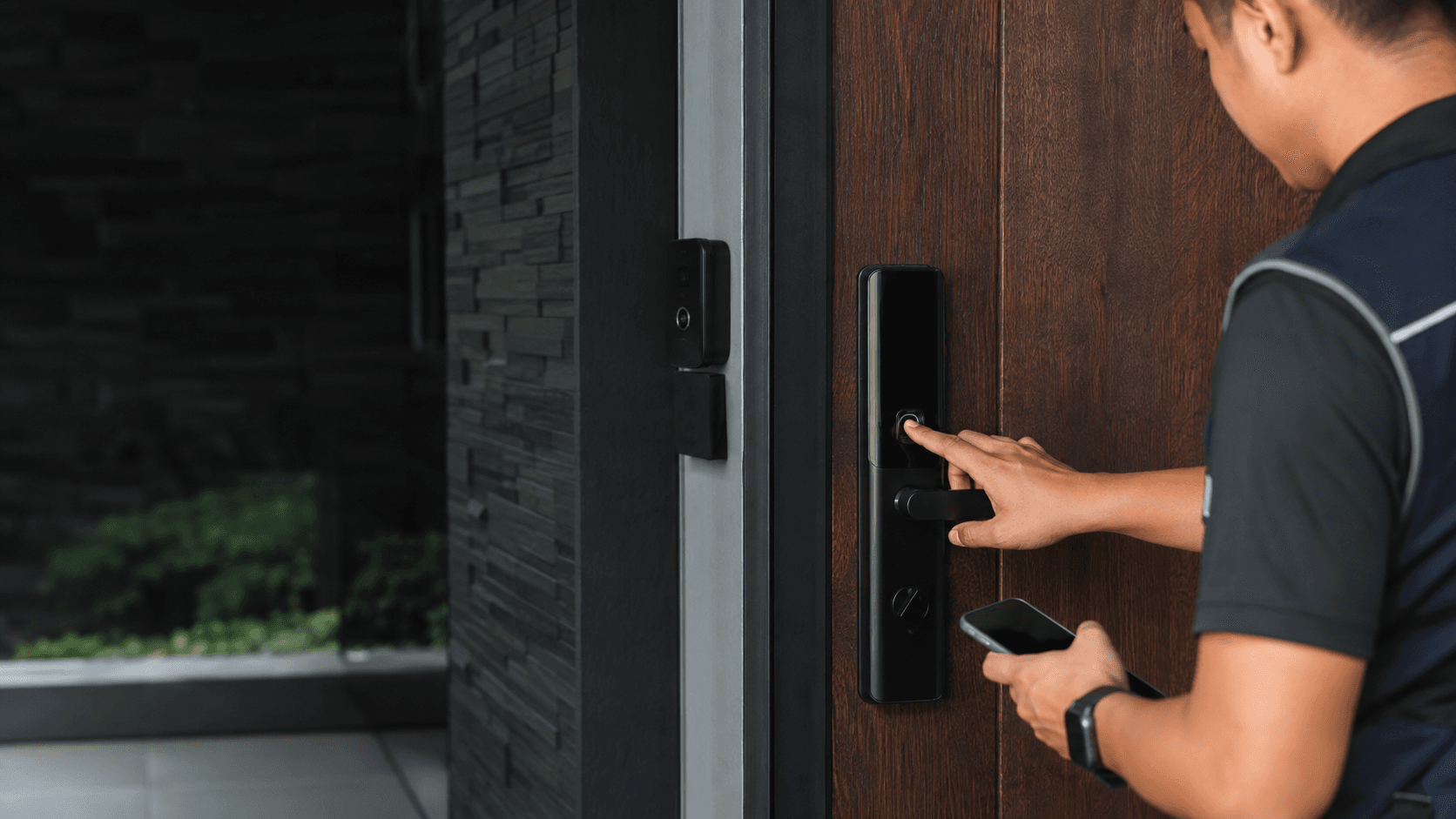
The exact-match query electronic keypad door entry describes a small family of products and setups rather than one device. A keypad door lock is a self-contained unit fitted to a single door. A keypad entry system can also be a keypad wired to a separate controller that releases an electric lock on a door or gate. Both remove the need to hand out keys, and both move the daily question from "who holds a key" to "who holds a code".
Eyonic's own review of smart lock door access notes that these products suit controlled convenience when user permissions and backup entry are planned properly, and that smart locks work best when the door condition, user roles and backup method are reviewed before installation. That is the practical frame for everything below.
Electronic Keypad Door Entry. What It Covers
The term covers the keypad itself, the lock or release mechanism it drives, the power source, and the way codes are created, changed and removed. On a standalone keypad door lock, all four sit inside one housing on the door. On a wired system, the keypad sits outside while the controller and power sit elsewhere, and the lock may be an electric strike, a magnetic lock or a motorised gate operator.
Three things decide which shape fits a property:
- The door or gate itself. A timber or metal swing door, a glass door, a sliding door and a vehicle gate each need a different release mechanism. Door condition is one of the first things to check.
- Who needs entry and how often. A household with four regular users behaves differently from an office with staff, cleaners, contractors and visitors arriving at different hours.
- What happens when the keypad has no power or fails. Backup entry is not an optional extra; it is part of the design.
Eyonic's product review page groups smart lock door access under access control and treats it as a multi-brand category, which reflects how the market is actually sold: the mechanism matters more than the badge on the box.
Keypad Entry Systems for Doors and Gates
A keypad entry system is the broader category. It includes the keypad, the credential method, the locking hardware and the wiring or wireless link between them. The same keypad family can often drive a door strike in an office and a gate operator at a driveway, but the hardware at the far end is not interchangeable.
Standalone keypad door lock
A standalone unit contains the keypad, the electronics, the batteries and the locking bolt. It is the simplest option for a single door, and it needs no cabling to a panel. The trade-offs are real. battery replacement becomes a recurring task, the unit is exposed to weather on an external door, and code management usually happens at the lock itself or through a phone app rather than from a central point.
Keypad wired to a controller
Here the keypad is a reader and the decision-making happens elsewhere. This suits gates, multiple doors on one site, and any property where codes need to be issued and revoked from one place. It also allows the lock to be released by other means, such as an intercom or a reception button, because the release is a separate device rather than part of the keypad.
Eyonic's review note draws the same line for business use: the choice between a standalone smart lock and an access-control panel is a site question, not a product question.
Where keypads sit alongside other entry hardware
Keypads are frequently one layer in a wider setup. A gate may have a keypad for regular users, a remote for residents, and an intercom for visitors. An office may pair a keypad with a doorbell or keyphone intercom so reception can release the door without walking to it. Eyonic supplies and installs keyphone intercom systems and autogate packages alongside its access control work, which is why the entry method is usually decided together with the rest of the door hardware rather than in isolation.
How Code Access Works Day to Day
An access code is a number, or a number plus a card or fob, that the system accepts as proof the person is allowed through. The mechanics are simple, but the operating routine is where most of the value and most of the friction sit.
- A site survey confirms the door or gate, the frame, the power route and the traffic pattern.
- A system proposal sets out whether a standalone keypad lock or a keypad-plus-controller arrangement fits the site.
- Installation fits the keypad, the release mechanism and the power or battery arrangement.
- Codes are created for each user or user group, with a plan for temporary and one-time access.
- Backup entry is confirmed and tested before the system goes live.
- Handover covers code changes, battery or power checks, and who to call when something fails.
Eyonic's installation process follows site survey, system proposal, installation and handover, so the sequence above matches how the work is actually staged.
Code management
Code management is the part that decides whether a keypad system stays useful after the first month. A code that was issued to a contractor and never removed is a permanent open door. A shared code used by ten people cannot be traced to one of them. A system that only supports one code forces the whole household or office onto the same number.
Before committing, it is worth confirming how many separate codes the system supports, whether codes can be given a start and end time, whether the record of who entered is retrievable, and how a lost or leaked code is removed. These are the questions that separate a system that scales with a site from one that has to be replaced.
Backup entry
Every keypad system needs a second way in. The common options are a mechanical key override, a physical key cylinder built into the lock body, a remote control, or a release command from an intercom or reception point. The choice depends on who is left outside when the primary method fails: a resident, a staff member, or a visitor with no local contact.
Backup entry also has to survive a flat battery. A lock that only opens with a code and has no external power terminal or key override turns a dead battery into a lockout, and on a commercial door that can mean a closed premises.
Power and failure behaviour
Battery-powered locks trade wiring for maintenance. Wired locks trade maintenance for a dependency on the power supply and, in some designs, on the controller. Neither is universally better. The relevant question is what the door should do when power is lost: fail secure, staying locked, or fail safe, releasing. That decision belongs to the site's own requirements and should be settled before hardware is ordered.
What to Compare Before Choosing a System
Comparisons are usually made on the wrong axis. Brand names and price tags are easy to line up; the factors that decide whether the system works are harder to see on a product page.
- Door and frame condition. A warped frame, a weak strike plate or a gate that has dropped on its hinges will defeat a correctly specified lock. This is checked first.
- User roles. Residents, staff, cleaners, contractors and visitors need different levels of access, and the system has to express that difference.
- Code capacity and grouping. How many distinct codes or credentials the system holds, and whether they can be grouped.
- Credential type. Keypad only, keypad plus card or fob, or keypad plus phone. Each changes how a lost credential is replaced.
- Backup method. Key override, remote, or release from another device.
- Environment. An external gate keypad faces rain, heat and dust that an internal office door never sees.
- Handover and support. Who changes codes, who replaces batteries, and who attends when the door will not open.
Eyonic's review of smart lock door access makes the same point in one line: door condition, user roles and backup method are reviewed before installation. Skipping any of the three tends to surface as a complaint after handover rather than a problem during the survey.
in Malaysian Properties
Malaysian properties put keypad entry through conditions that product listings rarely describe. External gates and doors face direct sun, monsoon rain and high humidity. Internal office doors face heavy daily traffic with staff, visitors and deliveries arriving through the same opening.
That split matters for specification. A gate keypad needs to tolerate weather and, in many terrace or semi-detached layouts, sit far enough from the house that wiring has to be planned rather than assumed. An office door keypad needs to handle frequent use and a steady turnover of codes as staff and contractors change.
Eyonic's completed work in Sarawak reflects both patterns. The Kuching Immigration Office project focused on arrival flow, staff areas, visitor movement and dependable daily operation for a public office. The KTA Sarawak Sdn Bhd project supported staff movement, visitor handling, tidy cabling and clearer daily site control for an engineering consultancy office. Both are the kind of environment where a keypad is one part of a wider entry arrangement rather than the whole solution.
Eyonic's founder, Eric Yong, has worked in the industry for more than 10 years and is described as highly experienced in technical installation of digital security solutions for commercial businesses in Sarawak. That experience is relevant mainly to the survey stage, where the door, the traffic and the failure case are settled.
What is not settled by a product listing
Several things that matter in Malaysia cannot be confirmed from a catalogue. Local building or fire egress requirements for a keypad-locked door are not something this article can state, and any door that forms part of a means of escape needs its own check against the applicable requirement before a lock is fitted. The same applies to any claim about weather resistance, code capacity or battery life: those figures belong to the manufacturer's documentation for the specific model, and they should be read there rather than assumed from a category description.
Planning Installation and Handover
The work is straightforward when the sequence is respected and expensive when it is reversed. Buying a lock first and discovering the frame will not take it is the most common way a keypad project stalls.
Eyonic's CCTV installation process runs site survey, system proposal, installation and handover, and the same staging applies to access control work. The survey establishes the door, the power route and the traffic. The proposal fixes the mechanism and the credential method. Installation fits and tests. Handover transfers the operating knowledge, which for a keypad system means code changes, backup entry and battery or power checks.
Two constraints are worth naming. First, a keypad on a door that is also used as an escape route needs its release behaviour confirmed against the applicable requirement, not against convenience. Second, a system with no clear owner for code changes will drift: codes accumulate, nobody knows who holds what, and the audit value of the system disappears.
For readers comparing options in Sarawak, Eyonic's published packages cover a Hikvision CCTV package at RM 1,599, a Hikvision alarm system at RM 1,599 and an autogate package at RM 1,599, each including supply, setup and handover. Those figures cover the listed systems, not keypad entry hardware, and no verified pricing for electronic keypad door entry supply or installation in Malaysia was available for this article.
Share your location, property type and required system with Eyonic on WhatsApp at +60 11-5111 7959 for the next practical step.