
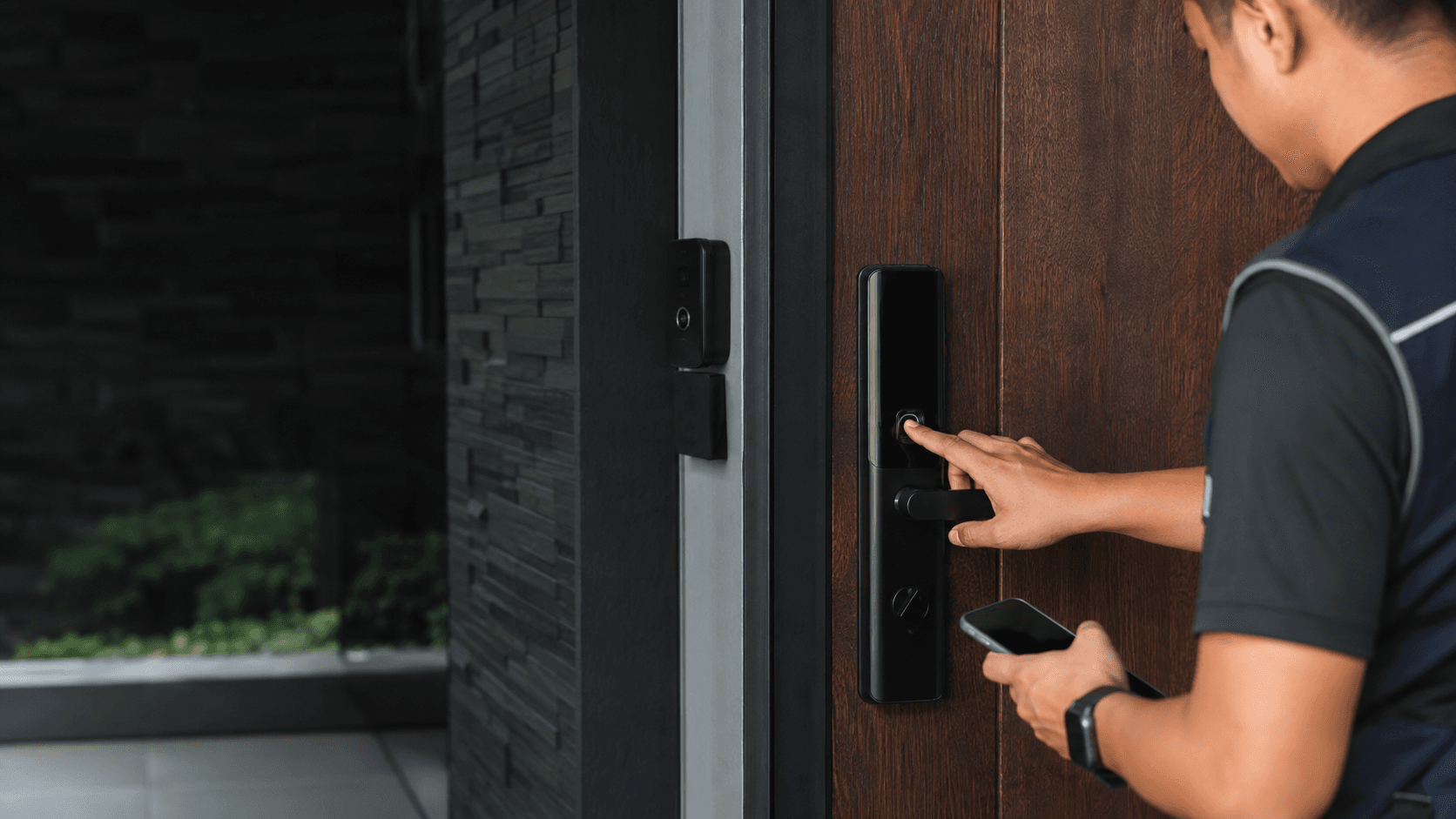
The term covers a wide range of hardware, from a deadbolt that talks directly to a home router to a keypad lock that needs a separate bridge before it reaches the internet. The differences matter more than the label, because they decide what happens when the network drops, when the battery runs low, and when someone needs to get in without a phone.
Wifi Controlled Lock. What Matters Before You Choose
Most buying mistakes with a wifi controlled lock happen before any product is compared. They happen when the door, the users and the backup entry method are never reviewed. Eyonic's own product review notes that smart locks work best when door condition, user roles and backup method are checked first, and that for business use the choice between a standalone smart lock and an access-control panel should be settled early.
Four questions carry most of the decision weight:
- Does the door already have a deadbolt that can be replaced, or does the whole lockset need changing?
- Who needs entry, and do they need it permanently, on a schedule, or once?
- What happens during a power cut, a Wi-Fi outage or a flat battery?
- Is this a single door for a household, or a site where staff and visitor movement must be tracked?
A household usually answers these quickly. A shop, office or industrial site often cannot, because the same door serves staff, visitors and deliveries at different times. That is the point where a wifi controlled lock stops being a hardware purchase and becomes part of a wider access plan.
What Is a Wifi Controlled Lock and How Does It Connect?
A wifi controlled lock is a lock with a network radio inside it, or attached to it, that lets an app or platform send lock and unlock commands and receive activity records. The lock still does the physical work of a deadbolt or lever. The network connection only carries instructions and logs.
There are three common connection arrangements, and they behave differently in daily use.
| Connection type | How it reaches the internet | Practical consequence |
|---|---|---|
| Built-in Wi-Fi | The lock connects to the existing router directly | No extra hub, but the lock depends on Wi-Fi signal at the door |
| Bluetooth plus bridge | A separate bridge or hub links the lock to the network | Extra device to power and place, but often better battery life at the lock |
| Panel-based access control | A controller manages the door as part of a larger system | Suits sites with many doors, many users and a need for central records |
Remote control is the headline feature, but the more useful capability is usually the record. A lock that reports who entered and when turns a door into a source of information. That is why the same hardware can be adequate for a family home and inadequate for a business entrance where visitor movement needs to be accounted for.
What happens when the network fails
A wifi controlled lock should never be the only way through a door. Every practical installation keeps at least one method that does not depend on the network: a mechanical key, a keypad code stored on the device, or a physical override. The lock's own memory usually holds its codes, so a keypad entry can still work while the router is down. Remote unlock will not.
Battery and power realities
Battery-powered locks trade wiring for maintenance. The trade is reasonable on a low-traffic door and less reasonable on a main entrance used dozens of times a day. Where a door is busy, or where the lock also drives a motorised deadbolt, power planning belongs in the design rather than in a later complaint.
Choosing the Right Wifi Controlled Lock
The right choice follows the door and the users, not the feature list. A lock with fingerprint, keypad, app and voice control is not better than a simpler lock if half those methods go unused and the extra hardware adds a failure point.
Fit the lock to the situation.
- Family home, one main door. A built-in Wi-Fi deadbolt with a keypad and a mechanical key covers most needs. Remote unlock is convenient for deliveries and guests.
- Rental or short-stay unit. Temporary codes that expire matter more than permanent user accounts, because guests change constantly.
- Shop or office entrance. Staff arrive and leave on a schedule, and the owner may need to confirm who was on site. Scheduled codes and an activity record carry more value than voice control.
- Site with several doors. A standalone lock per door becomes hard to manage. A panel-based access-control approach keeps users and records in one place.
Door condition decides feasibility. A door that does not close squarely, a frame that has moved, or a strike plate that no longer aligns will cause problems for any motorised lock, regardless of brand. This is checked before installation, not after.
Retrofit or full replacement
A retrofit keeps the existing deadbolt and adds a connected exterior unit. It suits rented property and doors where the existing hardware is sound. A full replacement swaps the deadbolt or lockset and gives more control over the mechanism, the finish and the keyway. The trade-off is cost and, on some doors, additional preparation work.
Compatibility with what already exists
Smart home platforms, voice assistants and Matter support appear across most current product lines. Compatibility is worth confirming, but it should not lead the decision. A lock that integrates with three ecosystems and fits the door badly is a worse outcome than a plain keypad lock that works every day.
Practical Considerations for Installations
Installation quality decides whether a wifi controlled lock feels reliable or erratic. The lock itself is a small part of the work. Alignment, fixing, network reach and user setup carry the rest.
Eyonic's installation process follows a defined sequence: site survey, system proposal, installation, and handover. The same shape applies to door access work, because the survey is where door condition, user roles and backup method get settled.
Points that repeatedly affect the outcome:
- Signal at the door. A lock that connects directly to Wi-Fi needs usable signal where the door is, not where the router is. Thick walls, metal doors and distance all reduce it.
- Door alignment. A motorised deadbolt pushes against resistance. If the door or frame has shifted, the motor works harder and battery life drops.
- User roles. Permanent codes for family, scheduled codes for staff, one-time codes for visitors. Deciding this at setup avoids rework later.
- Backup entry. A key kept off-site, or a code held by a second person, prevents a lockout when a phone is lost or a battery dies.
- Record keeping. For business premises, the activity log is often the reason the lock was installed. Someone needs to review it.
Where a single lock stops being enough
A single wifi controlled lock on a single door is straightforward. The picture changes when a site has a front entrance, a staff entrance, a store room and a gate. Managing separate apps and separate user lists for each door creates gaps, and gaps are where access control fails. At that scale, the question shifts from which lock to which system, and the answer usually involves a controller rather than more standalone locks.
Working alongside other security systems
Door access rarely stands alone. Cameras at the entrance, an alarm system, an intercom at the gate and internet connectivity all touch the same daily routine. Eyonic works across these categories, including CCTV, alarm systems, autogate, keyphone intercom and Starlink internet installation, which means door access can be planned as one part of a site rather than as an isolated purchase.
The Kuching Immigration Office project is an example of that approach in a public building, where the focus was arrival flow, staff areas, visitor movement and dependable daily operation. Those are the same concerns that shape a business door access decision, even at a much smaller scale.
Making an Informed Choice About
A good decision here is usually a modest one. Match the lock to the door, keep a method of entry that does not depend on the network, and decide user roles before installation rather than after. Where the site has several doors or a need for records, treat the door as part of an access system instead of buying more standalone locks.
For households in Sarawak, a built-in Wi-Fi deadbolt with a keypad and a mechanical key covers the common cases. For shops, offices and industrial sites, the useful questions are who needs entry, when, and how that will be reviewed. Those answers point to either a standalone smart lock or a panel-based approach, and settling them early avoids paying twice.
Share your location, property type and required system with Eyonic on WhatsApp at +60 11-5111 7959 for the next practical step.