
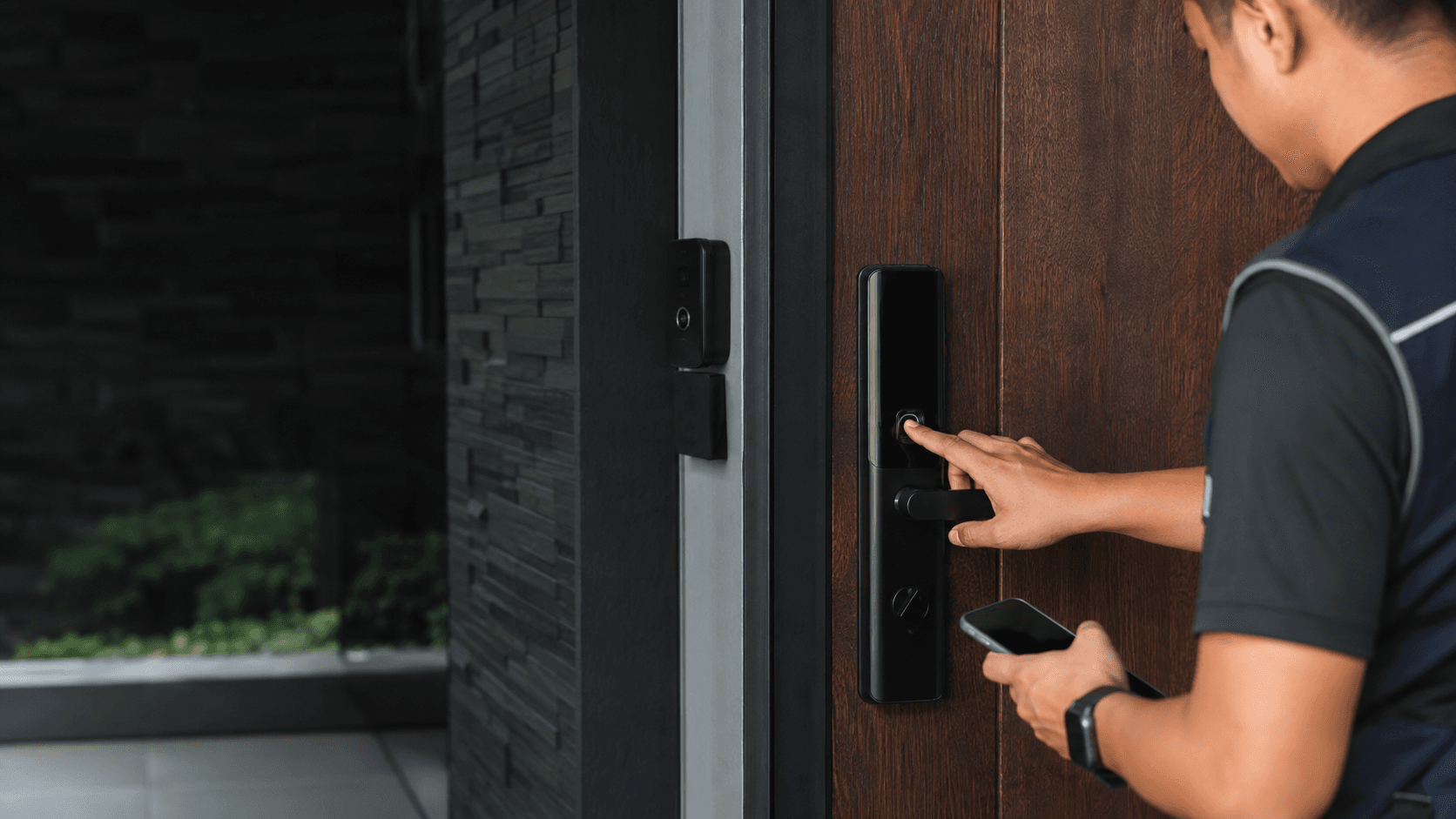
Fingerprint entry works by reading the ridge pattern on a finger, converting it into a stored template, and matching a live scan against that template before releasing the locking mechanism. Nothing is copied from the finger itself; the lock keeps a mathematical reference and compares it at the moment of entry.
That difference matters at the door. A key can be duplicated without the owner knowing, while a fingerprint template stays inside the device and is tied to a named user. The trade-off is that the lock now depends on a reader, a power source and a decision about what happens when either one fails.
What to check before buying a finger id door lock
Five checks cover most of the risk in a finger id door lock purchase. Each one can be answered before money changes hands, and each one changes what gets installed.
- Confirm the door condition, thickness and existing hardware, including whether the frame closes squarely and whether the current lock is a deadbolt, knob or lever set.
- Decide who needs access and at what level, separating permanent household or staff users from visitors, contractors and short-stay occupants.
- Agree a backup entry method before installation, so a failed scan or a flat battery does not leave the door unusable.
- Confirm power and battery expectations, including who monitors the low-battery warning and how the lock behaves when power runs out.
- Confirm who installs, who tests the enrolled users, and who hands over the access list and admin credentials.
Eyonic's own review of smart lock door access reaches the same conclusion from the installation side: smart locks work best when the door condition, user roles and backup method are reviewed before installation, and for business use the choice between a standalone smart lock and an access-control panel is usually settled at that stage.
Finger Id Door Lock fit. door condition, thickness and existing hardware
Fingerprint entry hardware is not universal. A lock body has to sit inside an existing cutout or a new one, and the door has to be thick enough and solid enough to carry it.
Three door conditions cause most retrofit problems. A door that has swollen or dropped on its hinges will not align with a motorised or spring-loaded latch. A hollow-core interior door may not have the material to hold a deadbolt body under repeated use. A metal or glass door usually needs a different mounting approach from a timber door.
The existing hardware matters just as much. A deadbolt replacement and a knob or lever replacement are different products, and the bore holes left by the old lock constrain what fits. Where the door already carries a mortise lock, the replacement has to match that format or the door needs modification.
This is why a site survey comes before a recommendation rather than after. Eyonic's installation process runs site survey, system proposal, installation and handover in that order, which means the door is measured and the closing behaviour observed before a model is proposed.
Access roles, backup entry and power failure planning
Access planning is the part buyers most often skip, and it is the part that causes complaints later. A finger id door lock is only as useful as the list of people enrolled on it.
Separate users into groups before installation. Permanent users are household members or long-term staff who need daily entry. Temporary users are cleaners, contractors, delivery access or short-stay occupants who need entry for a defined period. Administrative users are the people who can add, remove or suspend a fingerprint, and that group should be as small as practical.
Backup entry needs a decision, not an assumption. Common options are a mechanical key override, a keypad code, or a second credential held by a trusted person. Whichever is chosen, the backup has to be stored somewhere that is not inside the property, because a backup that lives behind the locked door is not a backup.
Power failure behaviour should be confirmed for the specific model. Battery-powered locks typically warn before depletion, and some support a temporary external power contact. Mains-powered access control behaves differently again, and the fail-safe or fail-secure setting determines whether the door releases or stays locked when power is lost. That setting is a safety decision as much as a security one, and it should be agreed with the installer rather than left at a default.
Finger Id Door Lock in Malaysian homes, shops and offices
Malaysian doors vary more than product listings suggest. Terrace houses, apartments, shophouses and converted office units often carry different door formats within the same building, so a model that fits one unit may not fit the next.
In a home, the usual driver is convenience for a small number of people plus the ability to give a one-off entry to a contractor without cutting a key. The risk is low user count and simple access rules, which suits a standalone lock.
In a shop, the pattern changes. Staff turnover means fingerprints have to be added and removed regularly, and the person managing that list is often not the owner. Opening and closing times create a need for time-limited access, and a shared entrance may need a record of who entered and when.
In an office, the question is usually whether a standalone smart lock is enough or whether an access-control panel is more appropriate. Eyonic's guidance on smart lock door access notes that for business use the choice between the two is normally reviewed before installation, because a panel handles multiple doors, scheduled access and audit history in a way a single lock does not.
Public and controlled-access buildings add another layer. Eyonic's work at the Kuching Immigration Office focused on arrival flow, staff areas, visitor movement and dependable daily operation, which is the same set of concerns that shapes access decisions in any building where the public and staff share an entrance.
Installation and handover. what a proper site check covers
A site check is not a sales visit. It produces the measurements and decisions that determine whether the installation works on the first attempt.
The check should record the door material, thickness and closing behaviour, the existing lock format and bore dimensions, and whether the frame is square. It should confirm the mounting position relative to the handle and the reach of a hand at the reader. It should also confirm the power arrangement, whether the lock runs on batteries or a supply, and where the backup credential will be held.
Handover is the second half of the job and the part that determines whether the system stays usable. A proper handover enrols the agreed users, tests each one at the door, confirms the backup method works, shows the administrator how to add and remove a fingerprint, and records who holds the admin credential.
Eyonic's installation process ends at handover for the same reason. A system that is installed but not demonstrated tends to be abandoned the first time a scan fails.
Cost, support and the next practical step
Pricing for a finger id door lock supply-and-install package in Malaysia is not published here, because the figure depends on the door, the model and the access rules rather than on the lock alone. A single residential door and a multi-door office entrance are not comparable jobs.
What can be stated is the shape of the cost. Hardware, door preparation, installation labour and handover all contribute, and a door that needs modification adds work that a straight replacement does not. Where a business needs multiple doors, scheduled access or audit history, the access-control route usually changes the scope again.
Eyonic's published package pricing covers other security work rather than this category: the Hikvision CCTV package, the Hikvision alarm system and the autogate package are each listed at RM 1,599. Those figures are useful as a reference point for how the company structures supply-and-install work, not as a price for a finger id door lock.
Support matters more than the initial fitting. A lock that cannot be re-enrolled, or whose administrator has left the company, becomes a problem within months. Confirming who to contact for user changes, and whether that support is local, is a reasonable question to settle before installation rather than after.
For a specific property, the practical next step is to share the location, property type and required system with Eyonic on WhatsApp at +60 11-5111 7959, so the door and access requirements can be assessed against what is actually available.