
Buyers searching for hikvision 7100 series usually want one thing settled before money changes hands: is this the right recorder tier for a home, a shop, or a small office? The honest answer depends less on the badge on the box and more on how many cameras the site needs, how long footage must be kept, and who will watch it back.
Most published material on this family is either a raw specification dump or a product listing that mixes unrelated hardware into the same series. That makes the tier hard to judge. This page keeps to what can be verified and explains where the recorder sits in a real small-site layout.
What the Hikvision 7100 Series covers
The Hikvision 7100 Series sits in the entry tier of Hikvision recording hardware. It is aimed at sites that need continuous recording and playback without the cost and complexity of a larger commercial platform.
Public listings for the family describe compact recorders built for small installations, with recording from connected cameras, local storage, and remote viewing through a mobile app. Those descriptions are consistent across listings, but they are not a substitute for a current datasheet, and model-level details change between revisions.
One caution matters here. Some aggregator pages file unrelated products under a "7100" label, including door hardware from other manufacturers. A series name is not a guarantee that every result sharing that number belongs to the same product line. Confirm the exact model before treating any listing as part of the family.
Hikvision 7100 Series models and channel counts
Channel count is the number that decides most small-site purchases. It sets how many cameras the recorder can accept, and it is the first figure to confirm against a current datasheet rather than a reseller page.
Public listings for this family have referenced four, eight, and sixteen channel recorders. Those figures come from third-party listings, not from a verified Hikvision datasheet supplied for this page, so they should be treated as a starting point for a conversation rather than a confirmed range.
Two practical rules apply regardless of the exact model:
- Buy channels for the cameras the site will actually run, plus a small margin for a later addition.
- Confirm the recorder accepts the camera type already on site, because analog and network cameras are not interchangeable at the recorder end.
A four-channel unit suits a small home or a single-counter shop. An eight-channel unit covers a shop with a back entrance, a small office, or a home with outdoor coverage. Sixteen channels moves into larger premises where the recorder is no longer the cheapest part of the job.
Where a 7100 Series recorder fits in a small CCTV layout
The recorder is the box that stores footage and serves it back. Cameras capture, the recorder keeps, and the viewing device displays. A small site fails more often at the placement and storage stage than at the recorder stage.
Camera placement decides whether the footage is worth keeping. A recorder can only store what the cameras actually see, and a well-chosen unit behind a badly aimed lens produces nothing useful. Eyonic checks actual lighting conditions before confirming placement, particularly for cameras chosen for low-light performance, because a position that looks correct in daylight can behave differently after dark.
Recorder position matters too. It needs power, a network path, and enough ventilation to run continuously. Small cabinets and enclosed shelves are common causes of early hardware trouble in warm rooms.
For a home, the usual layout is one recorder and a handful of cameras covering entry points. For a shop, the priority shifts to the counter, the till area, and the stock entrance. For a small office, coverage tends to follow staff and visitor movement rather than perimeter security.
Storage, playback, and remote viewing basics
Storage is the constraint that surprises small-site buyers most. Footage retention depends on how many cameras run, how much detail each stream carries, and how many hours a day recording is active. More cameras and higher detail both shorten the retention window for the same disk.
Playback is where a recorder earns its place. The practical test is whether a specific moment can be found quickly, without scrubbing through hours of footage. That depends on how the recorder indexes and searches recordings, and on whether the person reviewing footage has been shown how to use it.
Remote viewing lets a phone or computer check live and recorded footage over the internet. It is the feature most small-site owners ask about first, and the one most likely to be set up incorrectly. Remote access depends on a stable internet connection at the site and a correct configuration at the recorder. A recorder that records perfectly can still fail at remote viewing if the network side is not handled during installation.
Retention, playback speed, and remote access are all decided at planning time. Changing them later usually means adding storage or reconfiguring the network, not swapping a setting.
Planning a Hikvision 7100 Series installation in Sarawak
A recorder purchase is only one line in a small CCTV project. The rest is survey, cabling, mounting, configuration, and handover, and those steps decide whether the system is usable six months later.
Eyonic's CCTV installation process follows a fixed sequence:
- Site survey to review the property, entry points, lighting, and existing cabling.
- System proposal covering camera placement, recorder choice, and storage.
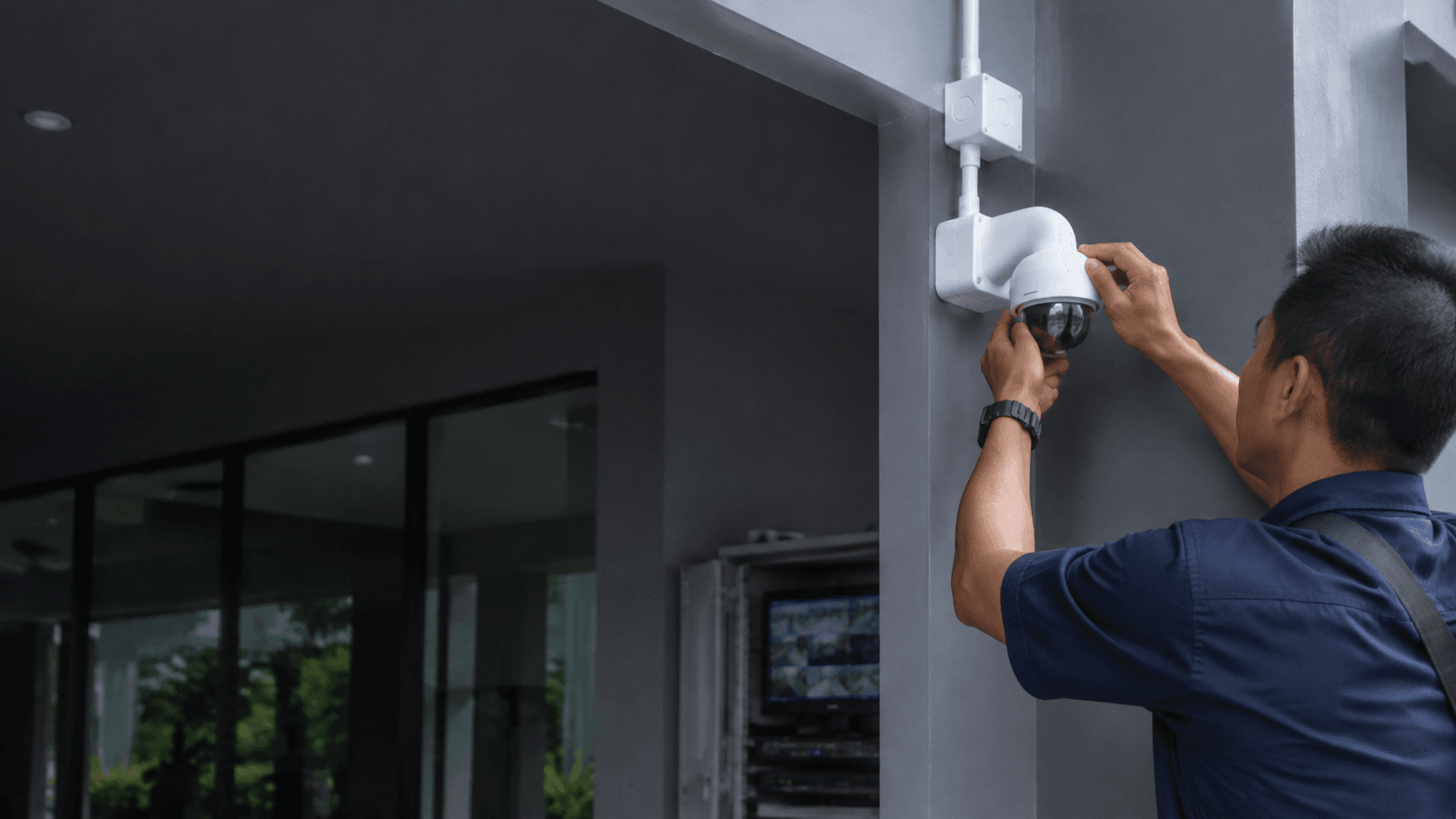
- Installation of cameras, recorder, cabling, and network configuration.
- Handover with mobile viewing set up and the system explained.
That sequence matters more than the model number. A survey catches the problems that a product page cannot: a doorway that is backlit all afternoon, a cable run with no practical path, or a recorder position with no ventilation.
Local conditions in Sarawak add their own constraints. Long cable runs across larger properties, humid rooms, and intermittent power all affect how a small system should be built. None of these are reasons to avoid a recorder in this tier. They are reasons to plan the installation before ordering hardware.
Eyonic has completed work for the Kuching Immigration Office, focused on arrival flow, staff areas, visitor movement, and dependable daily operation. That project is larger than a typical home or shop job, and its approximate budget range of RM 12,000 to RM 28,000 reflects a public-office scale of work rather than a small-site installation. It is useful as an example of how coverage priorities are set by how a site is actually used.
Getting a Hikvision 7100 Series system supplied and installed
Supply and installation are usually handled together for small sites, because the recorder, cameras, storage, and network settings have to agree with each other. Buying the recorder separately and arranging installation afterwards tends to create compatibility questions that are easier to avoid at the start.
Eyonic's Hikvision CCTV Package is priced at RM 1,599 and covers camera supply and setup, basic recording configuration, and mobile viewing handover. That package is a reference point for a small installation rather than a quotation for a specific property, because camera count, cable runs, and site conditions vary.
For a small site, the practical starting information is location, property type, and the coverage required. Those three details are enough to judge whether a recorder in this tier fits, how many channels are needed, and what storage will support the retention the site wants.
Share your location, property type and required system with Eyonic on WhatsApp at +60 11-5111 7959 for the next practical step.