
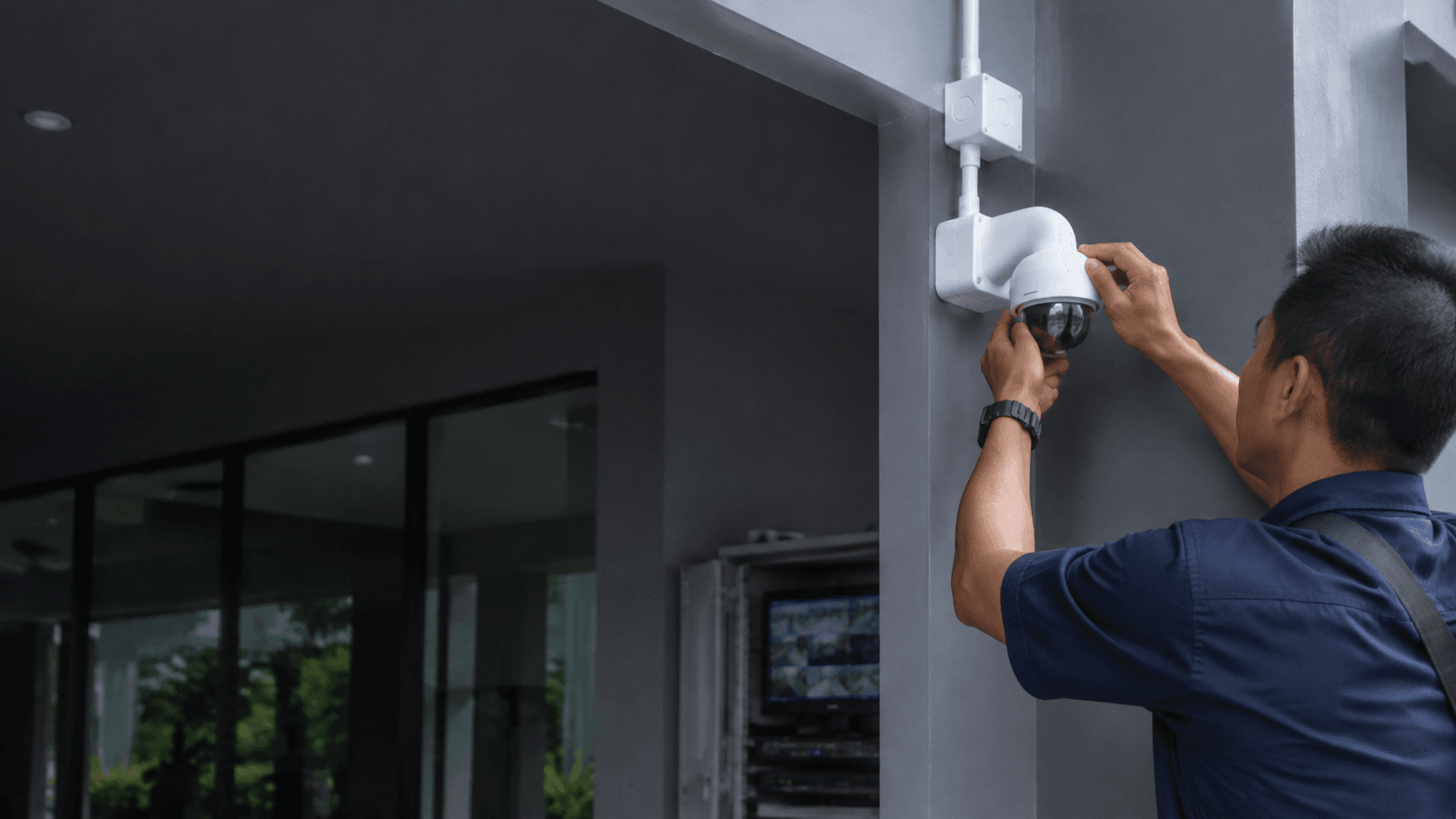
The exact-match query battery powered security camera no wifi describes a real category of equipment, but the phrase hides three separate decisions. Power, connectivity and recording are independent choices, and each one changes what the camera can actually do at a site with no wireless network.
Most buyers assume "no wifi" means one thing. In practice it can mean three different things: the camera has no wireless radio at all, the site has no internet connection, or the owner simply does not want the camera on the same network as everything else. Each case leads to a different system design.
Battery Powered Security Camera No Wifi: How These Systems Stay Connected
A battery powered security camera no wifi system stays connected through one of three paths. The camera can use a cellular data connection, it can record locally and be checked on site, or it can sit on a wired network that carries data without any wireless link.
Cellular models carry a SIM and send footage over a mobile network. Local-recording models write to a memory card or a recorder and never transmit anything. Wired models use a cable run to a router or recorder, which is common in shops and offices where cabling already exists.
The choice matters because it decides how footage leaves the site. A cellular camera can be viewed from anywhere with mobile coverage. A local-recording camera can only be reviewed by someone physically present, unless the recorder itself is networked.
What Replaces Wi-Fi When a Site Has No Network
Three things replace Wi-Fi, and they are not interchangeable. Cellular data replaces the transmission path. Local storage replaces the need to transmit at all. A wired connection replaces the wireless link with a physical cable.
Cellular connectivity is the closest match to what most people expect from a connected camera. The camera talks to a mobile network instead of a router, so it works at a farm, a construction site or a remote gate as long as mobile coverage reaches the spot.
Local recording is the simplest and most private option. Footage stays on the device or on a recorder inside the building. Nothing is uploaded, so nothing depends on signal strength. The trade-off is that checking footage means going to the recorder.
A wired network sits between the two. Data travels over cable to a recorder or router, which may itself have an internet connection. This suits a shop or office where cabling is already part of the fit-out.
Power, Recording and Remote Viewing in Practice
Battery runtime is the constraint that shapes everything else. A camera that records continuously drains far faster than one that wakes on motion. That single design choice decides how often someone has to visit the site to recharge or swap batteries.
Motion-triggered recording is the usual answer for battery-powered units. The camera sleeps, wakes when something moves, records a clip, then returns to sleep. Continuous recording on battery is possible but demands either a much larger battery or a permanent power source.
Remote viewing adds another draw. Every time the camera streams live video to a phone, it uses power and data. A site that is checked once a day behaves very differently from one watched continuously.
Storage choice follows the same logic. A memory card holds a fixed amount of footage and needs periodic review. A recorder holds more and can be expanded, but it needs its own power and a place to sit.
Where Off-Grid and No-Network Sites Fit in Sarawak
Sarawak sites often combine two problems at once: no fixed internet and no convenient power. Rural properties, farm entrances, logging access roads and remote gates all fall into this group.
Mobile coverage is the first thing to confirm, because a cellular camera is only as good as the signal at the exact mounting point. Coverage at the gate can differ from coverage at the house, and a hill or a metal roof can change the result.
Power is the second check. A battery camera needs a realistic recharge plan, whether that is a solar panel, a periodic swap, or a cable run from an existing supply. Without a plan, the camera becomes a maintenance task rather than a security measure.
Eyonic has completed work for the Kuching Immigration Office, focused on arrival flow, staff areas, visitor movement and dependable daily operation. That project shows how much weight a public-facing site places on reliable day-to-day operation rather than on features alone.
Planning Steps Before Any Camera Is Mounted
Eyonic's documented CCTV installation process runs through four stages: site survey, system proposal, installation, and handover. The same sequence applies to a no-network site, with extra attention on the first two stages.
- Site survey. Confirm where coverage is needed, what power is available, whether mobile signal reaches the mounting point, and what lighting exists after dark.
- System proposal. Match the connectivity method, recording method and power plan to the site, then set out what the system will and will not do.
- Installation. Mount cameras, run any cabling, configure recording and set up viewing access.
- Handover. Walk through live view, playback and basic checks so the people on site know how the system behaves day to day.
The survey stage carries the most risk on a no-network site. A camera placed where signal is weak will fail intermittently, and intermittent failure is harder to diagnose than a camera that never worked at all.
Lighting deserves its own check. Eyonic advises confirming actual lighting conditions before finalising placement for ColorVu-style cameras, because a position that looks adequate in daylight can behave very differently at night.
What Eyonic Checks Before Recommending a Setup
Several questions come before any product recommendation. What is the property type, and is it a home, a shop, an office or an industrial site? Where does the owner need coverage, and what happens on site that needs to be seen?
Connectivity comes next. Is there any internet at the site, and is mobile coverage reliable at the intended camera position? If neither is dependable, local recording becomes the practical answer, and remote viewing is set aside as a limitation rather than promised as a feature.
Power follows. Is there a permanent supply near the mounting point, or does the camera need to run on battery with a recharge plan? This decides how much recording the system can realistically sustain.
Camera placement is then confirmed against real conditions rather than assumptions. The KTA Sarawak Sdn Bhd project, for example, centred on a practical office setup in Kuching supporting staff movement, visitor handling, tidy cabling and clearer daily site control. Cabling tidiness and daily usability mattered as much as the cameras themselves.
Only after those checks does a system proposal make sense. A battery powered security camera no wifi recommendation that skips the survey stage tends to produce a camera that works on paper and disappoints on site.
Trade Offs Between Cellular Local and Wired Setups
Each connectivity path carries a cost that is not always financial. Cellular gives remote viewing but depends on signal and on an ongoing data arrangement. Local recording gives privacy and independence but requires physical access to review footage. Wired gives stability but needs cabling and a network to connect to.
Battery power adds its own trade-off. It removes the need for a cable run, which is often the hardest part of an installation, but it introduces a maintenance cycle. Someone has to recharge or replace batteries, and that visit has to be planned rather than assumed.
There is also a coverage trade-off. A camera watching a gate, a driveway or a storefront is doing a narrow job. Adding more cameras spreads the same power and storage budget across more devices, which shortens runtime or fills storage faster.
Edge cases are worth naming. A site with strong mobile signal but no power suits a cellular camera with solar charging. A site with power but no signal suits a wired or local-recording camera. A site with neither is the hardest case, and it usually means local recording with a planned maintenance visit.
Common Questions About No Network Camera Systems
Can a camera record without any network at all
Yes. A camera with a memory card or a connected recorder captures footage with no network involved. The footage is stored locally and reviewed on site. Nothing is transmitted, so nothing depends on signal or data.
Does a battery camera need Wi Fi to send alerts
Alerts need a transmission path. Without Wi-Fi, that path is either cellular data or nothing at all. A purely local-recording camera will not send a phone alert, because there is no route for the message to travel.
How long does a battery last
Runtime depends on how often the camera records, how much it streams, and the conditions at the site. No single figure applies across models, and any estimate should come from the manufacturer's specification for the exact unit being considered.
Is a no Wi Fi camera harder to install
Not necessarily. Removing the wireless link can simplify configuration, but it shifts effort to the survey stage. Confirming signal, power and placement takes longer when there is no fallback network to lean on.
What about sites with no power and no signal
This is the most constrained case. Local recording with a planned recharge or battery-swap schedule is the usual approach, and remote viewing is treated as unavailable rather than promised. The system still records; it simply cannot be watched from elsewhere.
Matching the System to the Site
The right answer depends on which constraint is hardest to solve. If power is the problem, battery and solar matter most. If connectivity is the problem, cellular or local recording decides the design. If both are problems, the system has to be built around a maintenance routine.
Eyonic plans, supplies and installs monitoring systems with camera placement, recording and remote viewing for homes, offices, shops and industrial sites across Sarawak. Published package pricing starts at RM 1,599 for a Hikvision CCTV package covering camera supply and setup, basic recording configuration and mobile viewing handover.
That package structure assumes a site with power and a network path. A no-network site needs the survey stage to establish what is actually possible before any package is matched to it, because the connectivity and power decisions come first.
Share your location, property type and required system with Eyonic on WhatsApp at +60 11-5111 7959 for the next practical step.