
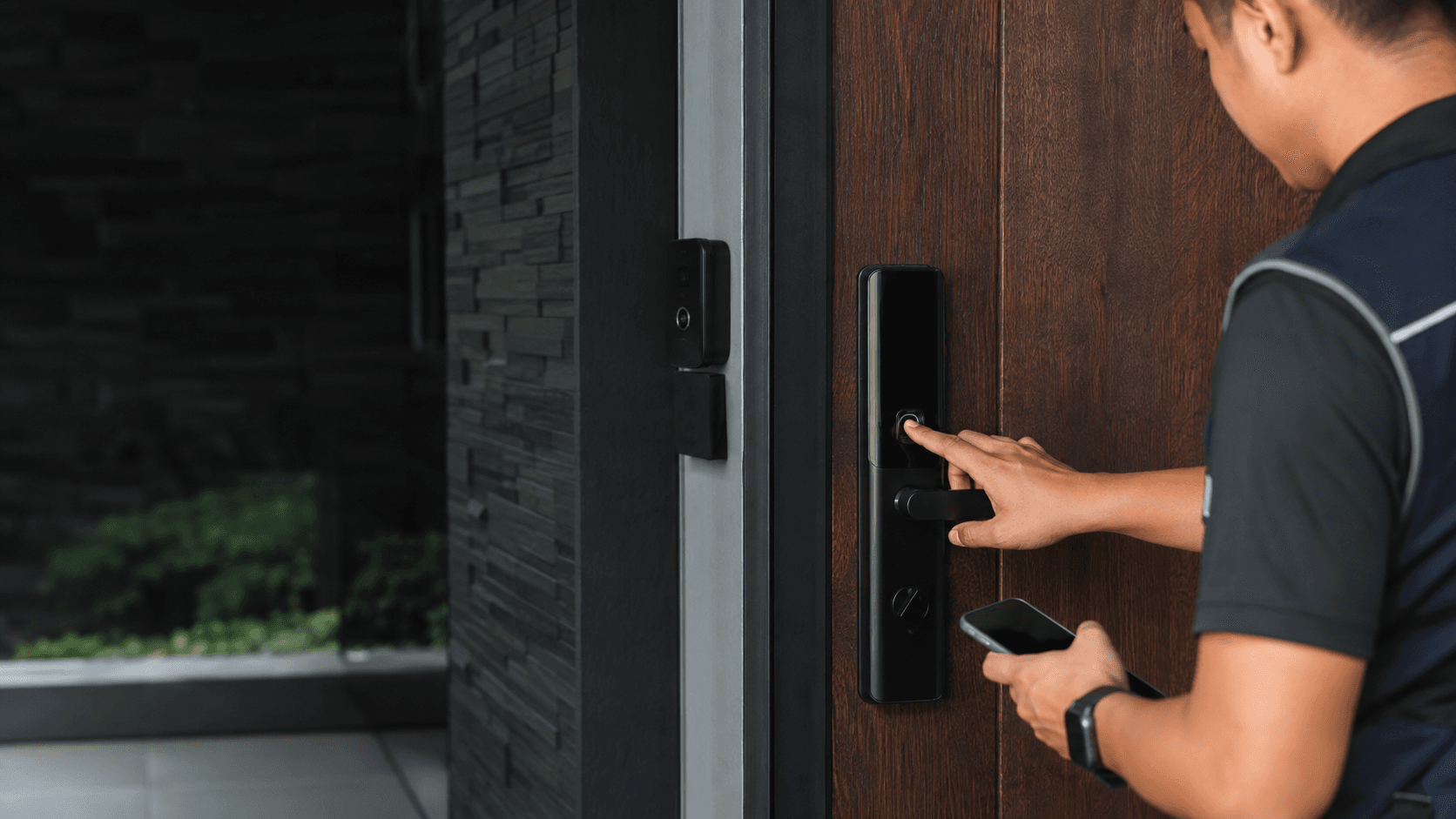
The exact-match query fingerprint front door lock describes a lock that replaces or supplements a keyed cylinder with a biometric reader at the door. Eyonic's own product review guidance states that smart locks work best when the door condition, user roles and backup method are reviewed before installation, and that for business use the choice between a standalone smart lock and an access-control panel is usually checked first.
That guidance matters in Malaysia because the deciding factors are rarely about the reader itself. They are about the door the lock has to sit in, the people who need to pass through it, and what happens on the day the fingerprint does not read or the power runs out.
Fingerprint Front Door Lock. What It Does at the Door
A fingerprint front door lock is a door-mounted access device. A stored fingerprint template is matched at the reader, and a successful match drives the locking mechanism to release. The reader sits on the outside face of the door; the mechanism and the power source sit inside the door body or the interior escutcheon.
This is the practical difference between a fingerprint front door lock and a keyed lock. A keyed lock grants access to whoever holds a copy of the key, and copies can be made without the owner knowing. A fingerprint lock grants access to whoever has an enrolled finger, and enrolment is controlled by whoever administers the lock. That shift is the whole point of the product, and it is also the source of most of its operational risk.
Eyonic's published position on smart lock door access is narrow and worth quoting directly: it is good for controlled convenience when user permissions and backup entry are planned properly. The word "controlled" carries the weight. A fingerprint front door lock is not a substitute for a managed access-control system on a site with many staff, many visitors, or a need for an audit trail. It is a convenience device that happens to be more accountable than a key under a flowerpot.
What the lock does not do
A fingerprint front door lock does not verify identity beyond the finger presented. It does not know whether the person attached to that finger is authorised to be on site today. It does not, on its own, produce the kind of movement record that a public office or a commercial premises may need. Those are access-control functions, and Eyonic's guidance separates them from the smart lock category for exactly that reason.
When a Fingerprint Front Door Lock Suits a Home or Office
The fit depends on how many people need routine access and how often that group changes.
A fingerprint front door lock suits a home where a small, stable group of people comes and goes: a household, a family, a landlord managing one rental unit. Enrolment happens once, the group rarely changes, and the convenience of not carrying a key is real. The same logic applies to a small office or a shop where a handful of staff open and close the premises.
It suits less well where access is transactional. If a site needs to grant temporary access to contractors, track who entered and when, or revoke access the moment someone leaves the organisation, a standalone smart lock becomes an administrative burden. Eyonic's review guidance notes that for business use the usual check is whether a standalone smart lock or an access-control panel is more appropriate. That check is not a formality. It determines whether the installation solves a problem or creates one.
Home versus business. the dividing question
The dividing question is whether access rights change often. A home with the same four people for five years is a good fit. A business where staff turn over, where visitors arrive unannounced, and where someone needs to prove who was in the building last Tuesday is a poor fit for a standalone device.
Eyonic's completed work in Sarawak illustrates the difference in scale. The Kuching Immigration Office project focused on arrival flow, staff areas, visitor movement and dependable daily operation. That is a public building with continuous movement and a need for dependable daily operation, which is a different problem from a household door. The KTA Sarawak Sdn Bhd project needed a practical office setup in Kuching to support staff movement, visitor handling, tidy cabling and clearer daily site control. Both are office environments where the access question is about flow and control, not about one door and one finger.
Door Condition and User Roles Before Installation
Two things decide whether a fingerprint front door lock can be installed at all: the door itself and the people who will use it.
Door condition covers the physical facts of the door. A hollow-core interior door, a solid timber door, a metal grille door and a glass door present different mounting problems. The existing cutout, the door thickness, the position of the existing lock body and the way the door closes all affect what can be fitted without modification. Eyonic's stated process for its installation work begins with a site survey, followed by a system proposal, then installation and handover. The survey exists because these facts cannot be established from a photograph or a product listing.
User roles cover who gets access and on what basis. A household needs one administrator and a handful of enrolled users. A business needs a decision about who holds administrator rights, who can enrol or remove a finger, and what happens when someone leaves. If that decision is not made before installation, it gets made badly afterwards, usually by handing out a backup key to everyone.
Why the survey comes before the model choice
Choosing a fingerprint front door lock model before surveying the door is the most common way these projects go wrong. The lock that fits a standard timber door with an existing deadbolt cutout is not the lock that fits a metal gate or a glass panel. Eyonic's approach to its other installation work follows the same order: survey first, then a proposal that reflects what was actually found on site. The same order applies here.
Access Backup Entry and Daily Use
Daily use is where a fingerprint front door lock either earns its place or becomes a nuisance.
The routine is simple when it works. A finger is presented, the reader matches it, the mechanism releases, the door opens. The friction appears at the edges: a finger that is wet, dirty, cold or injured; a reader that has been rained on; a household member whose enrolment was never completed properly; a visitor who needs to get in once and has no enrolled finger.
Backup entry is the answer to all of those cases, and it has to be decided before installation, not after the first lockout. The options are a mechanical key override, a keypad code, a second enrolled finger, or a physical key held somewhere secure. Each has a trade-off. A mechanical key override reintroduces the key that the lock was meant to remove, but it is the only method that works when the electronics are dead. A keypad code works without a finger but can be shared and cannot be unshared. A second enrolled finger helps one person and not a visitor.
Eyonic's guidance places backup entry alongside user permissions as one of the two things that must be planned properly for smart lock door access to work. That pairing is deliberate. Permissions decide who gets in normally; backup entry decides what happens when normal fails.
What happens when the fingerprint does not read
When a fingerprint does not read, the person at the door needs a second method that works immediately. If the only backup is a key stored inside the house, the lock has failed at the moment it mattered. The backup method has to be reachable from outside the door, and everyone who uses the door has to know what it is and where it is.
What happens when the power runs out
Battery-powered locks stop releasing the mechanism when the battery is exhausted, and the backup method becomes the only way in. This is why the backup decision is not optional. It is also why the person who administers the lock needs to know how the lock signals a low battery, and that detail belongs to the specific model's documentation rather than to a general guide.
What Eyonic Checks During a Site Survey
Eyonic's published installation process runs through site survey, system proposal, installation and handover. Applied to a fingerprint front door lock, the survey stage is where the door and the access requirement get tested against each other.
- Door condition. the material, thickness, existing cutout and closing behaviour of the door, checked to establish whether a lock can be fitted without structural modification.
- User roles. who needs routine access, who administers enrolment, and how often that group changes, checked to establish whether a standalone smart lock or an access-control panel is the better fit.
- Backup entry method. the mechanical key, keypad code or second credential that will be used when a fingerprint does not read or the power is exhausted, decided before installation rather than after a lockout.
- Handover testing. confirming that enrolled users can open the door, that the backup method works from outside, and that the person responsible for administration knows how to add and remove access.
The handover stage is the one most often skipped. A lock that works for the installer but not for the household is not a finished installation. Testing every enrolled finger and the backup method at handover is what turns a device into a working door.
Eyonic's wider project record shows the same pattern of matching the system to the site rather than the site to the system. The Kuching Immigration Office work centred on arrival flow, staff areas, visitor movement and dependable daily operation. The KTA Sarawak Sdn Bhd work centred on staff movement, visitor handling, tidy cabling and clearer daily site control. In both cases the access requirement shaped the installation, not the other way round.
Practical Next Step for a
The practical next step is to establish the two facts that decide everything else: what door the lock has to fit, and who needs to get through it. Those two answers determine whether a fingerprint front door lock is the right device, which model category fits the door, and what the backup method should be.
Eyonic Sdn Bhd is a security system supplier in Sarawak, Malaysia, working across CCTV and ELV systems with planning, supply and installation for homes, offices, shops and industrial sites. The company's founder, Eric Yong, has been in the industry for more than ten years and is experienced in the technical installation of digital security solutions for commercial businesses in Sarawak.
Share your location, property type and required system with Eyonic on WhatsApp at +60 11-5111 7959 for the next practical step.