
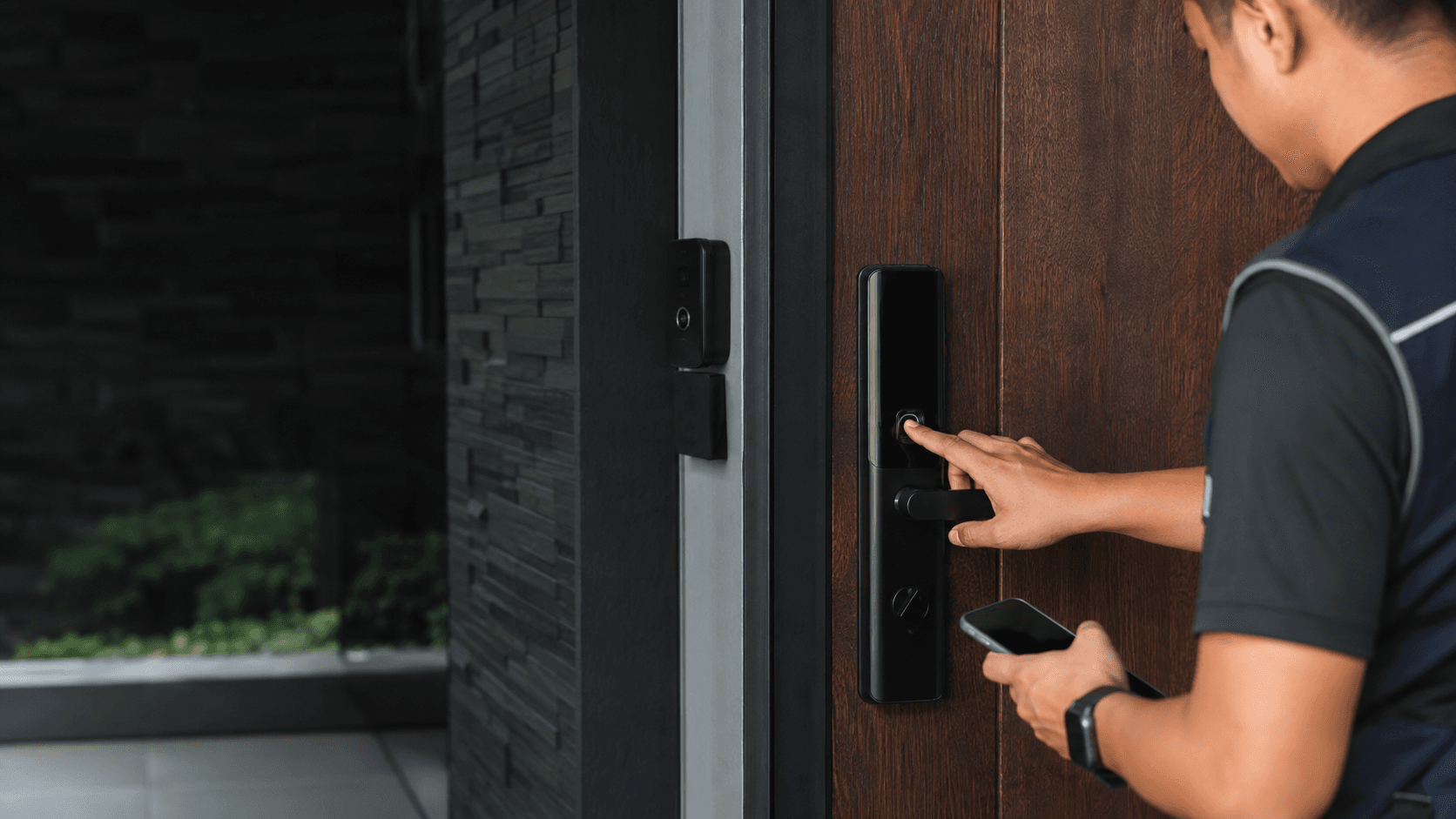
The brand appears in two forms online: BE-TECH, which publishes hotel lock and access-control systems, and BE-TECH IoT, which presents smart lock manufacturing. Neither page uses the phrase be tech door lock in its heading, and the editorial roundups that rank alongside them discuss smart locks generally. That gap matters because the practical questions — will it fit this door, who needs a code, what happens when the battery dies — are answered before purchase, not after.
What a Be Tech Door Lock Is Used For
BE-TECH's own sites describe the product range as hotel door locks, key card systems, smart locks, safes and cabinet locks for hospitality and commercial projects, alongside residential and commercial keyless access. That is a wider footprint than a single front-door deadbolt.
The practical split is between controlled convenience and shared access. A household wants one door that opens without a key. A hotel, office, dormitory or serviced apartment wants many doors, many users, and a record of who entered. The same hardware family can serve both, but the planning is different.
Eyonic's own product review notes that smart locks work best when door condition, user roles and backup method are reviewed before installation, and that for business use the usual question is whether a standalone smart lock or an access-control panel is more appropriate. That framing applies directly to a Be Tech Door Lock.
Door Condition and User Roles Come First
Two checks decide most of the outcome, and both happen before anything is ordered.
- Door condition — thickness, material, existing cutout, frame alignment and whether the door closes squarely. A lock body that does not seat properly will keep failing regardless of how good the electronics are.
- User roles — who needs permanent access, who needs temporary access, who needs access only during set hours, and who must be able to revoke a credential quickly.
- Backup entry method — the mechanical key, a secondary code, or a staffed reception point, decided before the lock is fitted rather than after the first lockout.
- Standalone lock or access-control panel — whether the door works on its own or needs to sit inside a wider system with shared administration.
Door condition is the constraint that cannot be argued with. A metal door, a glass door, a fire-rated door and a hollow-core interior door each behave differently, and the frame matters as much as the leaf. Where the existing cutout is non-standard, the installation may need additional preparation before the lock can be mounted.
User roles are the constraint that is usually underestimated. A home with four residents needs four credentials and one spare. An office with thirty staff, cleaners and occasional contractors needs a way to add and remove people without reissuing physical keys. The number of people who must be managed, and how often that list changes, is what separates a simple lock from a system.
Where a standalone lock fits
A standalone smart lock suits a single entrance where access is managed at the door itself. It is the simpler choice when the user list is short, changes rarely, and nobody needs a central record. Fewer components means fewer points of failure and less to maintain.
Where an access-control panel fits
An access-control panel suits a site where several doors, several user groups or several administrators are involved. It centralises permissions so a departure or a role change is handled in one place. The trade-off is more infrastructure, more setup, and a dependency on that panel continuing to work.
Standalone Lock or Access-Control Panel
The deciding question is not which product is better. It is how many doors and how many people must be managed together.
If the answer is one door and a stable group of users, a standalone lock covers it. If the answer is multiple doors, rotating staff, or a need to prove who entered and when, an access-control panel is the more honest fit. Choosing a standalone lock for a multi-door site usually ends with a second purchase.
Eyonic's review of smart lock door access describes the product as good for controlled convenience when user permissions and backup entry are planned properly. That phrasing is deliberate. the lock delivers convenience, and the planning delivers control.
For sites in Sarawak, the surrounding infrastructure often decides the question. Eyonic's work at the Kuching Immigration Office focused on arrival flow, staff areas, visitor movement and dependable daily operation — the kind of brief where a door is one part of a movement pattern rather than an isolated fixture. A similar project for KTA Sarawak Sdn Bhd in Kuching covered staff movement, visitor handling, tidy cabling and clearer daily site control. Both are examples of access being planned as a flow, not a single lock.
Backup Entry and Daily Operation
Every electronic lock needs a plan for the day it does not open. That plan is a design decision, not an emergency measure.
The mechanical key remains the most reliable fallback, provided it is stored somewhere reachable and not inside the locked room. A secondary code held by one responsible person covers the case where the primary credential fails. A staffed reception point with a physical key covers sites where nobody can be relied on to remember a code.
Daily operation is where small choices accumulate. Battery replacement intervals, who holds administrator rights, how a lost credential is revoked, and whether the lock still functions during a power or network interruption all belong in the handover conversation. A lock that works perfectly in week one and cannot be administered in month six has not solved the problem.
Eyonic's installation process runs through site survey, system proposal, installation and handover, and the same sequence applies to door access work. The survey is where door condition and user roles get checked against reality rather than assumption. Handover is where the people who use the door daily learn how to add a user, remove one, and open the door when the electronics do not cooperate.
Getting a Supplied and Installed
Supply and installation are separate questions from product choice, and both depend on what is actually available locally.
Eyonic Sdn Bhd is a security system supplier in Sarawak that plans, supplies and installs monitoring and ELV systems for homes, offices, shops and industrial sites, with a product range that includes smart locks. The company's published packages cover a Hikvision CCTV package, a Hikvision alarm system and an autogate package, each at RM 1,599, which gives a sense of how bundled security work is priced in the local market. Door access is quoted by scope rather than as a fixed package, because door condition and user count vary too much to price blind.
Before confirming anything, it is worth establishing which Be Tech Door Lock models can actually be supplied and installed locally, what the lead time looks like, and what the warranty and after-sales terms are. Those details are specific to the supplier and the model, and they should be confirmed in writing rather than assumed from a manufacturer page.
For a site with several doors, the sensible sequence is a survey first, then a proposal that states which doors get which hardware, then installation, then handover with the administrator credentials documented. Skipping the survey is the most common reason a lock ends up on the wrong door.
Share your location, property type and required system with Eyonic on WhatsApp at +60 11-5111 7959 for the next practical step.