
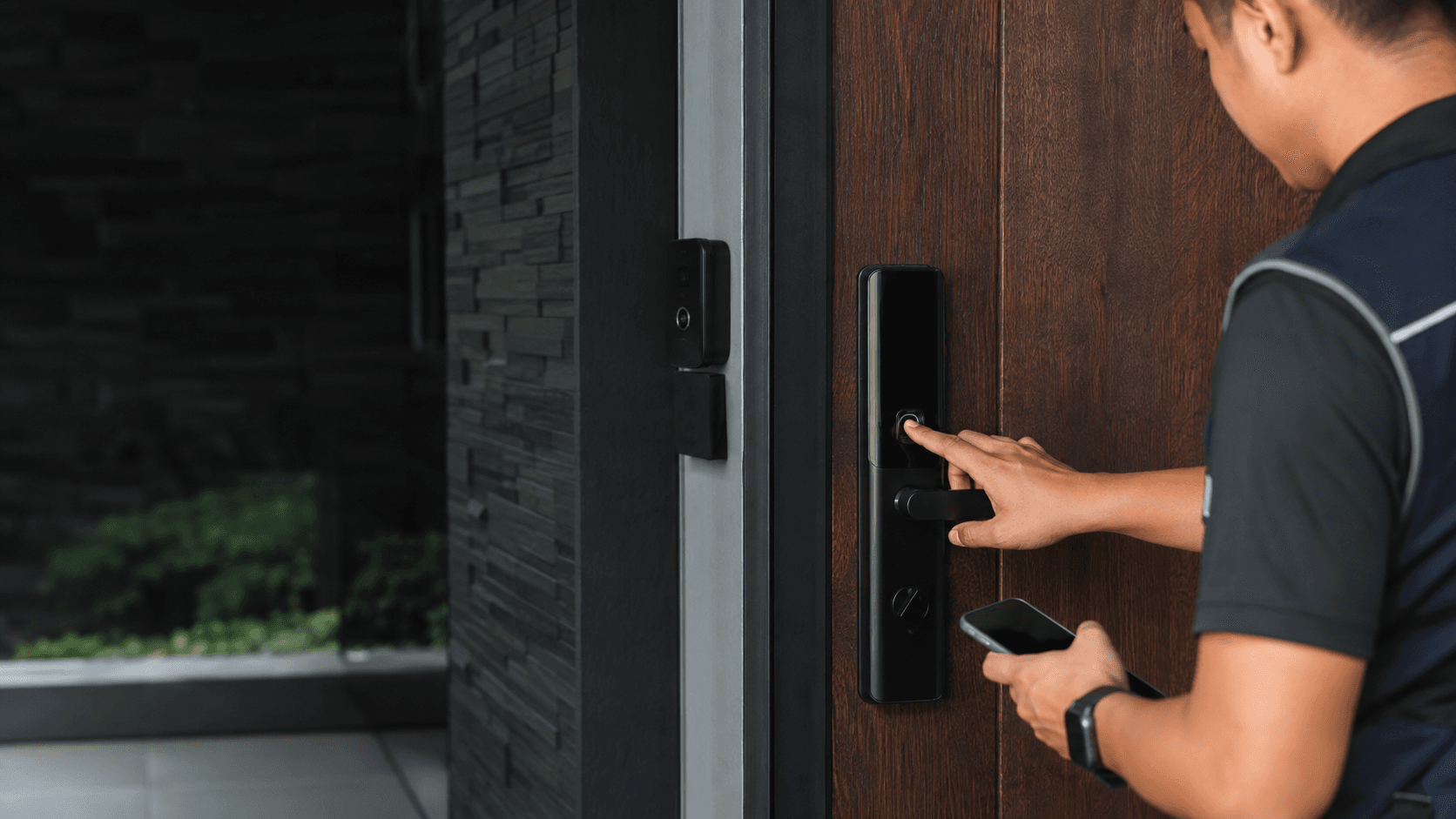
The exact-match query top smart door locks usually returns long brand rankings built for North American homes. That format answers a different question from the one that matters at the door: whether a given lock body, latch and frame will accept a smart lock at all, and who manages the codes afterwards.
Eyonic Sdn Bhd, a security system supplier in Sarawak, treats smart lock door access as controlled convenience that works when user permissions and backup entry are planned properly. The same review notes that for business use, the choice between a standalone smart lock and an access-control panel should be checked before installation.
Top Smart Door Locks: What Matters Before You Choose
Door condition decides more than brand preference. Three physical situations cover most Malaysian residential and small commercial doors, and each one narrows the shortlist before any feature comparison begins.
| Lock type | Door condition it suits | Typical access methods | Backup entry |
|---|---|---|---|
| Deadbolt replacement | Existing deadbolt cut-out that can be swapped for a full lock body | Keypad, fingerprint, app | Mechanical key or external power point |
| Retrofit lock | Existing deadbolt kept in place, with the smart unit fitted over the interior thumb-turn | App, keypad accessory | Original key still works |
| Lever-handle lock | Doors with a lever handle rather than a separate deadbolt | Keypad, fingerprint, app | Mechanical key or override cylinder |
Retrofit units leave the original key cylinder untouched, which keeps a mechanical fallback in place without extra parts. Deadbolt replacements give a cleaner result but commit the door to a new lock body. Lever-handle locks suit office and shop doors where the handle is the only locking point.
Deadbolt, Retrofit and Lever-Handle Options
A deadbolt replacement removes the existing lock and installs a complete smart lock body in the same opening. It suits doors where the current deadbolt is worn, mismatched or already due for replacement, and it produces the most consistent look because the exterior and interior hardware arrive as one set.
A retrofit lock keeps the existing deadbolt and adds a motorised unit on the inside face. This is the least invasive route and the easiest to reverse, which matters for rented premises. The trade-off is that the exterior of the door still looks like an ordinary lock, and the retrofit body adds bulk to the interior side.
A lever-handle lock replaces the handle set itself. It fits doors that never had a separate deadbolt, common on internal office doors and some shop lots. Because the handle carries the locking mechanism, the door's existing bore and backset have to line up with the replacement.
Access Methods. Keypad, Fingerprint and App
Keypad access issues a numeric code per person, so a code can be changed or deleted without rekeying anything. Fingerprint access removes the need to share a code at all, which suits a small number of regular users. App control adds remote unlocking, temporary codes and an activity record, and it depends on the lock's connectivity rather than the lock body itself.
Most installations combine two of the three. A keypad for daily entry plus app control for temporary visitors covers the common household and small-office case without relying on a single method.
Power, Connectivity and Backup Entry
Every smart lock needs power, and every smart lock needs a way in when that power runs out. Battery life varies by how often the lock motor runs, whether the keypad is backlit and how frequently the app is polled, so the practical figure depends on usage rather than a single published number.
Backup entry is the part that gets decided last and matters most. A mechanical key cylinder, an external power point for a flat battery, or a second independent entry route each solve the same problem differently. For a business door, the backup method should be something a staff member can use without calling a technician.
Connectivity is a separate decision from locking. A lock that works over Bluetooth alone needs someone nearby with a paired phone. Adding a bridge or a Wi-Fi connection enables remote control and temporary codes, but it also adds a device that needs its own power and network.
What to Check Before Buying Smart Door Locks
Work through the door itself before comparing features. The checks below are the ones that most often change the shortlist.
- Measure the door thickness at the lock edge and confirm the lock's supported range covers it.
- Measure the backset, the distance from the door edge to the centre of the existing bore, and the bore diameter.
- Identify the lock type already fitted: separate deadbolt, combined handle and deadbolt, or lever handle only.
- Check the door material and frame condition, since a heavy or misaligned door puts more load on the lock motor.
- Confirm whether the door is external or internal, and whether it is exposed to rain or direct sun.
- Decide the backup entry method before purchase, not after installation.
- List who needs access and what each person should be able to do, so user permissions can be set up at handover.
- For business premises, confirm whether a standalone lock or an access-control panel fits the door and the staff flow better.
For business use, the standalone-versus-panel question is worth settling early. A standalone smart lock manages a single door with its own user list. An access-control panel manages multiple doors, shared credentials and a central record, which suits premises where staff move between several entry points.
Where Smart Door Locks Fit in a Wider Security Setup
A door lock is one layer. Eyonic's project work at the Kuching Immigration Office focused on arrival flow, staff areas, visitor movement and dependable daily operation, which is the same sequence that applies to a smaller site: decide how people arrive, where they are allowed to go, and what has to keep working every day.
Eyonic's installation process runs through site survey, system proposal, installation and handover. That sequence applies to door access as much as to cameras, because the survey is where door thickness, frame condition and user roles get confirmed rather than assumed.
Where a site combines door access with cameras or an alarm, the same survey can cover both. Eyonic's published packages for a Hikvision CCTV system, a Hikvision alarm system and an autogate setup are each listed at RM 1,599, which gives a reference point for how a single-system budget compares with a combined one.
Frequently Asked Questions About
Does a smart lock fit any door
No. Door thickness, backset, bore diameter and the existing lock type all constrain the choice. A retrofit lock has the widest fit because it keeps the existing deadbolt, while a full deadbolt replacement needs the opening to match the new body.
What happens when the battery runs out
The lock stops motorised operation, so the backup entry method takes over. That is usually a mechanical key cylinder or an external power point, and it should be confirmed before installation rather than discovered afterwards.
Is a smart lock enough for a shop or office
For a single door with a small number of users, a standalone smart lock can be sufficient. Where several doors or a shared staff list are involved, an access-control panel is usually the better fit because it centralises user permissions and records.
Can a smart lock be removed later
A retrofit lock can generally be removed and the original deadbolt left in place. A deadbolt replacement or lever-handle replacement changes the door hardware, so reversing it means fitting a conventional lock again.
Share the location, property type and required system with Eyonic on WhatsApp at +60 11-5111 7959 to move from shortlist to a confirmed door check.