
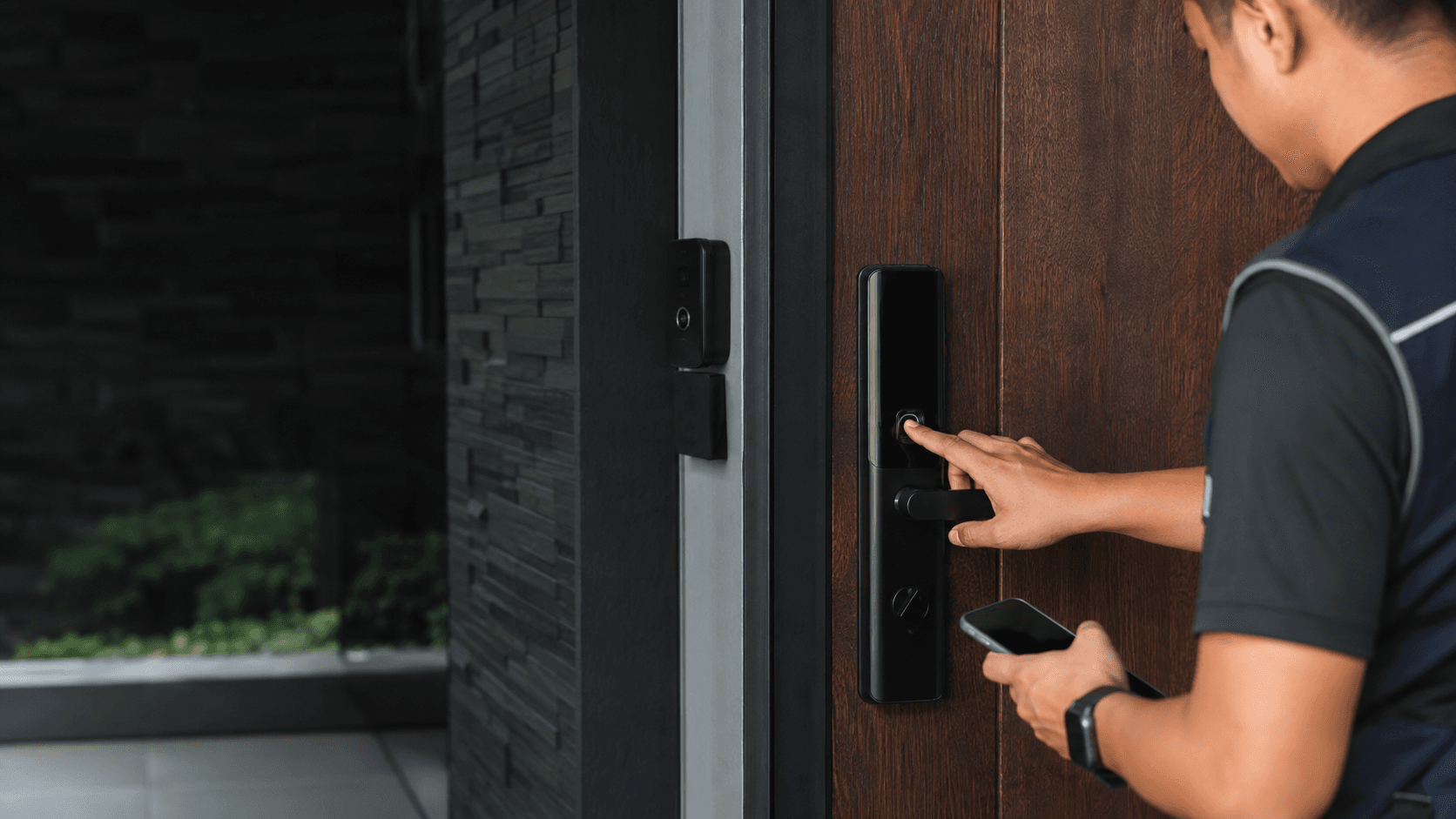
The exact-match phrase weiser fingerprint lock describes a narrow slice of the smart lock market: a deadbolt where the primary credential is a finger rather than a code or a key. Weiser builds this around its Halo Touch hardware, which the brand markets as a fingerprint door lock with Wi-Fi built in and no separate hub required. That combination matters for Malaysian homes and offices because it removes two everyday friction points — lost keys and shared codes — while adding a new dependency on battery power and a working reader surface.
This article covers what the lock does, how fingerprint entry compares with codes and keys, what to inspect on a door before committing, how to plan access for households and businesses, and what handover looks like when a Sarawak installer finishes the job.
What the Weiser Fingerprint Lock Does
The core function is simple. a capacitive or optical reader on the exterior escutcheon scans a fingerprint, matches it against stored templates, and drives the deadbolt motor to unlock. Weiser's Halo Touch product pages describe the reader as the primary access method, with the Weiser app used to enrol fingerprints, manage users, and review lock activity. The lock connects directly to a home Wi-Fi network and a smartphone, so remote lock and unlock commands do not need a third-party hub, panel, or subscription service.
Beyond the reader, the Halo Touch family supports voice control through Amazon Alexa and Google Assistant, and the app allows access to be limited by date, weekday, and time window. Weiser also builds SmartKey Security into the cylinder, which lets an owner rekey the lock to a new key without removing the hardware from the door. Those features sit alongside the fingerprint reader rather than replacing it.
One structural point is worth stating plainly: the fingerprint reader is an input device, not the lock itself. The deadbolt, motor, and cylinder do the physical work. A reader that fails to match a print does not mean the door is insecure — it means the credential was rejected and another method must be used.
Fingerprint Entry Compared With Codes and Keys
Each credential type has a distinct failure mode, and the choice usually comes down to which failure is easiest to live with.
A physical key fails when it is lost, copied, or left inside. A keypad code fails when it is shared too widely, observed by someone nearby, or forgotten. A fingerprint fails when the reader surface is dirty, wet, or damaged, or when the enrolled finger has a cut, blister, or heavy moisture on it. In a Malaysian climate, humidity and frequent hand-washing make reader hygiene a real maintenance item rather than a theoretical one.
Fingerprint entry wins on two counts. It cannot be lent out casually, and it leaves no reusable secret behind. A code can be passed to a contractor and never changed; a fingerprint template is tied to a person and can be deleted individually. That makes biometric access attractive for a household with a rotating cast of helpers, or an office where a departed staff member's access needs to end cleanly.
Codes and keys still hold advantages. A keypad works with wet or gloved hands. A mechanical key works when the battery is flat. Weiser's own comparison material positions the Halo Touch for users who prioritise ease of use for a smaller group, and the touchscreen variant for those who need more flexible code-based access with per-user schedules. Neither is universally better; the deciding factor is how many people need entry and how often that group changes.
Door and Installation Checks Before Buying
Most smart lock problems trace back to the door, not the electronics. A pre-purchase inspection should confirm the door can accept the hardware and that the household can still get in when the electronics are unavailable. The checks below follow the order that matters most.
- Measure the door thickness and the existing bore hole and backset, then confirm the deadbolt cross-bore matches the lock's preparation requirements.
- Check the door and frame for swelling, warping, or misalignment that would make the bolt bind, since a motorised deadbolt has less tolerance for a tight strike than a hand-turned one.
- Confirm the strike plate and frame are solid enough to hold the bolt, and note whether the door is exposed to direct rain or sustained damp.
- Decide who needs access and what role each person holds, so fingerprint slots and any code or app permissions are planned before enrolment rather than added ad hoc.
- Agree on a backup entry method — a mechanical key, a second credential type, or an external power option — and store it somewhere the household can actually reach.
- Test the finished installation across every credential, confirm the auto-lock behaviour, and walk through the handover so the people who use the door know how to add or remove a user.
Door condition is the single most common reason a biometric deadbolt underperforms. A door that needs a shoulder to close will fight a motorised bolt regardless of how good the reader is. Eyonic's own product guidance makes the same point: smart locks work best when door condition, user roles, and backup method are reviewed before installation, and for business use the question of whether a standalone smart lock or an access-control panel is more appropriate should be settled first.
Planning Access for Homes and Businesses
A home and a business use the same hardware very differently, and the planning should reflect that.
In a home, the user list is short and stable. Two to six fingerprints usually cover the household, with a code or key reserved for a trusted neighbour or a domestic helper. The main risks are a flat battery at an inconvenient hour and a family member locked out because their print was never enrolled or was deleted by mistake. A simple rule helps. every adult in the house should have at least one enrolled finger and know where the backup key lives.
In a business, the user list is longer and changes more often. Fingerprint slots are finite, so a standalone biometric deadbolt suits a small office, a clinic side door, or a staff entrance with a handful of regular users. Once the requirement grows to shift-based access, audit trails, or integration with an existing alarm or CCTV system, a dedicated access-control panel is usually the more sensible path. Eyonic's project work reflects this pattern: for the Kuching Immigration Office, the focus was arrival flow, staff areas, visitor movement, and dependable daily operation rather than a single door credential. A similar logic applies to the KTA Sarawak Sdn Bhd office setup, where staff movement, visitor handling, and tidy cabling drove the design.
Budget expectations should be set before hardware is chosen. Eyonic's published package pricing for related security work sits at RM 1,599 for a Hikvision CCTV package, RM 1,599 for a Hikvision alarm system, and RM 1,599 for an autogate package, and completed office projects have carried approximate budgets of RM 8,000 to RM 18,000 and RM 12,000 to RM 28,000 depending on scope. Those figures cover broader systems rather than a single lock, but they show the range a business should expect once installation, cabling, and handover are included.
Support and Handover in Sarawak
Hardware choice is only half the decision. The other half is who installs it, who tests it, and who answers when something stops working.
Eyonic Sdn Bhd is a security system supplier based in Sarawak that plans, supplies, and installs monitoring and access systems for homes, offices, shops, and industrial sites. The company's installation process runs through site survey, system proposal, installation, and handover, which is the same sequence that suits a biometric lock: confirm the door and the user list first, propose the right hardware, install and test, then walk the owner through daily use. Eric Yong, the founder, has worked in technical installation of digital security solutions for commercial businesses in Sarawak for more than ten years.
Handover is where most installations succeed or fail. A useful handover covers how to enrol and delete a fingerprint, what the lock does when the battery runs low, how to use the backup entry method, and who to contact if the reader stops responding. Without that walkthrough, a capable lock becomes a source of frustration within weeks.
For readers weighing a weiser fingerprint lock against a code-based or panel-based system, the practical test is straightforward: count the users, inspect the door, and confirm the backup plan. If those three answers are clear, the credential type becomes an easy choice rather than a gamble.
Share your location, property type and required system with Eyonic on WhatsApp at +60 11-5111 7959 for the next practical step.