
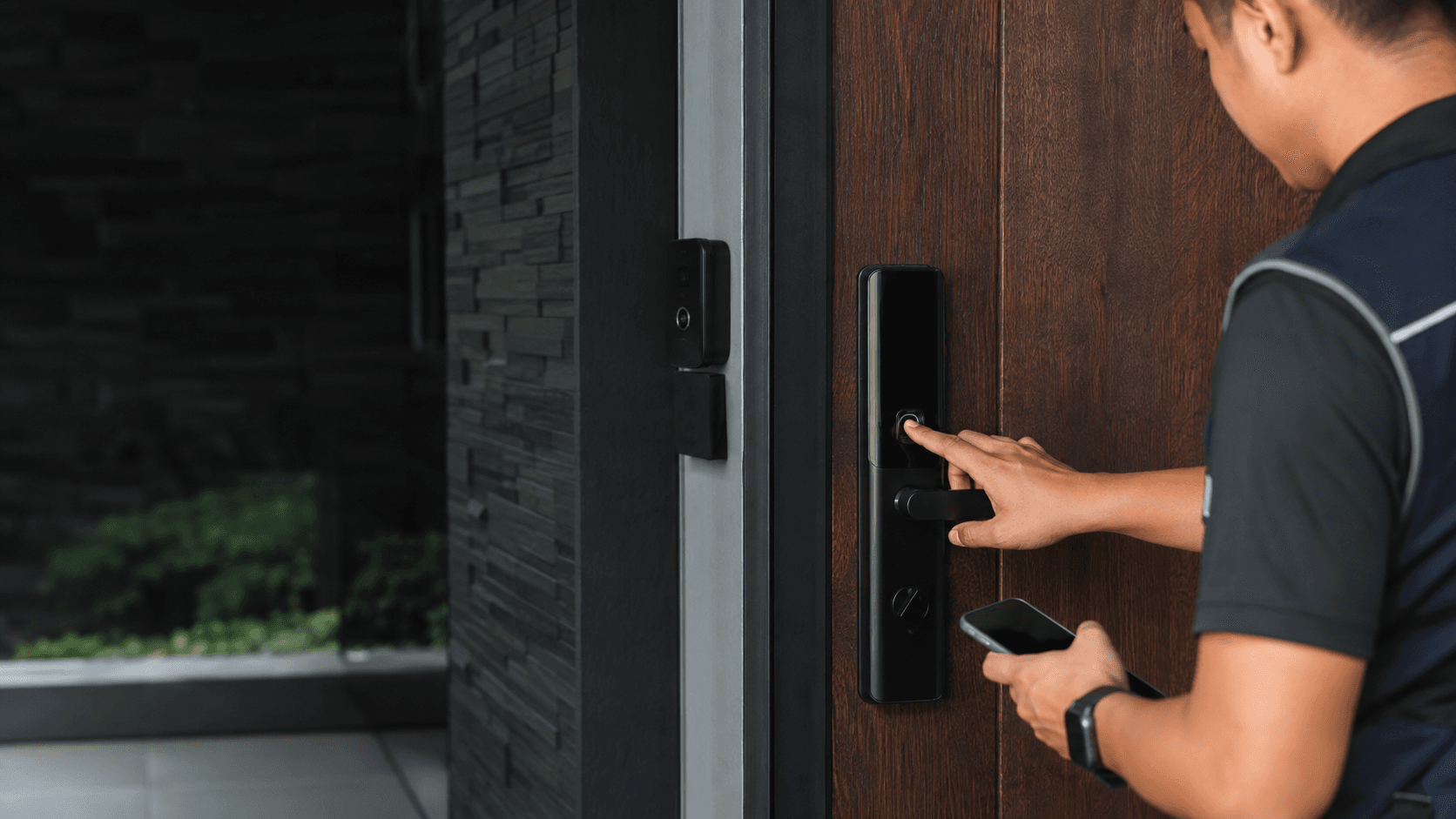
The appeal is simple. no key to copy, no key to lose, and a code that can be changed when circumstances change. The trade-offs are equally real. A keypad lock depends on power, on a working mechanism, and on a code that someone has to manage. Getting those three things right matters more than the brand name on the box.
Key Pad Lock For House. What Matters Before You Choose
Most disappointing keypad lock experiences trace back to the door, not the lock. Before comparing models, confirm what the door can actually accept.
- Check the door thickness and the existing bore hole, because a deadbolt replacement and a full handle replacement need different cutouts.
- Confirm whether the door is wood, metal, or glass, since glass and thin metal doors often need a different mounting approach.
- Decide how many people need regular entry, because that sets the number of user codes required.
- Agree on a backup entry method, whether that is a physical key override, a second code, or a mechanical alternative.
- Confirm the power source and how it will be maintained, since a flat battery on a keypad lock is an access problem, not just a maintenance task.
- Match the finish and form factor to the door so the hardware does not look retrofitted.
Eyonic's own product guidance makes the same point from the installation side: smart locks work best when the door condition, user roles, and backup method are reviewed before installation. For business use, the same guidance notes that a standalone smart lock and an access-control panel are not interchangeable, and the choice should follow the actual pattern of use.
Door condition decides more than the model
A solid timber door with an existing deadbolt is the simplest case. The old deadbolt comes out and the keypad unit goes in, usually without new holes. A door with a narrow stile, a glass panel, or a non-standard backset is a different job. In those cases the lock may need an adapter, a different body, or a move to a wall-mounted keypad reader that controls an electric strike rather than a self-contained lock.
This is the point where a site survey earns its place. Eyonic's installation process begins with a site survey and a system proposal before any hardware is fitted, which is the stage where door condition, cabling routes, and power availability get settled.
Choosing the Right Key Pad Lock For House
The category splits into three practical groups, and each suits a different household.
| Type | How entry works | Best fit | Main constraint |
|---|---|---|---|
| Mechanical push-button lock | Code only, no electronics | Doors where power and batteries are unwelcome | Codes are harder to change and share |
| Electronic keypad deadbolt | Code plus key override | Main entry doors on homes | Battery replacement and code management |
| Smart lock with keypad | Code, app, and often remote access | Households wanting temporary codes and activity records | Depends on network, app, and firmware upkeep |
The mechanical option is the most forgiving. It has no battery, no firmware, and no app, which makes it a reasonable choice for a gate, a store room, or a secondary door. Its weakness is administration. changing a code usually means physically reconfiguring the lock, and there is no record of who entered.
The electronic keypad deadbolt sits in the middle. It keeps a key override for the day the battery dies, and it allows codes to be added or removed without dismantling anything. For most houses this is the version people mean when they search for a key pad lock for house.
The smart lock adds connectivity. That brings temporary codes for contractors or visitors, entry notifications, and the ability to check whether a door is locked. It also brings dependencies. If the network drops or the app is abandoned by its maker, the convenience shrinks. The lock still opens by code, but the remote features may not.
Matching the lock to the household
A single-occupant home with one main door needs very little. A code and a key override are enough. A family with children, a helper, and regular visitors needs more: separate codes per person, a way to revoke a code quickly, and a clear rule about who holds the backup key.
A rented property adds another layer. The lock may need to be restored to its original state at the end of a tenancy, which favours a unit that reuses the existing deadbolt cutout rather than one that requires new holes. Landlords also tend to prefer a lock that can be re-coded between tenants without replacing hardware.
Home offices and small shops sit closer to the business case. Eyonic's guidance for business use is to check whether a standalone smart lock or an access-control panel is more appropriate, because a panel handles multiple doors, scheduled access, and audit trails in ways a single lock cannot.
What is key pad lock for house?
A key pad lock for house is door hardware that opens with a numeric code entered on a keypad instead of, or alongside, a physical key. It may be a mechanical push-button unit, an electronic deadbolt, or a smart lock with a keypad and app control.
The phrase covers a wider range than the name suggests. Some units are purely mechanical and have no electronics at all. Others are electronic but not connected. Others again are fully smart, with Wi-Fi or another wireless protocol, an app, and integration with a broader access system.
What they share is the entry method. The code is the primary credential, and the key becomes a fallback. That shift changes how a household manages access. Instead of copying a key, a code is issued. Instead of collecting a key, a code is deleted. The physical object stops being the thing that grants entry.
What a keypad lock does not solve
A keypad lock does not make a door stronger. The strike plate, the frame, and the hinge are still the weak points in a forced entry, and a lock rated for residential use is not the same as a commercial-grade unit. A code also does not stop someone from watching it being entered, so shielding the keypad from direct line of sight at the street is worth considering.
It also does not remove the need for a backup. Every keypad lock should have a second way in, whether that is a key override, a second code held by someone trusted, or a mechanical lock on another door. The failure mode is predictable. the battery runs down, the code is forgotten, or the mechanism jams, and the household is locked out of its own front door.
Practical Considerations for
Several details decide whether the lock is pleasant or irritating after the first month.
Code management. A lock that supports multiple user codes lets each person have their own. That matters when someone leaves the household or a helper's engagement ends, because a single code can be deleted without affecting anyone else. A lock with one shared code forces a full reset every time access changes.
Battery life and warning. Electronic locks run on batteries, and the useful feature is an early low-battery warning rather than a long claimed runtime. A lock that gives notice before it fails is easier to live with than one that simply stops.
Weather exposure. An exposed door in a wet climate puts more demand on the electronics and the finish than a sheltered one. Sarawak's rainfall makes this a practical question rather than a theoretical one, and it favours units with a proper weather rating and a sheltered mounting position where possible.
Finish and wear. A keypad that is touched daily will show wear. A finish that hides fingerprints and resists corrosion keeps the door looking reasonable for longer.
Integration with the rest of the property. A keypad lock on the front door is one part of a wider setup. If the property also has cameras, an alarm, or an autogate, the entry point is where those systems meet. Eyonic's project work at the Kuching Immigration Office focused on arrival flow, staff areas, visitor movement, and dependable daily operation, which is the same logic applied at a smaller scale: the entry point has to work every day, not just on the day it is installed.
Where a keypad lock fits into a wider security setup
A lock controls one door. Cameras record what happens around it. An alarm responds when something is wrong. An intercom lets someone at the gate be identified before entry is granted. These are separate systems, but they are used together, and the entry point is usually where the household notices whether they work as a set.
Eyonic plans, supplies, and installs monitoring systems with camera placement, recording, and remote viewing for homes, offices, shops, and industrial sites, alongside alarm, autogate, and intercom work. That range matters for a keypad lock decision because the lock is rarely the only piece of hardware on the door.
Making an Informed Choice About
The decision comes down to four questions, answered in order.
First, what door is it? A standard timber door with an existing deadbolt is straightforward. A glass, metal, or narrow-stile door changes the options.
Second, who needs entry, and how often does that list change? A stable household can live with a simple lock. A household with rotating helpers, contractors, or tenants benefits from individual codes and easy revocation.
Third, what happens when the lock fails? A key override, a second code, or a second door with a mechanical lock answers this. Without one of those, the convenience of a keypad is borrowed against a future lockout.
Fourth, does the lock need to talk to anything else? If cameras, an alarm, or an autogate are already present or planned, the entry point should be chosen with that in mind rather than added in isolation.
For a straightforward house, an electronic keypad deadbolt with a key override covers most needs. For a property with multiple users and a wider security setup, a smart lock or an access-control approach is worth the extra planning. The wrong choice is usually not a bad product; it is a good product fitted to a door or a household it does not suit.
Eyonic Sdn Bhd is a security system supplier in Sarawak, Malaysia, working on CCTV and ELV systems with planning, supply, and installation for homes, offices, shops, and industrial sites. The founder, Eric Yong, has more than 10 years in the industry, with a focus on technical installation of digital security solutions for commercial businesses in Sarawak.
Share your location, property type and required system with Eyonic on WhatsApp at +60 11-5111 7959 for the next practical step.