
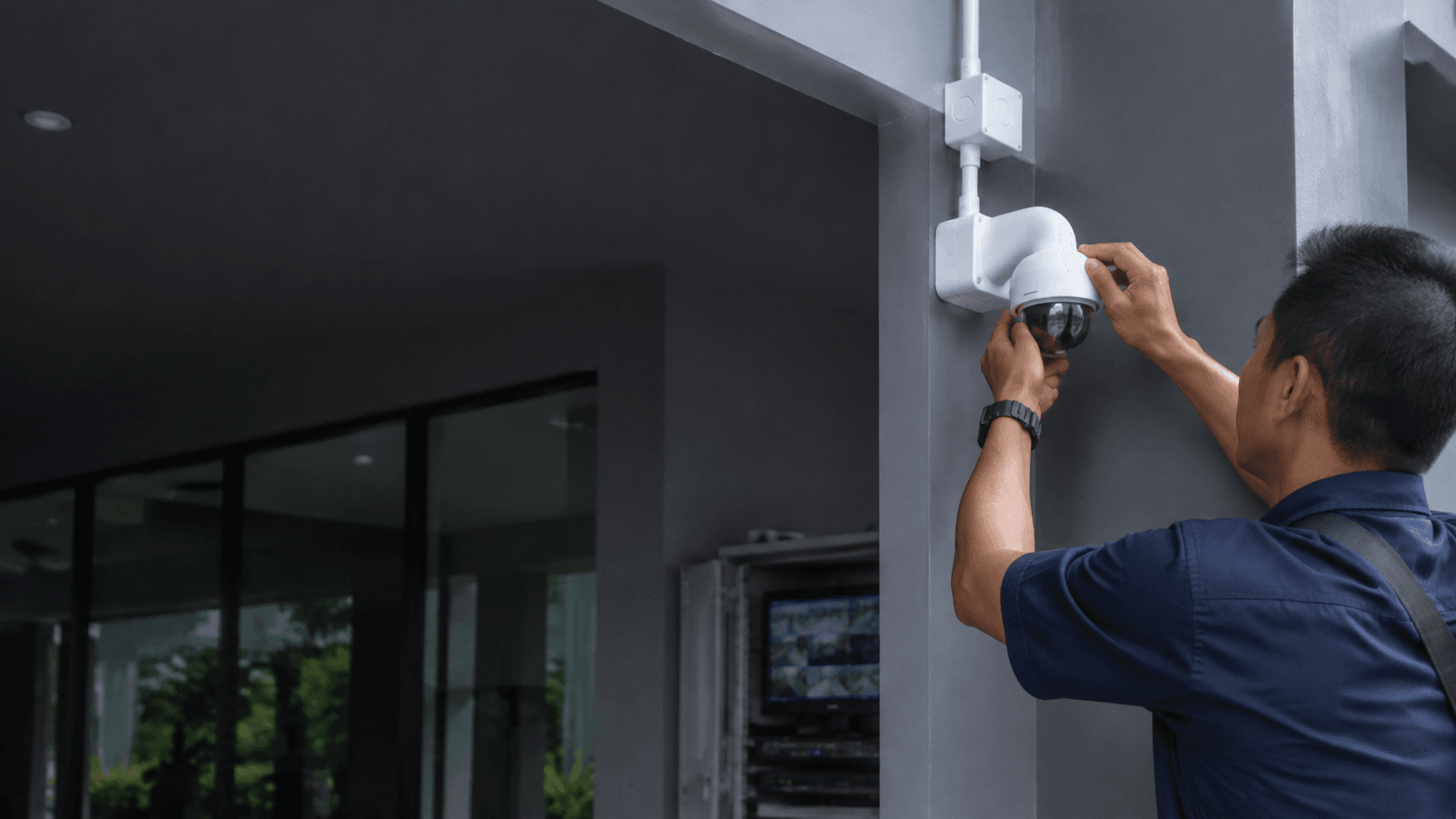
The exact-match query hikvision 2mp dome camera describes a camera class rather than a single model. Hikvision builds several dome families at 2 MP, and the differences between them matter less than where the camera is mounted, what light reaches it, and how it connects to recording and viewing. Eyonic Sdn Bhd, a security system supplier based in Sarawak, plans, supplies and installs monitoring systems with camera placement, recording and remote viewing for homes, offices, shops and industrial sites.
Most buyers in Malaysia arrive at this query with a real installation in mind. The useful questions are practical: what the camera class is suited to, what has to be checked on site before placement is confirmed, and how supply plus installation is handled locally.
What a Hikvision 2mp Dome Camera Is Used For
A dome camera is a ceiling or soffit-mounted unit with the lens set behind a curved housing. That shape makes it harder to see which way the lens points, and it keeps the camera visually compact in a room. The 2 MP resolution places it in the entry-to-mid tier of Hikvision's range, which is why it appears so often in small office, retail, clinic and residential work.
Typical positions include shop counters, office corridors, reception areas, stairwells, covered walkways and building entrances. The format also suits premises where a visible bullet camera would look out of place, such as a boutique, a clinic waiting area or a residential living space.
Dome cameras are not automatically the right answer everywhere. Long outdoor runs, positions exposed to direct rain, and sites needing very tight facial identification at distance often call for a different format or a higher resolution. That judgement belongs in a site survey, not in a product listing.
Lighting and Placement Checks Before a Hikvision 2mp Dome Camera Is Fixed
Placement is the decision that most affects whether the footage is useful. A camera aimed at a bright doorway from inside a dim corridor will produce a dark subject against a blown-out background, and no amount of resolution fixes that. Eyonic recommends checking actual lighting conditions before confirming placement, a point the company makes for ColorVu-style cameras and one that applies equally to any 2 MP dome.
Before a position is confirmed, these checks are worth completing:
- Walk the position at the times of day that matter, including after dark, and note where light falls and where it does not.
- Identify strong backlight sources such as glass doors, windows and shopfronts that sit behind the subject.
- Confirm the mounting surface can take the camera and that the ceiling or soffit is not the only route for cabling.
- Check the field of view covers the intended area without pointing into a neighbour's premises or a private space.
- Confirm the route back to the recorder, including whether power and data can reach the position.
Two constraints come up repeatedly in Malaysian premises. First, reflective surfaces such as polished floors and glass partitions can bounce infrared light back into the lens, which washes out the image at night. Second, air-conditioning trunking and drop ceilings often look like easy cable routes but may not be accessible after fit-out. Both are easier to resolve before drilling than after.
How a Hikvision 2mp Dome Camera Fits Into a Recording and Viewing Setup
A camera on its own records nothing. The practical system is the camera, the cabling or network link, the recorder, the storage inside it, and the viewing method used day to day. Eyonic's CCTV service covers camera placement, recording and remote viewing as one scope, which reflects how the parts depend on each other.
The recorder choice sets the ceiling on the whole system. A recorder with fewer channels than cameras cannot accept the full set, and a recorder that does not match the camera family may not display or record it at all. Storage size then determines how far back the footage reaches, which is usually expressed in days of retention rather than in terabytes.
Remote viewing is the part most users judge the system by. It depends on the recorder being reachable over the network and on the handover covering how the mobile app is set up and how footage is exported when it is needed. A system that records correctly but cannot be reviewed by staff is only half finished.
Where a site already has a recorder, the new camera has to be compatible with it. Where the site has none, the recorder, storage and viewing setup are part of the same decision as the camera. Both cases are settled during the survey rather than at the counter.
Supply and Installation of a Hikvision 2mp Dome Camera in Sarawak
Eyonic Sdn Bhd operates as a security system supplier in Sarawak, with planning, supply and installation handled as one engagement rather than as a box sale. The company's founder, Eric Yong, has been in the industry for more than 10 years and works on technical installation of digital security solutions for commercial businesses in Sarawak.
The installation process follows four stages:
- Site survey — the premises are reviewed for camera positions, lighting, mounting surfaces and cable routes.
- System proposal — the camera, recorder, storage and viewing setup are proposed together, with the scope of work.
- Installation — cameras are mounted, cabled and configured, and the recorder is set up.
- Handover — recording and mobile viewing are demonstrated, and the user is shown how the system is used.
Completed work includes the Kuching Immigration Office, where the focus was arrival flow, staff areas, visitor movement and dependable daily operation, and KTA Sarawak Sdn Bhd, an engineering consultancy office in Kuching that needed support for staff movement, visitor handling, tidy cabling and clearer daily site control. Both are public-office and commercial settings rather than single-camera domestic jobs, which is a useful indication of the scale the company works at.
Package pricing is published for a Hikvision CCTV package at RM 1,599, covering camera supply and setup, basic recording configuration and mobile viewing handover. That figure is a package price and not a per-camera price, so it should be read as an entry point for a small system rather than as the cost of a single dome unit. Larger or more complex sites are quoted from the survey.
Questions to Settle Before Confirming a Hikvision 2mp Dome Camera
Several details are worth pinning down before any order is placed, because they change what gets supplied.
Which dome model is being quoted. Hikvision's 2 MP dome range spans more than one series, and the model number determines the lens, the housing and the features. A quotation should name the model rather than describe it as a 2 MP dome.
Whether the position is indoor or sheltered outdoor. A dome under a soffit or in a covered walkway is a different proposition from one facing open sky. The housing rating has to match the exposure, and that rating should come from the manufacturer's documentation for the specific model.
How many channels the recorder has and how much retention is needed. These two figures decide whether the system still works when a camera is added later.
Who reviews the footage and how. If several staff need access, or if footage has to be exported for an incident, that should be part of the handover rather than discovered afterwards.
What happens after installation. Warranty terms, support arrangements and who to contact for a fault are worth confirming in writing at the proposal stage.
For premises in Kuching and elsewhere in Sarawak, the practical next step is a survey rather than a product decision. Share the location, property type and required system with Eyonic on WhatsApp at +60 11-5111 7959, and the survey will establish which positions work, what lighting they face, and what the system needs to include.