
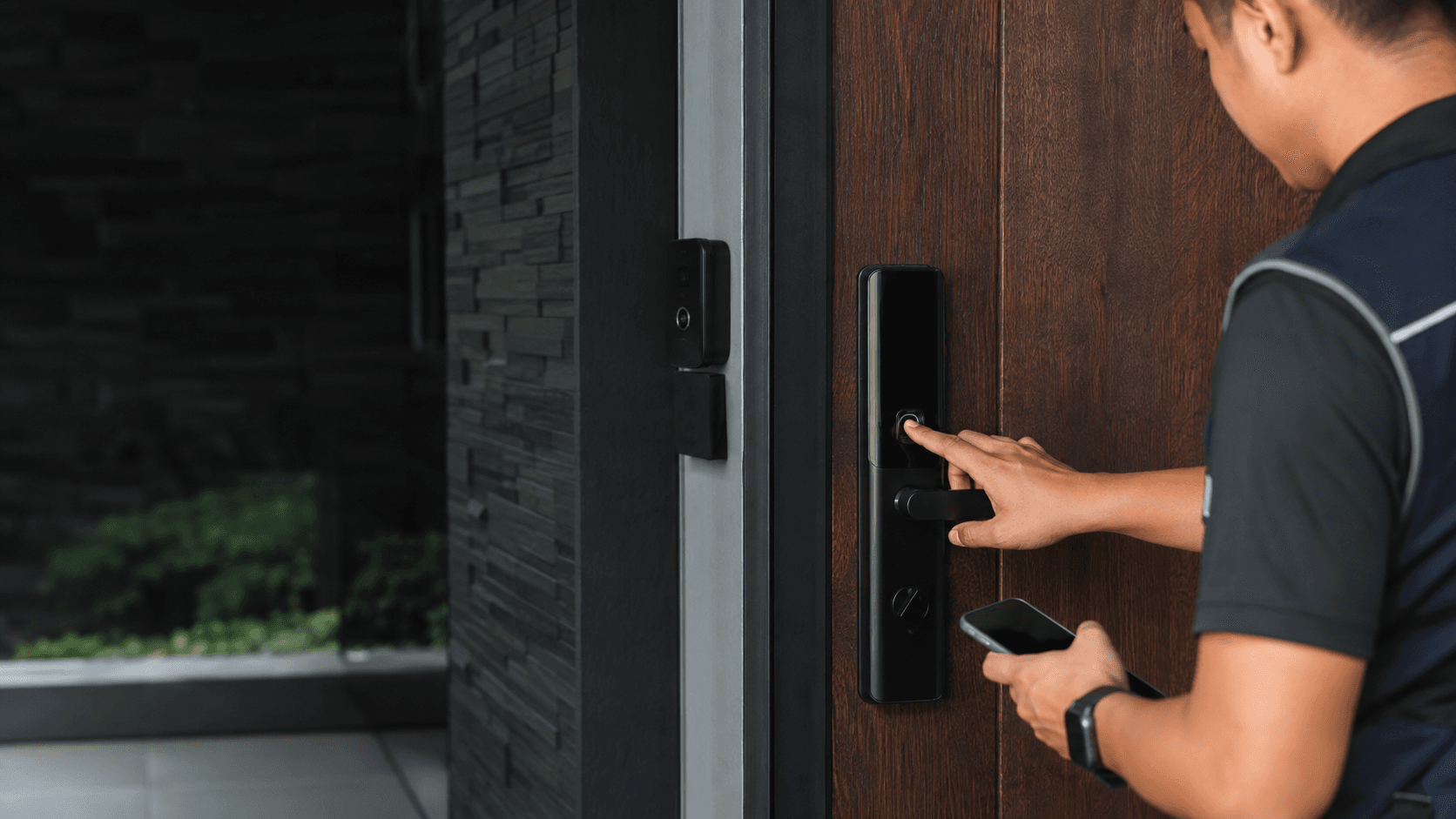
The lock body sits in a pocket cut into the door edge, which is why the hardware is largely hidden once the door closes. That pocket, called a mortice, is the reason this family of locks behaves differently from surface-mounted alternatives. Eyonic Sdn Bhd, a security system supplier in Sarawak, treats smart lock door access as suitable for controlled convenience when user permissions and backup entry are planned properly.
Most buyers in Malaysia arrive with a working door and a working key, not a blank opening. The practical question is therefore not which model looks best in a catalogue, but whether the existing door can accept a digital mortice lock without weakening it, and whether the access rules around that door are simple enough to manage.
What a Digital Mortice Lock Changes on a Door
A digital mortice lock changes the internal mechanism of the door, not just the way it is opened. The latch and deadbolt hardware is housed inside the door leaf, and the outside face usually carries a keypad, reader or handle rather than a full lock casing. The visible result is a cleaner door edge and a slimmer exterior profile.
The trade-off is that the door itself becomes part of the specification. A mortice pocket has to exist, or be cut, and the position of that pocket relative to the door edge determines whether a replacement body will line up with the existing strike plate on the frame. Where the pocket and the strike do not align, the door will not latch cleanly no matter how the electronics are configured.
This is also why a digital mortice lock is rarely a like-for-like swap with a cylindrical lock. Cylindrical hardware is bored through the door face; mortice hardware is set into the edge. Converting between the two changes the door preparation, and on a door that is already finished, that preparation is the part that carries risk.
Door Condition and Backset Before Any Digital Mortice Lock Decision
Backset is the distance from the door edge to the centre of the lock preparation. It is the single measurement most likely to decide whether a digital mortice lock can be fitted without reworking the door, because the lock body has to sit where the existing preparation already is, or where a new one can safely be cut.
Door condition matters just as much. A solid timber door, a hollow-core door and a metal door each behave differently when a pocket is cut into the edge. Thin or hollow sections may not have enough material to hold a mortice body securely, and a door that has already been repaired or re-hung may not sit squarely enough for a deadbolt to throw without binding.
Three checks settle most of the uncertainty before any ordering decision:
- Site survey — the door, frame, edge thickness and existing preparation are measured on site rather than estimated from a photograph.
- System proposal — the survey findings are turned into a recommendation covering the lock type, access method and whether a standalone lock or an access control panel suits the door.
- Installation — the door is prepared and the hardware fitted, with the strike alignment and latch operation tested on the actual frame.
- Handover — access credentials, user permissions and the backup entry method are set up and explained so the door can still be opened when the primary method fails.
Eyonic applies this survey-to-handover sequence to its installation work, including CCTV installation services in Sarawak, and the same logic applies to door hardware: the site conditions are confirmed before the equipment is committed.
Why the frame matters as much as the door
A frame that has moved, swollen or been patched will affect how a deadbolt seats. On external doors in humid conditions, seasonal movement can change the alignment between the lock body and the strike plate. A digital mortice lock with a motorised or electronic deadbolt has less tolerance for that misalignment than a manual lock, because the bolt travels on its own rather than under hand pressure.
Access Roles, Permissions and Backup Entry
Access roles decide how a digital mortice lock is actually used day to day. A home door usually needs a small number of permanent users and a way to admit a visitor temporarily. An office, shop or industrial site needs something closer to a hierarchy: staff who enter daily, contractors who need limited windows, and administrators who can add or remove credentials.
Where those roles are simple, a standalone lock with local credential management is often enough. Where they are not, the door becomes part of a wider access control panel, and the lock is one point in a system rather than an isolated device. Eyonic's own guidance on smart lock door access notes that for business use, the choice between a standalone smart lock and an access-control panel is usually reviewed before installation, precisely because the two options carry different management overhead.
Backup entry is the part most often deferred and most often regretted. Every electronic access method depends on power, connectivity or a working credential. A mechanical key override, a physical key cylinder, or a documented administrative bypass keeps the door usable when the primary method is unavailable. The backup method should be decided before installation, because some options require a specific lock body or an additional cylinder.
Questions that clarify access roles quickly
How many people need permanent access, and how often does that list change? Does anyone need access only during set hours? Who is authorised to issue and revoke credentials, and is that person reachable when a credential needs to be removed at short notice? If the answers are stable and few, local management is workable. If the list changes weekly or spans multiple sites, centralised control is easier to audit.
Digital Mortice Lock Compared With a Standalone Smart Lock
The comparison is less about security strength and more about where the hardware lives and how it is managed. A digital mortice lock is set into the door edge and typically presents a slimmer exterior face. A standalone smart lock is usually mounted on the door face or replaces the existing cylinder, which makes it easier to fit to a door that has not been prepared for mortice hardware.
For a door that already has a mortice pocket, the digital mortice lock keeps the existing preparation and the existing strike position, which reduces the amount of work and the risk of a poor fit. For a door with no mortice preparation, a standalone smart lock avoids cutting into the door edge altogether.
Management differs too. Standalone locks are usually configured at the door, which suits a single entrance with a short user list. Mortice hardware integrated with an access control panel suits sites where credentials, time windows and audit records need to be handled centrally. Neither option is automatically better; the deciding factor is how many people and how much change the door has to absorb.
Installation Sequence Eyonic Uses From Survey to Handover
The sequence below reflects how Eyonic structures installation work, from the initial site survey through to handover. It is the same four-stage flow used across its security installation services, and it exists to catch door and access problems before hardware is ordered rather than after it is fitted.
The survey establishes the door measurements, the existing preparation and the access requirements. The proposal converts those findings into a specific recommendation, including whether the door suits a digital mortice lock or whether a different approach is more appropriate. Installation covers the door preparation and fitting, with latch and strike alignment tested on the frame. Handover covers credentials, permissions and the backup entry method, so the people who use the door understand how to operate it and what to do when the primary method fails.
For sites with more than one entrance, the same sequence is repeated per door, and the access rules are set so that a failure at one door does not lock out the whole premises. Eyonic's project work for the Kuching Immigration Office focused on arrival flow, staff areas, visitor movement and dependable daily operation, which is the same set of concerns that shapes door access planning on a busy site.
Questions to Settle Before Ordering
Ordering is the point where assumptions become expensive. The questions below are the ones that most often change the recommendation, and each one can be answered from the door itself rather than from a product listing.
Does the door already have a mortice pocket, and does its backset match what is being considered? Is the door solid enough at the edge to hold a lock body securely? Is the frame square and the strike plate aligned? How many people need access, and how often does that list change? What is the backup entry method if the electronic access fails? Does the door need to remain usable during a power interruption?
Where the answers point to a single entrance with a stable user list, a standalone lock may be the simpler choice. Where they point to multiple users, changing permissions or several doors, the door hardware is better treated as part of an access control system rather than a one-off purchase.
One further constraint applies to any door that forms part of a fire-rated or escape route. Door hardware on those openings is governed by requirements that a general lock discussion cannot resolve, and the correct specification has to come from the door's own documentation or the relevant authority. That is a limit worth stating plainly rather than working around.
For readers who want the door assessed against its actual condition and access requirements, Eyonic can be reached on WhatsApp at +60 11-5111 7959 with the location, property type and required system.