
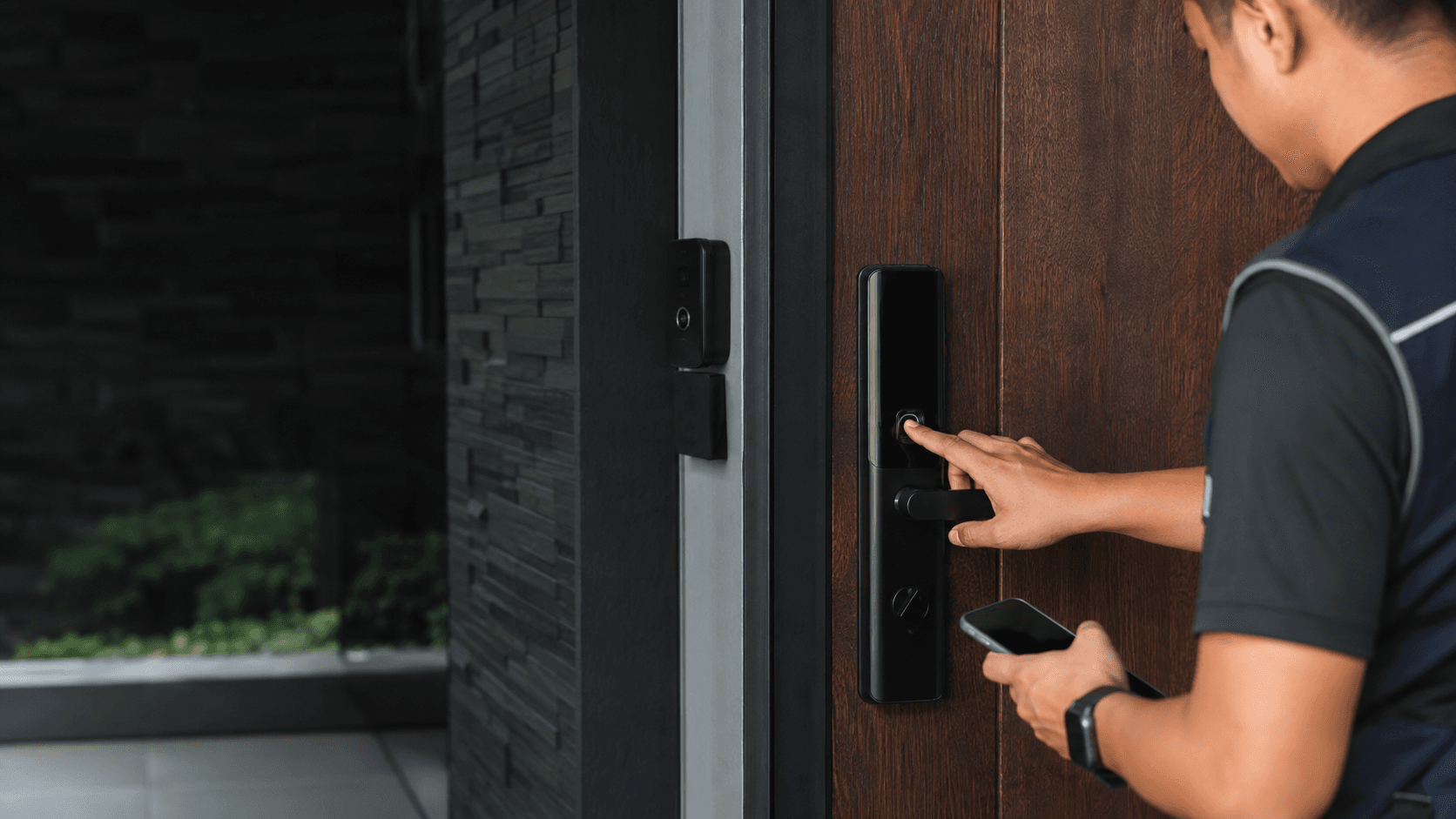
The appeal is simple. no key to carry, no code to remember, and a record of who entered. The work behind that convenience is less visible. A reader has to sit on a door that closes squarely, a lock has to fit the existing cutout or replace it, and someone has to decide what happens when a finger is wet, a battery runs down, or a staff member leaves.
Eyonic Sdn Bhd plans, supplies and installs security and extra-low-voltage systems in Sarawak, and smart lock door access is one of the categories the company reviews for controlled convenience when user permissions and backup entry are planned properly. That framing matters more than any single product name, because biometric entry is a system decision rather than a box on a shelf.
What a fingerprint front door involves at the main entrance
A fingerprint front door is the combination of three things working together: a reader that captures a finger image, a controller that decides whether that image matches a stored template, and a locking mechanism that physically releases the door. Some products bundle all three into one deadbolt or handleset. Others separate the reader from a motorised lock, which is common on heavier entrance doors.
The practical difference between those two approaches shows up in maintenance and in failure. A bundled unit is simpler to install and simpler to replace. A separated system gives more choice over the lock hardware but adds wiring, a power source and another component that can fail independently.
Biometric entry also changes how a household or business thinks about keys. Instead of cutting a new key for a new occupant, an administrator enrols a finger and removes it later. That is the real operational gain, and it is also where planning mistakes cause trouble, because a system with no clear administrator becomes a system nobody can audit.
How a fingerprint front door reads a finger and releases the door
The sequence is short. A finger touches or approaches the sensor, the sensor builds an image, the device compares that image against stored templates, and on a match it signals the lock to retract. Most readers also accept a PIN code, a card or a mechanical key as alternative credentials, and many support a mobile app for remote release or temporary codes.
Two failure modes are worth understanding before purchase. The first is a false rejection, where a legitimate finger is not recognised. The second is a false acceptance, where an unrecognised finger is treated as a match. Manufacturers publish error rates for both, but no verified figures for any specific fingerprint front door product are available here, so those numbers should be requested from the supplier in writing rather than assumed.
Environmental conditions affect reads more than marketing suggests. Wet fingers, dusty fingers, very dry skin, deep cuts and worn ridges all reduce the quality of the captured image. A covered porch or a recessed entrance helps. A reader mounted where rain drives onto it, or where direct sun hits the sensor, is working harder than one sheltered by the door reveal.
Eyonic applies the same principle to camera placement that it applies to entry hardware: actual lighting conditions at the site are checked before placement is confirmed, rather than assumed from a catalogue. The same logic applies to a reader, because a sensor that is shaded at noon may be in full glare at four in the afternoon.
Door condition, lighting and power before any fingerprint front door is confirmed
The door decides more than the reader does. A biometric lock needs a door that closes consistently, a frame that does not shift with humidity, and enough thickness and internal space for the lock body. A door that already sticks, or a frame that has moved, will cause alignment problems that no amount of reader quality can fix.
Three checks come before any product recommendation:
- Site survey of the actual door, frame, existing lock cutout, lighting and available power.
- System proposal covering the reader, the locking method, backup entry and user permissions.
- Installation, followed by handover that includes testing credentials and confirming the backup method works.
That four-stage sequence is the same one Eyonic uses for CCTV installation work, and it exists because the survey frequently changes the proposal. A door that looks suitable from a photograph may turn out to need a different lock body, additional wiring, or a separate power supply.
Power is the constraint most often underestimated. Battery-powered locks avoid wiring but introduce a maintenance schedule and a battery behaviour question that must be answered before installation. Mains-powered systems avoid battery changes but need a supply route to the door, which may mean surface trunking or concealed conduit depending on the building. No verified claim about behaviour during a power cut for any specific fingerprint front door product is available here, so the backup method should be confirmed in writing for the exact model proposed.
Fingerprint front door planning for homes, offices and shops in Sarawak
A family home and a shop entrance have different requirements even when the door looks similar. A home typically needs a small number of permanent users, a straightforward backup key, and a lock that a household member can operate without training. A shop or office needs a way to add and remove users as staff change, a record of entries, and a clear rule for who holds administrator rights.
Eyonic has completed work for the Kuching Immigration Office, focused on arrival flow, staff areas, visitor movement and dependable daily operation, and for KTA Sarawak Sdn Bhd, an engineering consultancy office in Kuching where the requirement covered staff movement, visitor handling, tidy cabling and clearer daily site control. Both projects point to the same lesson for entrance hardware: the entry point has to work on an ordinary Tuesday, not just on the day it is installed.
For business use, the choice between a standalone smart lock and a full access-control panel is a real fork in the road. A standalone lock is faster to deploy and cheaper to change later. An access-control panel supports more doors, more granular permissions and central administration, but it costs more and depends on more infrastructure. Eyonic reviews that choice per site rather than defaulting to one answer.
Property type also affects the survey. A terrace house with a covered porch presents different constraints from a shophouse with a street-facing entrance, and an industrial site with a heavy steel door presents different constraints again. The door material, the exposure to weather and the volume of daily traffic all feed into the recommendation.
Backup entry, user permissions and daily operation
Backup entry is the question that separates a workable installation from a frustrating one. Every biometric system needs at least one method that does not depend on a finger, a battery or a network. That may be a mechanical key, a PIN code, or a physical release on the inside face. The method should be tested at handover, not discovered during a failure.
User permissions need an owner. Someone has to be able to enrol a new finger, delete a departed user, and check the entry log. On a small domestic system that may be one person with an app. On a commercial system it is usually a named administrator with a documented process, because shared administrator access defeats the purpose of an audit trail.
Daily operation raises smaller questions that matter over months. How long does the door stay unlocked after a valid read? Does it relock automatically, and after how many seconds? Is there a hold-open period for deliveries? Can a one-time code be issued for a contractor? These settings are usually configurable, but they need to be decided deliberately rather than left at whatever the installer selected.
Maintenance is modest but not zero. Readers need occasional cleaning, batteries need replacing on a schedule, and firmware may need updating. A system installed without a maintenance plan tends to degrade quietly until a rejection rate becomes noticeable.
Fingerprint front door questions to settle before installation
Several questions are worth resolving in writing before any hardware is ordered, because the answers change the specification.
Does the existing door and frame accept the proposed lock, or does the door need work first? What is the backup entry method, and has it been tested? Who holds administrator rights, and how are users removed? What happens during a power interruption, and what happens when a battery reaches its low warning? How many fingers per user are enrolled, and are alternative credentials available for people whose fingerprints read poorly?
Pricing is a separate conversation. Eyonic publishes package pricing for a Hikvision CCTV package, a Hikvision alarm system and an autogate package at RM 1,599 each, but no verified pricing for a fingerprint front door or biometric lock supplied and installed by Eyonic is available here. A figure should come from a survey, because the door condition and power route drive the cost more than the reader does.
Readers researching this topic in Malaysia should also treat product listings with care. A listing describes a device. It does not describe whether that device fits a particular door, whether the backup method suits a household, or whether the administrator model suits a shop with rotating staff. Those are site questions, and they are answered by looking at the door.
Share the location, property type and required system with Eyonic on WhatsApp at +60 11-5111 7959 for the next practical step.