
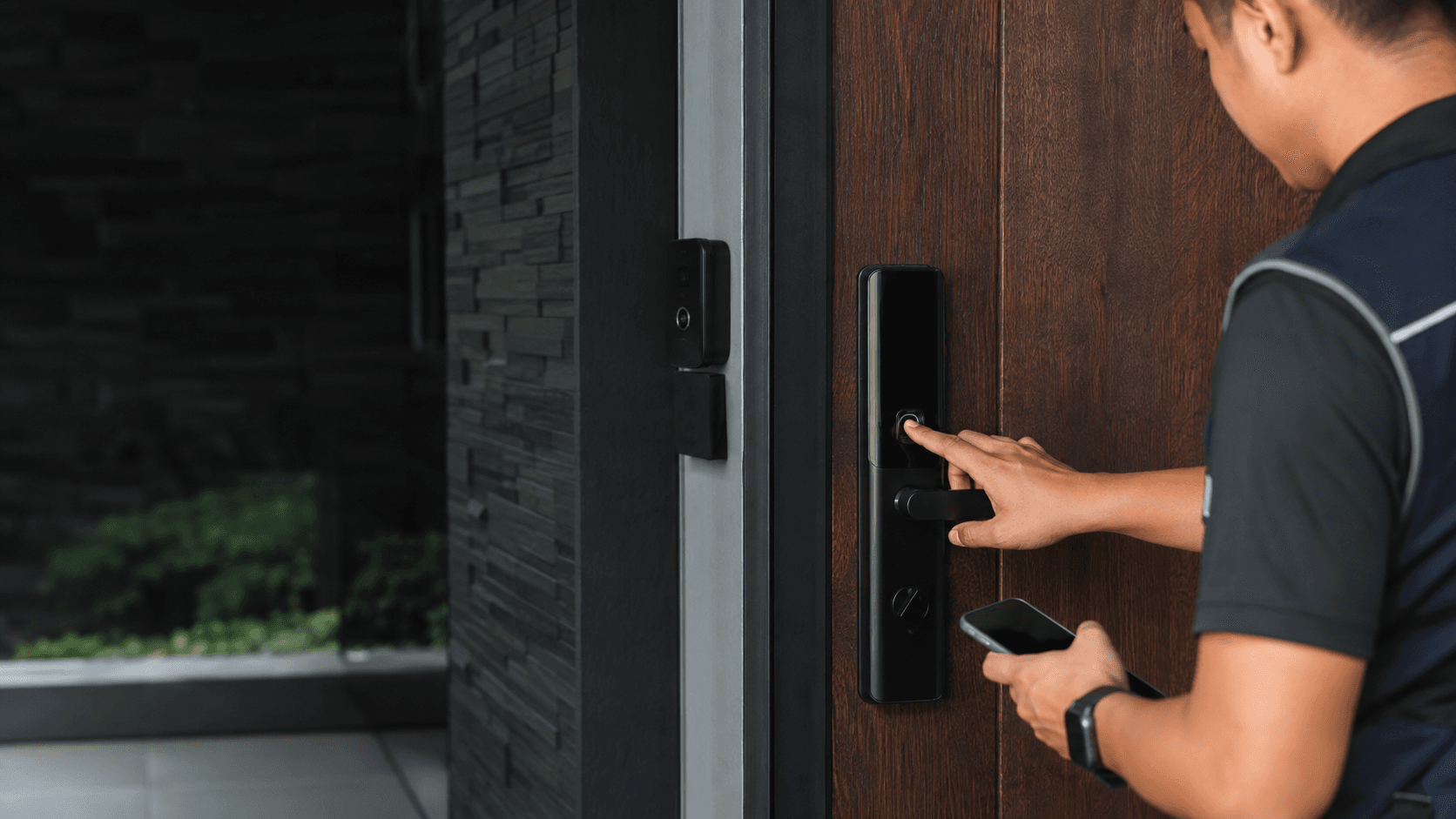
The igloohome digital lock family is usually described through the offline access technology behind it, and the practical questions that follow are about door condition, user permissions, and backup entry. Those three checks decide whether a lock suits a Malaysian home, office, or rental unit more than any single feature list does.
What an igloohome digital lock covers
The product family spans more than one type of door hardware. Published igloohome store pages group the range into door locks, gate locks, padlocks, lock boxes, and accessories, with named models such as Deadbolt Go, Mortise 2+, Padlock 2, Lockbox, Keybox 3, Bridge, Key Fob, and Keypad appearing across those catalogues.
That spread matters because the same brand name sits behind a deadbolt for a wooden door, a rim lock for a gate, and a padlock for a storage unit. A buyer comparing an igloohome digital lock against another brand is often comparing two different hardware categories without noticing it.
Accessories extend the core lock rather than replace it. A Bridge, Key Fob, or Keypad is an add-on to the lock's own credential system, so the lock still functions when the accessory is absent.
How offline access works without Wi-Fi
Offline access is the defining mechanism. The lock holds its own credential data and validates a code locally, so entry does not depend on a live internet connection at the door.
igloohome describes this through algoPIN technology, which generates PIN codes that the lock can verify without a network link. The practical result is that a guest, cleaner, or contractor can be given a working code before arriving, even at a property with no Wi-Fi and no mobile signal at the entrance.
Time-sensitive access is the second half of the mechanism. Codes can be issued as permanent, duration-based, recurring, or one-time credentials, which is what makes the system usable for short stays and scheduled visits rather than only for a household's own members.
The trade-off is that offline operation limits live remote control. A lock that validates codes locally cannot be unlocked in real time from another country unless a Bridge or similar accessory is added to bring it onto a network. Buyers who need instant remote unlocking should plan for that accessory from the start rather than assume it is included.
Where offline access fits and where it does not
Offline access suits rental units, Airbnb-style stays, storage rooms, and gates where running network cable is impractical. It fits less well where a site needs continuous audit trails pushed to a central system in real time, or where staff must be granted and revoked access within seconds across many doors.
Door types and fittings to check first
Door condition decides whether a lock can be fitted at all. Eyonic's smart lock door access review states that smart locks work best when the door condition, user roles, and backup method are reviewed before installation, and that for business use the usual question is whether a standalone smart lock or an access-control panel is more appropriate.
That review order is worth following before any purchase. The checks below are the ones that change the answer.
- Confirm the door type and existing hardware, since a deadbolt, mortise, rim lock, and glass door lock each need a different fitting.
- Check the door's physical condition, including alignment and how freely it closes, because a binding door stresses any lock mechanism.
- Decide the user roles, meaning who needs permanent access, who needs time-limited access, and who only needs a single visit.
- Choose the backup entry method, so a dead battery or a forgotten code does not leave the property inaccessible.
- Decide whether a standalone lock is enough or whether the site needs an access-control panel covering several doors.
Gate and glass door installations sit outside the standard wooden-door case and should be matched to a model built for that surface. Because published igloohome material does not supply door thickness limits or Malaysian fitting requirements, those figures should be confirmed against the specific model's documentation before ordering.
Access roles, PINs, and backup entry
User permissions are the part of the setup that most often gets under-planned. A household needs a small number of permanent codes; a rental needs codes that expire on their own; an office needs a way to remove a departed staff member's access without reissuing everyone else's.
Time-limited and one-time codes handle the rental and contractor cases well, because access ends without anyone needing to collect a key. Permanent codes suit residents and long-term staff.
Backup entry deserves the same attention as the primary method. A mechanical key, a keybox, or a second credential path keeps a property reachable when a battery runs down or a code is forgotten. Eyonic's own guidance places backup entry alongside door condition and user roles as a pre-installation decision rather than an afterthought.
For multi-door sites, the standalone-versus-panel question returns. A single lock manages its own users; several doors under one policy are usually easier to run from an access-control panel, which is the distinction Eyonic checks for business use.
Installation and support in Malaysia
Installation is where a Malaysian buyer's decision usually lands, because the lock has to fit a specific door on a specific property. Eyonic Sdn Bhd is a security system supplier in Sarawak that plans, supplies, and installs monitoring and ELV systems for homes, offices, shops, and industrial sites, and its product range includes smart locks alongside Hikvision cameras.
The company's stated process runs through site survey, system proposal, installation, and handover, which is the same sequence that applies to a door access job. A survey is what establishes door condition and fitting before any hardware is ordered.
Completed work includes the Kuching Immigration Office project, which focused on arrival flow, staff areas, visitor movement, and dependable daily operation, and the KTA Sarawak Sdn Bhd project, which covered staff movement, visitor handling, and tidy cabling for an engineering consultancy office. Both are examples of access and movement being planned around how a site is actually used.
Eric Yong, founder of Eyonic Security Systems, has worked in the industry for more than ten years and is experienced in technical installation of digital security solutions for commercial businesses in Sarawak.
Published igloohome material does not confirm Malaysian pricing, warranty terms, local stock, or a named local installer arrangement, so those details should be confirmed directly rather than assumed from a regional store page. Where a property already runs CCTV, an alarm system, or an autogate, coordinating door access with those systems is usually simpler than adding it later.
Share your location, property type and required system with Eyonic on WhatsApp at +60 11-5111 7959 for the next practical step.