
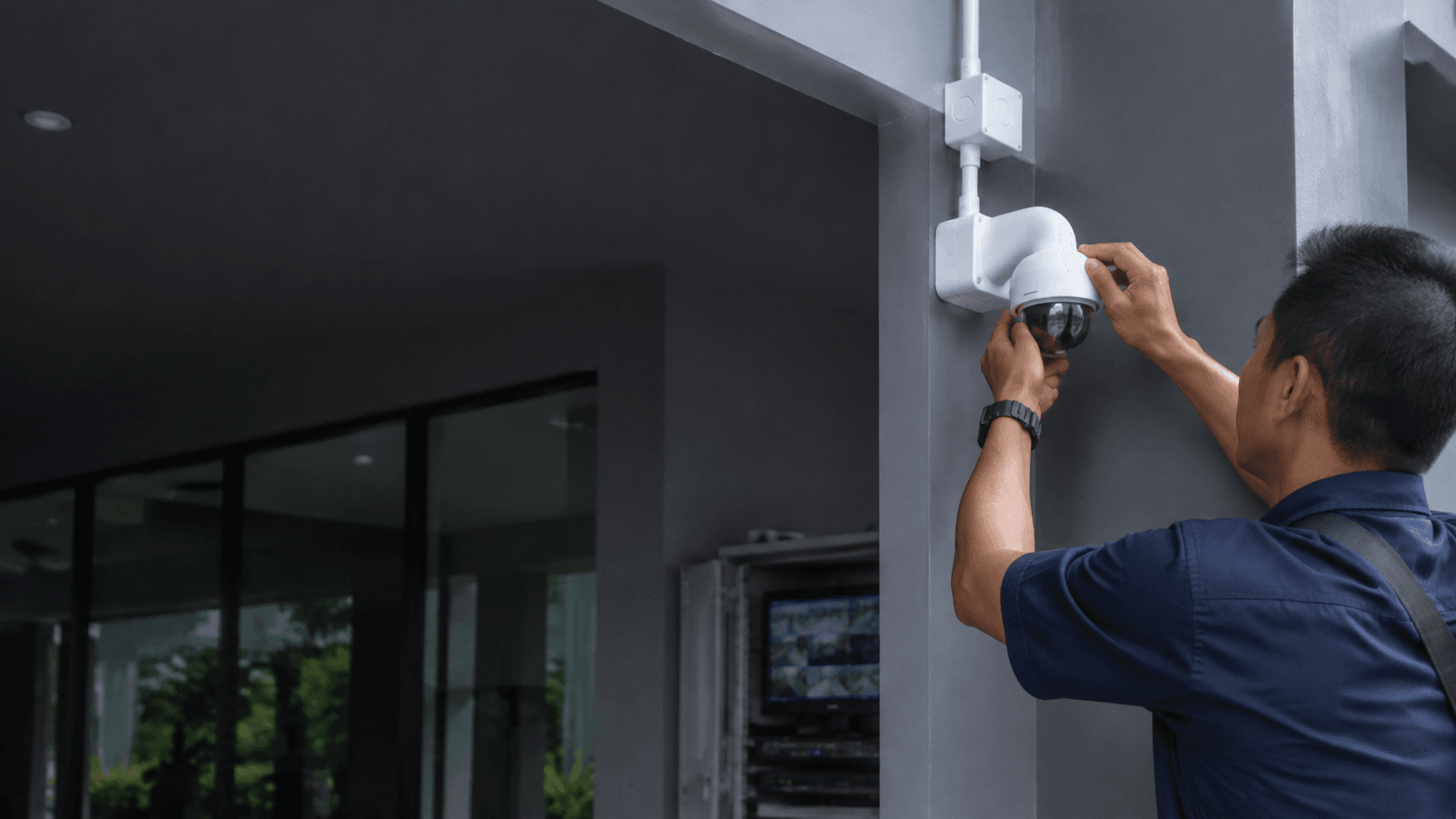
The exact-match query "d link cctv camera" is a brand-plus-category search, not a single product. D-Link publishes separate camera lines for home and business use, and the pages that rank for this query split between product catalogues, a long hands-on review, and a business surveillance landing page. That split matters because the reader arriving on this query is usually deciding between two different jobs: a self-installed Wi-Fi camera on an existing network, or a wired surveillance system with recording and remote viewing handled by an installer.
Eyonic Sdn Bhd is a security system supplier in Sarawak, Malaysia, working on CCTV and ELV systems. The company plans, supplies, and installs monitoring systems with camera placement, recording, and remote viewing for homes, offices, shops, and industrial sites. Its founder, Eric Yong, has worked in the industry for more than ten years, with a focus on technical installation of digital security solutions for commercial businesses in Sarawak.
D Link Cctv Camera. What Matters Before Choosing
Four things decide whether a D-Link camera fits a site: how the camera connects, where recordings are stored, how the footage is viewed, and who maintains the system after handover. Each of those has a different answer depending on whether the camera is bought off a shelf or specified as part of an installed system.
- Confirm the network path. Wi-Fi cameras need usable signal at the mounting point, while wired cameras need cable runs back to a recorder or switch.
- Decide where recordings live. Local storage on a memory card, a network video recorder, or a cloud subscription each change cost and retention.
- Check the mounting position against real lighting. Night performance depends on what light is actually present, not on the camera label.
- Agree who handles setup and handover. Self-install keeps cost down; an installer handles placement, recording configuration, and mobile viewing.
- Plan for maintenance. Firmware, app changes, and storage faults are the usual reasons a working camera stops being useful.
Eyonic's own installation process follows a comparable sequence: site survey, system proposal, installation, and handover. The survey stage exists because camera placement and lighting conditions are site-specific, and a proposal written before those are checked tends to be revised later.
What Is a D Link Cctv Camera?
A D-Link CCTV camera is a network camera from D-Link's surveillance range. The range covers indoor and outdoor models, pan and tilt units, and cameras with motion and sound detection, two-way audio, and night vision. D-Link also publishes business surveillance equipment, including IP cameras, network video recorders, and network infrastructure for larger sites.
Two D-Link models appear repeatedly in the pages that rank for this query. The DCS-6500LHV2 is a compact full HD pan and tilt Wi-Fi camera with 1080p resolution, 360-degree view, sound and motion detection, two-way audio, and IR night vision rated up to 5 m (16 ft). The DCS-6501LH is a 2K pan and tilt indoor Wi-Fi camera aimed at home and pet monitoring, with SD recording and an optional cloud subscription.
Those two models illustrate the split in the range. Both are Wi-Fi cameras designed to sit on an existing network and be managed through the mydlink app. Neither is a recorder-based system, and neither replaces a multi-camera installation with central storage.
Where D-Link Cameras Fit
D-Link's home range is built around the mydlink app, with smart plugs and sensors alongside cameras, and support for Google Assistant and Alexa. The business range is built around IP cameras, network video recorders, and switches, with ONVIF-compliant switches and a surveillance interface for larger deployments.
That means the same brand serves two very different buyers. A household adding one indoor camera and a business covering a shop floor or warehouse are not choosing between the same products, even though both searches land on the same brand.
Surveillance Cameras – D-Link Systems, Inc
D-Link's own surveillance pages describe a complete IP surveillance solution: cameras, network video recorders, and network infrastructure for round-the-clock monitoring, from a small shop to large industrial sites with multiple locations. The business pages also reference project surveys and network assessment before an upgrade.
That framing is useful for anyone comparing a D-Link camera against an installed system. A single Wi-Fi camera answers one question: what is happening in this one spot. A surveillance system answers a different question: what happened across this site, and can the footage be found again later.
Eyonic's project work sits in the second category. For the Kuching Immigration Office, the work focused on arrival flow, staff areas, visitor movement, and dependable daily operation. For KTA Sarawak Sdn Bhd, an engineering consultancy, the requirement was a practical office setup in Kuching supporting staff movement, visitor handling, tidy cabling, and clearer daily site control. Both are coverage-and-flow problems rather than single-camera problems.
Storage and Retention
D-Link's home cameras support local microSD recording, with cloud recording available as an optional subscription on some models. Business surveillance deployments typically use network video recorders and video storage devices instead. The practical difference is retention: a memory card holds a limited window of footage, while a recorder sized for the site holds more and survives the loss of a single camera.
Retention requirements usually come from the site, not the camera. A shop reviewing incidents weekly needs less than a site that has to reconstruct movement across a month.
Connectivity and Network Load
Wi-Fi cameras depend on signal quality at the mounting point, and outdoor mounting points are often the weakest part of a home or shop network. Wired cameras avoid that dependency but require cable runs. D-Link's business range includes switches with a surveillance interface, which exists because camera traffic and ordinary office traffic compete for the same network.
For a small site, that competition rarely matters. For a site with several cameras recording continuously, it usually does.
Practical Considerations for
Cost is the first constraint, and it splits along the same line as the products. A single Wi-Fi camera is a retail purchase. A multi-camera installation includes cameras, a recorder, cabling, mounting, configuration, and handover, which is why installed project budgets run well above the price of the cameras alone.
Eyonic's published project budgets illustrate the range. The Kuching Immigration Office project sits at an approximate RM 12,000 to RM 28,000, and the KTA Sarawak Sdn Bhd office project at approximately RM 8,000 to RM 18,000. Eyonic also lists package pricing at RM 1,599 for a Hikvision CCTV package covering camera supply and setup, basic recording configuration, and mobile viewing handover, with matching RM 1,599 packages for an alarm system and an autogate setup.
Those figures are for Eyonic's own supply and installation work, not for D-Link hardware, and they are useful mainly as a scale reference. The gap between a package price and a project budget reflects camera count, cabling, recorder capacity, and site complexity rather than brand.
Lighting and Placement
Night performance is the most common source of disappointment after installation. Eyonic's guidance on ColorVu-style cameras is to check actual lighting conditions before confirming placement, because a camera's low-light behaviour depends on the light present at that specific spot rather than on the specification alone.
The same logic applies to any camera with night vision, including D-Link models rated for a specific IR distance. A rating describes the camera under test conditions; a mounting position under an eave, facing a reflective wall, or pointed at a light source will behave differently.
App Firmware and Long Term Use
Independent reviews of D-Link home cameras describe them as affordable and easy to install, while noting app issues and confusing model naming across the range. Model naming is a real practical problem: DCS-6500LHV2 and DCS-6501LH are different products with similar names, and buying the wrong one is easy.
App quality and firmware support matter more over time than they do on day one. A camera that works well at handover but loses app support becomes a camera nobody checks.
Who Should Choose Which
A household wanting one indoor camera, pet monitoring, or a quick view of a single room is the natural fit for a D-Link Wi-Fi camera, particularly where an existing network already reaches the mounting point. A site needing several cameras, central recording, and footage that can be reviewed weeks later is a system project, and the camera brand is one decision among several.
Sites in Sarawak with commercial or public-facing requirements usually fall into the second group, because coverage, cabling, and handover all need to be planned together.
Making an Informed Choice About
The decision comes down to scope. One camera in one place is a retail purchase that can be installed and tested quickly. Coverage across a building, with recording that has to be found again later, is a planned installation with a survey, a proposal, and a handover.
For the second case, the useful starting information is the location, the property type, and the system required. Eyonic works from those three details before recommending anything, and can be reached on WhatsApp at +60 11-5111 7959 to take that next step.
For the first case, the practical checks are the ones that decide whether any Wi-Fi camera works: signal at the mounting point, light at night, and where the recording is stored.